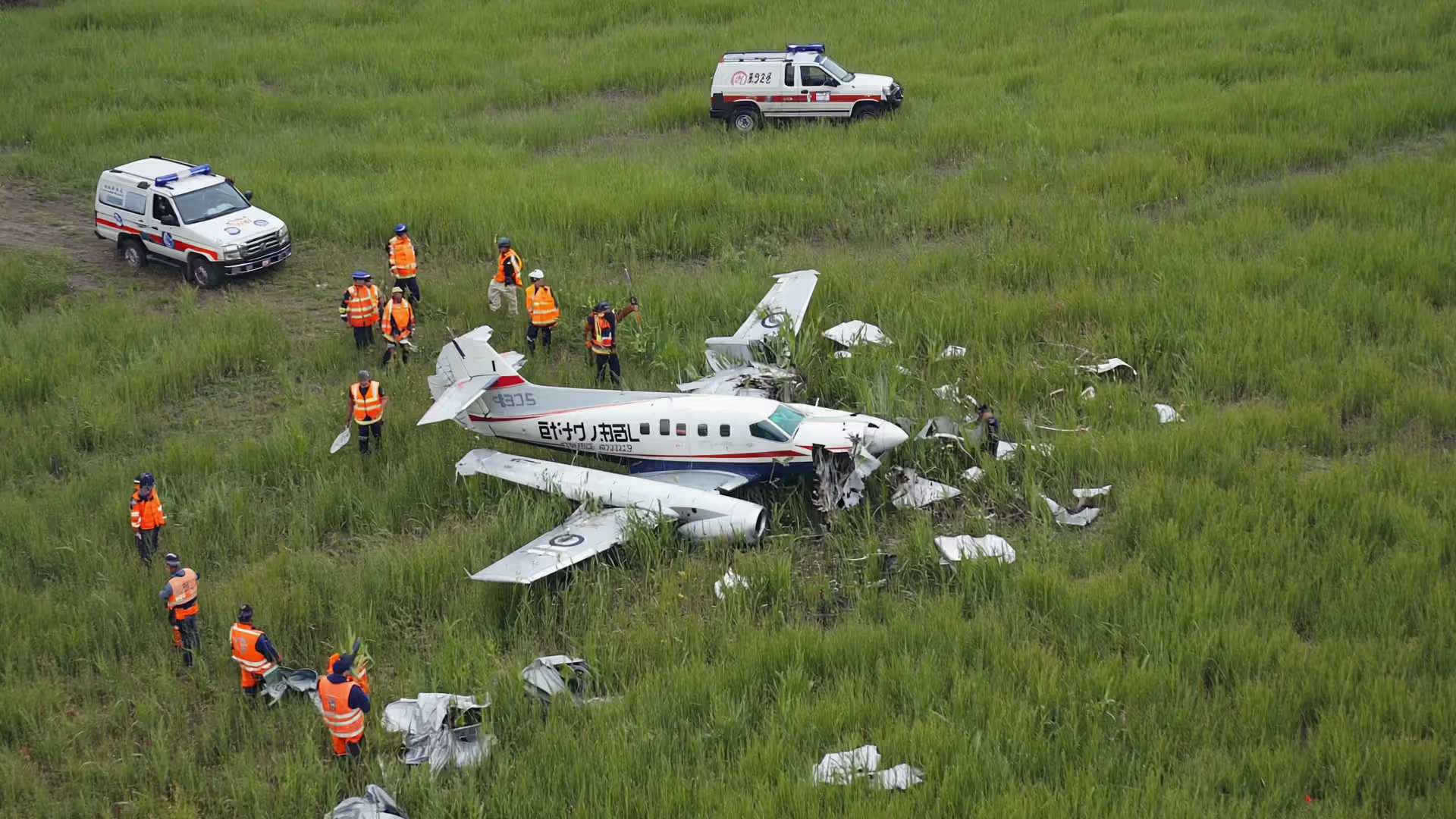
Aerial view of a small plane crash site in a green field with emergency responders and rescue vehicles
Aviation Wrongful Death Guide for Families

Content
Here's what most families don't realize: if someone's carelessness or recklessness caused that crash, you have legal options. Aviation wrongful death claims aren't like regular injury cases. They're messier, with FAA rules, international laws, multiple defendants, and investigations that can take years. But understanding what you're entitled to? That's your first step toward holding the right people accountable.
Who Can Be Held Liable When a Plane Crashes and Kills Someone?
Plane crashes rarely have one simple cause. You might think it's just the pilot's fault, but dig deeper and you'll often find a maintenance crew that cut corners, a manufacturer that knew about a defect, or an airline that pushed crews too hard. That's actually good news for your case—more liable parties usually means better compensation.
Pilot Error and Negligence
A shocking number of fatal crashes trace back to pilot mistakes. We're talking about professionals who ignored basic safety rules, flew drunk, or made terrible judgment calls that cost people their lives.
Take the pilot who decided whiskey before takeoff was fine. Or the charter pilot who flew straight into a thunderstorm because his client had an important meeting. These aren't accidents—they're negligence, plain and simple.
Sometimes it's about training nobody bothered to provide. A pilot certified only for clear-weather flying has no business navigating through clouds on instruments alone. When that pilot tries it anyway and crashes, you've got grounds for a solid case. We saw this in 2018 when a Cessna pilot with zero instrument training entered clouds over Tennessee. He became disoriented within minutes. Three passengers died because he was flying beyond his certification.
The tricky part? You're usually not suing the dead pilot personally. You're going after their employer, their insurance, or the company that trained them improperly.

Author: Daniel Whitford;
Source: mannawong.com
Aircraft Manufacturers and Maintenance Companies
Sometimes the plane itself was a death trap waiting to happen. Maybe Boeing installed faulty software. Maybe a maintenance shop used knockoff parts to save money. Maybe nobody noticed the wing was corroding until it failed at 10,000 feet.
Product liability cases don't even require proving the manufacturer acted carelessly. If the plane had a dangerous defect that caused the crash, that's enough. The Boeing 737 MAX disasters showed exactly how this works—hundreds of families filed claims based purely on the defective MCAS system, regardless of what Boeing knew or intended.
Maintenance operations face different rules. If a shop signed off saying an aircraft was airworthy when critical components were actually failing, they're liable for what happens next. I'm thinking of the Alaska Airlines flight where the jackscrew failed because the maintenance company used improper lubrication. Eighty-eight people died. The maintenance contractor paid.
Airlines and Operators
Commercial carriers can't just blame their pilots and walk away. They're responsible for everything: hiring qualified crews, providing adequate training, maintaining aircraft properly, and creating safety cultures that don't pressure pilots into dangerous decisions.
When airlines push pilots to fly despite mechanical problems or exhaustion, they're directly liable for resulting crashes. When they hire pilots with histories of violations and don't properly supervise them, same thing. When their maintenance programs fail to catch serious defects, they're on the hook.
Consider the Colgan Air crash in Buffalo in 2009. Fifty people died after the crew made serious errors. Investigation revealed the airline hired pilots with questionable training records, paid them so little they worked multiple jobs and arrived at work exhausted, and provided inadequate training for the specific situations they encountered. The airline faced massive liability.

Author: Daniel Whitford;
Source: mannawong.com
Air Traffic Control and Government Entities
Controllers guide planes through crowded airspace. When they make mistakes—clearing two planes to the same altitude, losing track of aircraft on their screens, or providing wrong information—people die.
Suing the government brings extra headaches, though. The Federal Tort Claims Act sets strict rules and shorter deadlines. You might face damage caps that don't apply to private defendants. And you'll need to prove the controller violated specific protocols, not just that they could've done better.
Still, these cases succeed. After the Überlingen mid-air collision in 2002, families pursued claims because the controller was managing too many planes alone while his supervisor slept. They won, even against government immunity arguments.
What Types of Compensation Can Families Actually Recover?
Aviation accident compensation splits into categories, and you need to understand both to know what your case is worth. Some damages are calculable with math and spreadsheets. Others depend entirely on how juries value human relationships.
| Damage Category | What This Actually Means | How Lawyers Calculate It |
| Money Your Family Lost | Everything the deceased would've earned (salary, bonuses, benefits, pension), plus medical bills before death, funeral expenses, inheritance they would've left | Economists examine pay stubs, employment contracts, career trajectory, and calculate present value over expected working years |
| Relationship Damages | The hole left in your life—no more companionship, guidance, protection, intimacy, or support from this person | No formula exists; juries decide based on relationship length, family dynamics, and specific testimony about what you lost |
| Punishment Damages | Extra money specifically to punish outrageous conduct and deter others | Only available when defendants acted with extreme recklessness or intentional disregard for safety; many states cap these amounts |
The money damages can get enormous fast. Imagine a 40-year-old orthopedic surgeon pulling in $550,000 yearly, planning to work another 25 years. That's not $550K in damages—it's over $13 million when properly calculated. Add the employer contributions to retirement plans, health insurance value, and potential partnership income, and the number climbs higher.
Relationship damages vary wildly based on circumstances. A widow who lost her husband of 35 years will typically recover more than siblings who lost a brother they saw twice a year. Children who lost their primary caregiver generally receive more than adult children whose parent was elderly. Courts consider specifics: How close were you? How involved was the deceased in daily life? What unique role did they play?
Some states cap certain damages. Texas limits wrongful death damages in specific situations. Other states restrict what you can recover from government defendants. California doesn't cap aviation death damages, but it does limit medical malpractice awards. These variations matter enormously when deciding where to file your case.
How Pilot Negligence Causes Fatal Crashes

Author: Daniel Whitford;
Source: mannawong.com
Understanding common pilot errors helps you recognize when you're looking at negligence versus an unavoidable accident. Most fatal pilot errors fall into predictable patterns.
Ignoring the checklist kills people regularly. Aviation safety depends on following detailed procedures for every flight phase. Pilots who skip fuel checks, ignore instrument readings, or rush through pre-flight inspections create deadly risks. We saw this when a charter jet tried taking off without verifying fuel quantity. The engines quit on approach. Everyone aboard died, and investigators found that simply checking the gauges would've prevented it.
Substance impairment accounts for more crashes than most people realize. Despite clear regulations prohibiting flight within eight hours of drinking or while impaired by any substance, some pilots break these rules. Post-crash toxicology sometimes reveals blood alcohol levels that would be illegal for driving, let alone flying. One 2017 crash killed four passengers after toxicology showed the pilot had cocaine and alcohol in his system.
Certification violations happen when pilots operate beyond their qualifications. Someone certified only for visual flight who attempts instrument navigation is gambling with lives. Currency requirements exist for a reason—pilots who haven't flown in months lack the sharp reflexes needed for emergencies. A Florida crash in 2020 occurred after a pilot whose instrument rating had lapsed years earlier tried navigating through clouds. Disorientation set in within minutes.
Weather-related poor judgment causes countless preventable deaths. Pilots call it "get-there-itis"—the pressure to complete flights despite deteriorating conditions. A business charter pilot flew into known icing conditions in 2016 because his passengers had an important meeting. Ice accumulated on the wings, reducing lift until the plane fell from the sky. Weather reports had clearly warned of dangerous conditions, but the pilot proceeded anyway.
In aviation, complacency is far more dangerous than any mechanical failure. The moment a pilot stops respecting the checklist, stops questioning the weather, or stops acknowledging the limits of their own certification, they transform a routine flight into a tragedy waiting to happen. Every shortcut in the cockpit is a gamble with human lives
— Captain Chesley «Sully» Sullenberger
Filing a Wrongful Death Lawsuit After Someone Dies in a Crash
Starting a plane crash lawsuit means navigating procedural requirements that can destroy your case if you mess them up. Here's what you're actually facing.
Time Limits Vary Dramatically by Jurisdiction
Most states give families two years from the death date to file wrongful death claims. But that's not universal. Some states allow three years. Others require filing within just one year. Miss your deadline by even a single day, and courts will dismiss your case regardless of how strong it was.
International flights complicate everything. The Montreal Convention controls liability for international travel, and it imposes an absolute two-year limit that overrides state law. File 731 days after the crash, and you're done—no extensions, no exceptions, no second chances.
Federal claims against the government move even faster. Depending on specific circumstances, you might need to file an administrative claim within six months. The Federal Tort Claims Act contains complex notice requirements that many families miss.
Bottom line: contact an aviation attorney immediately, not when you feel ready. Evidence disappears, witnesses forget details, and time limits don't pause for grief.
What Evidence Actually Proves Negligence
Demonstrating someone's carelessness caused the crash requires substantial technical proof. Your attorney will need:
- Black box data showing exactly what happened in the cockpit and how the aircraft systems performed
- Complete maintenance logs revealing whether proper inspections occurred
- Every document related to the pilot's training, medical certifications, and employment history
- Weather information from multiple sources at the exact time of the crash
- Recorded communications between the pilot and air traffic control
- Testimony from any survivors or ground witnesses who saw what happened
- Expert analysis from accident reconstruction specialists, aviation engineers, and safety consultants
Airlines and manufacturers don't voluntarily hand over documents proving their liability. Your attorney will need to subpoena records, depose witnesses under oath, and possibly fight in court just to access the evidence.
What the NTSB Report Means for Your Case
The National Transportation Safety Board investigates significant U.S. aviation accidents and issues detailed reports identifying probable causes and contributing factors. These reports provide valuable roadmaps for understanding what happened.
But here's the catch—courts won't allow NTSB reports as evidence during trial. Judges exclude them as inadmissible hearsay. Your attorney must develop independent proof reaching the same conclusions.
That doesn't make NTSB reports worthless. They're incredibly useful for litigation strategy. When the NTSB identifies pilot error, maintenance failures, and design defects, your attorney knows to pursue all three parties. The factual data in NTSB reports—physical measurements, recorded information, test results—can be used even though the agency's conclusions cannot.
Think of NTSB reports as detailed investigative guides that point you toward the evidence you'll actually need for court.
What Determines How Much Compensation You'll Actually Receive
Two families losing loved ones in the same crash might recover vastly different amounts. Multiple factors drive these variations.
| What Matters | Why It Affects Your Recovery | Real-World Example |
| Age of the deceased | Younger victims had more earning years remaining; middle-aged victims often had peak earnings; elderly victims may have lower wage loss but strong relationship damages | 32-year-old parent with toddlers versus 72-year-old grandparent |
| What they earned | Higher incomes create larger economic loss calculations; total compensation includes benefits and bonuses | Tech executive making $350K versus retail worker earning $35K |
| Who depended on them | More financial dependents increase economic damages; more family relationships increase non-economic damages | Sole provider for spouse and four children versus unmarried adult with no kids |
| How bad the negligence was | Egregious recklessness can trigger punitive damages; multiple defendants mean potentially more total recovery | Pilot flying drunk and ignoring all warnings versus pilot who made a reasonable but incorrect judgment call |
| Where you file the lawsuit | State laws differ dramatically on damage caps, allowable damages, and typical jury awards | Filing in California (no aviation caps) versus a state limiting non-economic damages to $250K |
Earning capacity trumps current salary. A medical resident currently making $65,000 will soon earn $450,000 as an attending physician. Damages calculations use the higher projected earnings, not what they made when they died. Expert economists project these trajectories using industry standards, the victim's education, and their career progression.
Family structure dramatically impacts non-economic awards. Juries consistently award more when young children lost a parent compared to adult children losing an elderly parent. A 30-year marriage ended by wrongful death typically generates higher companionship damages than a relationship of two years.
Comparative negligence can reduce what you recover in certain states. If your loved one knew the pilot was intoxicated but flew anyway, some jurisdictions would reduce your damages by their percentage of fault. Other states completely bar recovery if the victim bore any responsibility.
Mistakes That Cost Families Huge Money in Aviation Death Cases
Grieving families make predictable errors that slash their compensation or eliminate their claims entirely. Avoid these, and you protect what you're entitled to recover.

Author: Daniel Whitford;
Source: mannawong.com
Signing settlement papers too early is the worst mistake possible. Insurers and airlines will approach you within days offering quick cash before you understand what your case is actually worth. These initial payments typically represent maybe 10% of true value. Once you sign the release, you cannot pursue additional money even after discovering the offer was inadequate.
One family accepted $150,000 three weeks after their mother died in a charter crash. Later analysis showed proper evaluation would've supported a $2.8 million claim. The release they signed barred any further action.
Blowing filing deadlines destroys valid claims permanently. Some families assume the NTSB must finish investigating before they can file suit. Wrong. Lawsuits can proceed while investigations continue. Others simply don't realize how quickly deadlines arrive. Either way, missing the statute of limitations ends your case instantly.
Hiring the wrong lawyer happens when families choose general injury attorneys who've never handled aviation cases. Aviation wrongful death litigation requires specialized knowledge of FAA regulations, Montreal Convention provisions, aircraft operations, and NTSB procedures. Even excellent personal injury lawyers often lack this expertise.
Interview potential attorneys about their specific aviation experience. How many plane crash cases have they handled? Do they have relationships with aviation expert witnesses? Can they explain relevant FAA regulations? General wrongful death experience isn't enough.
Losing important documents weakens your case significantly. Keep everything related to the victim's employment, income, benefits, tax returns, employment agreements, and family relationships. These documents support damage calculations. Some families throw away financial records while cleaning out belongings, only to desperately need them during litigation.
Talking to insurance adjusters without legal advice backfires constantly. Adjusters ask carefully crafted questions designed to minimize what they'll pay. An innocent comment about the victim's health problems or family tensions can be twisted to argue for reduced damages. Politely refuse recorded statements until you've consulted an attorney.
Overlooking some liable parties leaves money on the table. Families often focus on the obvious defendant—the airline or pilot—while missing maintenance companies, parts manufacturers, or other contributors. Thorough investigation identifies everyone whose negligence contributed to what happened.
The greatest injustice after a preventable aviation disaster is a family that never learns the true value of their claim. Insurers count on grief, confusion, and urgency to settle cases for pennies on the dollar. Informed families who seek specialized counsel recover not just compensation — they recover accountability
— Mary Schiavo
Frequently Asked Questions About Aviation Wrongful Death Lawsuits
Facing life after someone you love dies in an aviation accident means carrying unbearable weight. Legal action won't bring them back—nothing will. But pursuing accountability through wrongful death claims serves real purposes: securing your family's financial future, forcing negligent parties to face consequences for their failures, and potentially preventing similar tragedies by exposing dangerous practices.
Aviation wrongful death cases demand specialized expertise, exhaustive investigation, and persistence through complicated litigation. Most cases take two to five years from filing through final resolution, whether by settlement or jury verdict. Throughout this period, you'll balance grief with litigation demands—producing documents, answering questions under oath, and making strategic decisions about settlement negotiations.
Selecting the right attorney makes an enormous difference in what you ultimately recover. Look for lawyers with specific, extensive aviation experience, resources to handle complex litigation against well-funded corporate defendants, and a proven track record of substantial settlements or verdicts in plane crash cases. Your attorney should explain the process in plain language, set realistic expectations without overpromising, and demonstrate understanding of both legal requirements and technical aviation issues.
Financial pressure often tempts families toward quick settlements, but patience typically yields dramatically better results. Thorough case development, complete investigation, and genuine willingness to proceed to trial position you to maximize compensation. Defendants offer substantially more when facing well-prepared opponents who can convincingly prove both negligence and damages.
Remember that wrongful death claims legally belong to the deceased person's estate and specific family members as defined by your state's law. Typically, spouses, children, or parents can file claims, though exact eligibility rules vary by jurisdiction. Your attorney will identify who has legal standing and ensure all eligible family members participate appropriately.
The compensation recovered through aviation wrongful death lawsuits addresses practical financial needs while providing some recognition of immeasurable losses. No dollar amount replaces someone you love. But holding negligent parties accountable provides a measure of justice while ensuring your family's financial stability for the future.