Dark apartment complex parking lot at night with broken security gate and dim lighting showing inadequate property security
Negligent Security Wrongful Death Claim Guide

Content
That's not an accident. That's a business decision with fatal consequences.
Right now, you're probably asking whether anyone can be held accountable. The answer depends on what the property owner knew, what they ignored, and whether you can prove that different choices would've saved your family member's life. None of this is simple, and the legal path ahead involves challenges that catch most families off guard.
What Constitutes Security Negligence in Wrongful Death Cases
Property owners owe you protection from foreseeable violence. That's the basic legal principle. But here's where it gets complicated—they only owe protection from crimes they should've seen coming.
If someone crashes through a third-floor window to commit a completely random attack with no precedent in that area, the property owner probably isn't liable. But if your apartment complex has had five armed robberies in the parking lot over eight months, and management did absolutely nothing to address it? That's a different story entirely.
The law classifies visitors into categories. You get maximum protection as a paying customer, hotel guest, or apartment tenant—the law calls you an "invitee." Friends visiting someone's home get moderate protection as "licensees." Even trespassers sometimes deserve minimal safeguards, particularly if the owner knows people regularly cut through the property.
Every case hinges on two questions: Should this property owner have anticipated this type of crime? Would reasonable security measures have actually stopped it?
Types of Properties With Heightened Security Obligations
Certain properties face intense scrutiny over their security choices.
Apartment complexes need working locks—that's baseline. But they also need lit hallways, functional gate systems, and security patrols that match neighborhood crime data. I've seen cases where tenants complained monthly about strangers sleeping in stairwells. Management did nothing. That documented trail of ignored warnings becomes powerful evidence.
Parking garages must provide adequate lighting on every level, camera coverage in high-crime spots, and potentially roving security depending on incident history. Consider this scenario: three armed robberies happen in the same structure over six months. The owner gets police reports for each one. No changes get made. When robbery number four ends in murder, claiming ignorance won't work.
Hotels and motels need secure room locks, trained front desk staff who recognize suspicious behavior, and protocols for responding to guest safety concerns. Properties known for drug activity or hourly rentals face especially tough judicial scrutiny.
Bars and nightclubs require trained security who know how to de-escalate fights, capacity limits they actually enforce, ID verification that works, and clear procedures for removing aggressive patrons before punches get thrown.
Retail stores in high-crime areas should employ visible security personnel, maintain functioning alarm systems, and control entry during vulnerable hours like late-night closing.

Author: Olivia Hartman;
Source: mannawong.com
Common Security Failures That Lead to Fatalities
Certain patterns show up repeatedly. Access gates break and never get repaired, letting anyone walk in. Stairwell lights burn out and stay dark for months, creating perfect ambush spots. Properties hire one security guard to cover five buildings simultaneously—physically impossible. Cameras stop working or turn out to be fake deterrents that criminals recognize immediately.
Sometimes the failures reflect pure calculation. A management company decides overnight security "exceeds budget limitations" despite repeated car break-ins. They deny requests for emergency alert buttons after two workplace assaults. Police recommend specific improvements after an incident—those recommendations get filed and forgotten. When these decisions get documented in emails (and discovery usually finds them), they become devastating proof of negligence.
Marcus Chen has spent eighteen years litigating premises liability and security negligence cases. He puts it this way: "Property owners usually know exactly what's wrong with their security. We find email threads during discovery where managers acknowledge crime patterns but conclude that security upgrades aren't 'financially justified.' Six months later, someone dies in circumstances those upgrades would've prevented. That internal correspondence becomes our strongest evidence—it shows they chose profit over human life."
Proving Your Negligent Security Claim After a Fatal Assault or Crime
Proving someone died on another person's property isn't enough. You've got to connect specific security failures directly to the death. That's harder than it sounds.
Four Elements Required for a Successful Case
Duty of care: You must establish the property owner owed your family member a legal obligation to provide protection. This varies significantly. A hotel charging $200 per night owes substantially more protection than a vacant lot owner owes to someone cutting through without permission.
Breach of duty: You need evidence the owner performed below the standard of care applicable to that property type in that specific location. Take a luxury apartment building in a high-crime neighborhood. No security personnel anywhere. The perimeter fence has multiple gaps. Entry gates have been jammed open for five months without repair. Those failures constitute clear breaches.
Causation: Here's where cases get difficult. You must prove the security deficiency directly enabled the fatal attack. Defense lawyers argue that determined criminals might strike anyway. But evidence showing the perpetrator specifically chose this location because of its known security weaknesses dramatically strengthens your causation argument.
Damages: You establish the death produced quantifiable losses—funeral costs, lost future earnings, lost parental guidance for children, profound emotional trauma.
Causation creates the biggest obstacles. Defense attorneys claim that criminal acts by independent third parties "break the causal chain"—that the attacker caused the death, not the property owner. You overcome this argument by establishing foreseeability: the owner either knew or should've known their security deficiencies created conditions where exactly this type of crime could occur.

Author: Olivia Hartman;
Source: mannawong.com
Evidence That Strengthens Property Crime Liability Claims
Crime statistics and incident records form your evidentiary foundation. Police reports showing comparable crimes at that property or within roughly a quarter-mile during the previous 12-24 months establish foreseeability. A murder in an apartment parking lot where six armed robberies occurred that year becomes nearly impossible to characterize as unforeseeable.
Security assessments and expert recommendations provide especially powerful proof when ignored. Police departments sometimes conduct security audits recommending particular improvements. Properties occasionally hire private security consultants who identify critical vulnerabilities. When ownership receives these professional warnings but chooses inaction, negligence becomes obvious.
Maintenance records and tenant complaints reveal what ownership knew and precisely when. Documentation showing broken locks reported five times but never fixed, lighting fixtures dark for four months, or surveillance equipment disconnected indefinitely creates an undeniable timeline.
Video footage—even from adjacent properties—might capture the attack itself, show the attacker surveilling the location beforehand, or demonstrate the complete absence of functioning security measures.
Witness testimony from other residents, employees, or property users about previous incidents, dismissed complaints, or ignored safety warnings builds the pattern showing callous indifference.
Expert witness testimony proves essential. Security professionals testify about recognized industry standards for that property classification and location, identify measures a reasonable owner would've implemented, and explain how those measures likely would've prevented the attack. Their analysis converts abstract legal concepts into concrete failures juries immediately understand.
Photographs documenting conditions right after the incident preserve evidence before repairs erase it. Property owners frequently address security problems within days of fatal incidents—not from genuine concern, but to eliminate tangible proof of their earlier negligence.
The landlord is not an insurer of the safety of his tenants, but he is bound to exercise reasonable care to protect them from foreseeable criminal acts of third persons. When prior incidents put an owner on notice and he fails to act, negligence is not merely alleged — it is demonstrated by the owner’s own inaction
— Judge Benjamin N. Cardozo
Who Can Be Held Liable When Safety Failures Result in Death
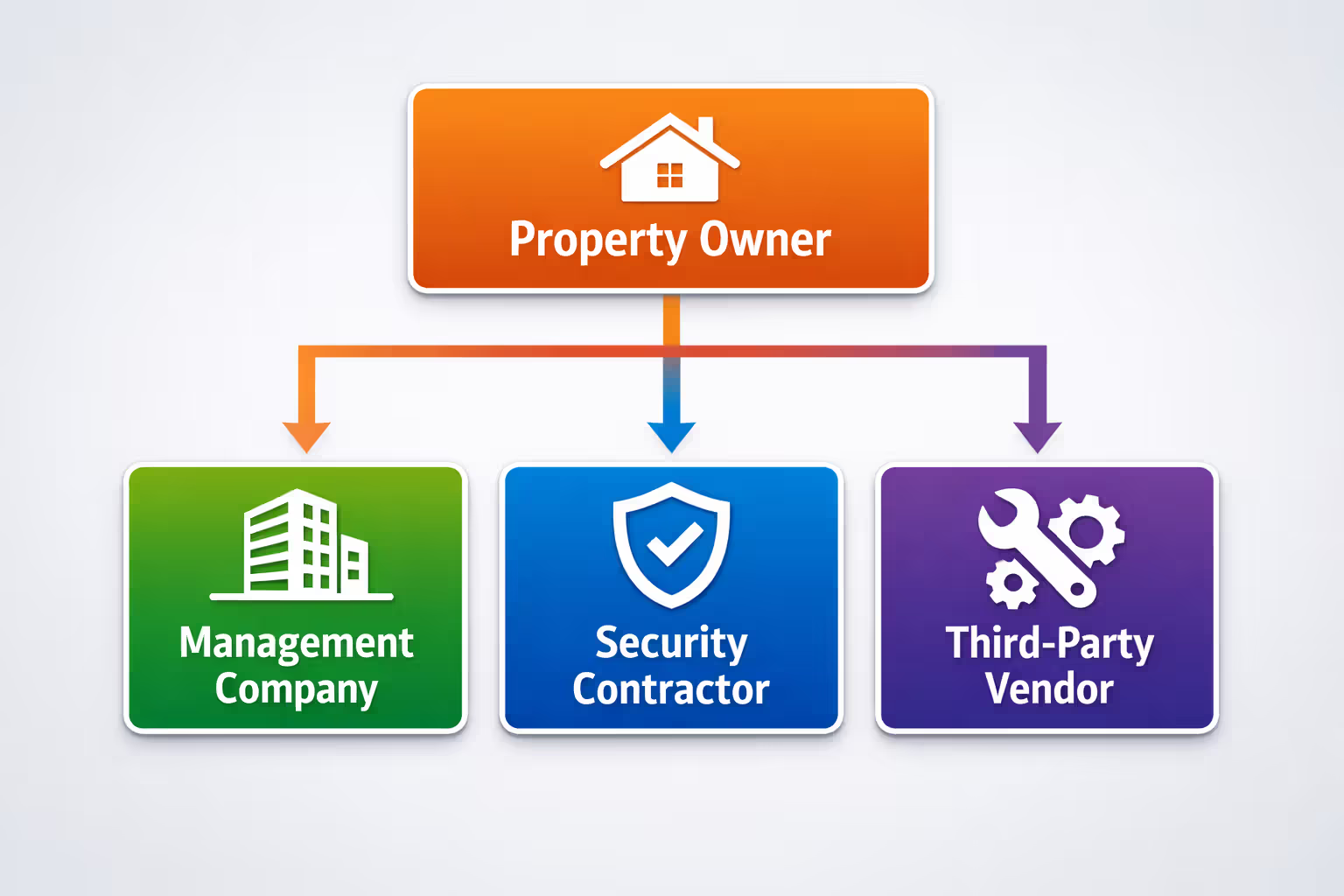
Figuring out who you can actually sue requires understanding the complex relationships governing property security decisions.
Property owners bear ultimate responsibility for security choices. Even when they delegate to management companies, owners retain liability for systemic security failures, especially when they control budgets and reject recommended security investments.
Management companies face independent liability for operational decisions they make: ignoring tenant complaints, failing to implement security protocols, or inadequately training personnel. Their contracts with owners sometimes attempt shifting liability through indemnification clauses, but courts frequently rule these unenforceable when management companies exercise daily operational control.
Security contractors providing inadequate services—guards sleeping during shifts, patrol services falsifying their rounds, alarm companies whose systems repeatedly fail—face direct liability for their negligence. Their insurance policies often carry substantially lower limits than property owners maintain, though, making them less attractive defendants from a recovery perspective.
Third-party vendors occasionally share responsibility. A locksmith installing defective locks, a lighting contractor creating dark zones through improper fixture placement, or a fencing installer whose product fails to adequately secure the perimeter might all contribute to conditions allowing the fatal attack.
The legal tension between premises liability and independent criminal conduct permeates every case. Property owners argue they can't be held responsible for unforeseeable criminal behavior by independent actors beyond their control. You counter that the crime was entirely foreseeable given the property's documented history and that the owner's negligence directly facilitated it.
State laws vary dramatically. Some jurisdictions require proof of substantially similar prior crimes at that exact property. Others accept evidence from surrounding neighborhoods. A few states hold that property owners never face liability for intentional criminal acts by third parties absent special relationships.
California, Florida, Georgia, and Texas have developed substantial case law supporting security negligence claims. New York and Illinois enforce more restrictive standards making these cases considerably harder. Some states impose statutory caps on wrongful death damages, affecting potential recovery regardless of how clear liability appears.
Author: Olivia Hartman;
Source: mannawong.com
Damages Available in Inadequate Security Wrongful Death Lawsuits
Compensation in these cases attempts addressing both financial destruction and emotional losses. Obviously, no dollar amount actually replaces a human life.
| Damage Type | What It Includes | Concrete Examples | Who Can File | Typical Recovery Range |
| Economic Losses | Calculable financial harm | Funeral and burial expenses, medical bills before death, lost wages and benefits, lost inheritance, value of household services the deceased provided | Estate, surviving spouse, financially dependent children | $200,000 to $5 million+, depending heavily on the deceased's age, income, and remaining work years |
| Non-Economic Damages | Intangible losses without precise dollar values | Lost companionship, emotional support, guidance and consortium, mental anguish, lost parental care for children | Immediate family as defined by state wrongful death laws | $500,000 to $10 million+ in cases involving young parents or particularly horrific circumstances |
| Punitive Damages | Punishment for extremely reckless behavior | Awarded when defendants showed willful indifference to safety; requires clear and convincing proof of malice or gross negligence beyond ordinary carelessness | Estate or family depending on state law; many states prohibit these entirely in wrongful death cases | Usually one to four times compensatory damages where allowed; some states enforce specific caps |
Calculating economic damages depends heavily on age and earning capacity. A 35-year-old software engineer earning $150,000 annually with 30+ working years remaining represents vastly different economic loss than a retired individual collecting Social Security. Forensic economists project lifetime earnings, adjusting for anticipated promotions, benefits, and inflation.
Non-economic damages involve greater subjectivity. Juries consider relationship quality, the deceased's role within family structure, and testimony from surviving family about their loss. A parent whose child watched them get murdered might receive substantially elevated non-economic damages given the compounded psychological trauma.
Punitive damages remain relatively rare but extraordinarily powerful. They require proving more than simple negligence—you need evidence the property owner acted with conscious disregard for safety. Remember those email threads where management discussed security vulnerabilities but chose inaction? That becomes your punitive damages foundation. Courts award these specifically to punish defendants and discourage similar conduct by other property owners.
State damage caps complicate everything. Some jurisdictions restrict non-economic damages to $250,000-$500,000 regardless of circumstances. Others cap total recovery or apply multipliers to economic damages. Multiple states prohibit punitive damages entirely in wrongful death cases.
Common Mistakes That Weaken Safety Failure Lawsuits
Families processing preventable death frequently make legal errors undermining otherwise strong claims.

Author: Olivia Hartman;
Source: mannawong.com
Missing the statute of limitations destroys valid cases permanently. Most states give you one to three years from the death date to file wrongful death claims. Some jurisdictions pause this deadline during criminal proceedings against the attacker, but others keep the clock running regardless. Waiting until criminal cases conclude might feel emotionally right, but it can extinguish civil claims legally. Set calendar reminders and consult attorneys within months, not years.
Accepting initial settlement offers rarely serves families well. Insurance adjusters contact grieving relatives within weeks, offering quick payment for releasing all claims. These early offers typically represent 10-30% of actual case value. The adjuster knows you haven't calculated lost lifetime earnings yet, haven't collected evidence about prior incidents, haven't consulted security professionals. Their pressure benefits them exclusively.
Failing to preserve evidence lets critical proof vanish. Property owners fix security problems immediately after fatal incidents—repairing broken locks, installing new lighting, hiring security guards—then claim at trial that adequate security always existed. Photograph everything within days: broken gates, poorly lit parking areas, non-working cameras, absent security personnel. Get incident reports from police and property management before they mysteriously "disappear."
Neglecting to document the decedent's life and contributions substantially weakens damages claims. Juries need to understand who died and what the family truly lost. Collect photographs, videos, school records, work evaluations, testimony from friends and colleagues. Present the deceased as a complete person with dreams and relationships, not just a name on legal documents.
Hiring general practice attorneys without premises liability expertise costs money and outcomes. These cases demand specialized knowledge: understanding security industry standards, knowing which experts to engage, recognizing evidence patterns establishing foreseeability. An attorney handling car accidents and divorces lacks the focused expertise maximizing your security negligence death case.
Social media activity about the case, the property, or your emotional state hands defense attorneys ammunition. They'll scrutinize your posts searching for statements suggesting your loved one acted recklessly, that you're coping well (undermining emotional distress claims), or that financial motivation drives you rather than justice. Privacy settings don't protect you—assume anything posted online becomes courtroom evidence.
Failing to investigate every potential defendant leaves money on the table. The property owner might be judgment-proof or carry minimal insurance, but the management company, security contractor, or parent corporation could possess substantially deeper resources. Thorough investigation identifies all potentially liable parties and their insurance coverage before filing.
Justice delayed is justice denied, but justice abandoned is a tragedy compounded. Families who lose loved ones to preventable violence must understand that the statute of limitations waits for no one’s grief — and that preserving evidence in the earliest days is the single most critical step toward holding negligent parties accountable
— Professor Laurence H. Tribe
How to Choose an Attorney for Your Security Negligence Death Case
Your attorney selection profoundly impacts both case outcomes and your experience navigating this legal ordeal.
Questions revealing competence and compatibility during initial consultations:
- How many security negligence wrongful death cases have you personally handled in the past three years, and what results did you achieve?
- What percentage of your practice focuses specifically on premises liability?
- Which security professionals do you regularly work with, and what credentials establish them as credible experts?
- How will you prove foreseeability in my specific case given the property's documented history?
- What's your actual trial experience? (Most cases settle, but attorneys prepared for trial negotiate substantially better settlements)
- How do you communicate with clients, and how often should I expect updates?
- What do you see as my case's strongest elements and most significant vulnerabilities?
Avoid attorneys guaranteeing specific outcomes or quoting settlement amounts before investigating anything. Honest lawyers acknowledge uncertainties while explaining their strategic approach transparently.
Track records with security negligence claims matter far more than general personal injury experience. Ask for case examples resembling yours—not client identities, but scenarios: "I represented a family whose mother was murdered in an apartment parking lot with documented lighting deficiencies and three prior robberies. We established foreseeability through crime data and negotiated a $3.2 million settlement."
Review attorney websites, verdict databases, and state bar association records. Look for speaking engagements on premises liability topics, published articles, or leadership roles in trial lawyer organizations. These indicators signal respected expertise.
Contingency fee arrangements make legal representation accessible without upfront payment. Most wrongful death attorneys charge 33-40% of any settlement or verdict, plus case expenses like expert fees, court costs, and investigation charges. The percentage often increases if trial becomes necessary, reflecting substantial additional work required.
Understand what "expenses" actually covers. Some firms advance all costs and deduct them from your recovery. Others require clients reimbursing expenses regardless of outcome—a risky arrangement if you lose. Get fee agreements in writing and question every provision you don't immediately understand.
Calculate net recovery under different scenarios. A 33% contingency fee sounds better than 40%, but if the first attorney settles quickly for $1 million while the second obtains a $2 million verdict at 40%, you net more with the second attorney ($1.2 million versus $670,000 after fees).
Frequently Asked Questions
Losing a family member to preventable violence on someone else's property creates trauma no legal action can fully address. But holding negligent property owners accountable serves multiple purposes: it provides financial resources helping your family move forward, it delivers consequences for dangerous cost-cutting decisions, and it potentially prevents future tragedies by forcing security improvements.
The path from grief to justice requires gathering evidence quickly, understanding complex liability rules, and partnering with experienced counsel who treats your case as more than just another file number. Property owners count on families being too overwhelmed to pursue claims or accepting inadequate early settlements. Informed families who understand their rights and the claims process achieve substantially better outcomes.
Your loved one deserved protection from foreseeable violence. When property owners failed that duty, the law provides mechanisms holding them responsible. Taking action won't bring back the person you lost, but it affirms their life held value and that those who contributed to their death must answer for that failure.