
Emergency lights reflecting on wet highway behind a large semi-truck at night
Fatal Truck Crash Claims Guide for Families Seeking Justice

Content
The phone call no family expects. A knock at the door from a state trooper. These moments shatter lives instantly when someone you love dies in a crash with an 80,000-pound commercial truck. Beyond the immediate shock and grief, families discover they're entering unfamiliar legal territory—one where federal regulations, corporate liability structures, and multi-million-dollar insurance policies create a landscape completely different from typical traffic accidents.
The death of someone in a semi collision launches you into a world of specialized laws you never wanted to learn about. But here's what matters: these laws exist specifically to protect families like yours and hold negligent companies accountable.
Who Can Be Held Liable After a Semi Truck Accident Death?
Here's something most families don't realize at first: that truck driver who caused your loved one's death? He's probably not the only one who should be paying for it. In fact, he's often just one piece of a much larger puzzle.
Truck Driver Negligence vs. Employer Responsibility
Let's say a driver fell asleep and crossed the centerline, killing your spouse. Your initial reaction points toward the driver—he's obviously at fault. But zoom out for a moment. Who gave him a route that required driving through the night? Who set delivery deadlines so tight he couldn't legally rest? Who tracked his location every minute and sent threatening messages when he fell behind schedule?
That's where respondeat superior enters the picture—a legal doctrine stating employers must answer for what their employees do on the job. The trucking company doesn't get to profit from rushed deliveries while dodging responsibility when those same time pressures cause someone's death.
What gets interesting: companies can be liable even beyond respondeat superior. Direct negligence happens when they hire drivers with terrible safety records, ignore failed drug tests, or skip required background checks. Take the case of a Midwest carrier that hired a driver whose license was suspended in three states—they're on the hook for their own reckless hiring practices, separate from whatever that driver did behind the wheel.
The trucking industry is built on tight schedules and thin margins, but no delivery deadline is worth a human life. When corporations treat safety regulations as optional suggestions rather than the life-saving mandates they are, the courtroom becomes the last line of defense for grieving families seeking accountability and justice
— Robert C. Hilliard
Some companies claim drivers are "independent contractors" to escape liability. Courts see through this regularly. If the company controls when drivers work, what routes they take, and how they do their jobs, calling them independent contractors is just paperwork gymnastics. The substance matters more than the label.
Why does this distinction change everything? That driver probably carries a personal auto policy—maybe $100,000 in coverage. The trucking company? They're required to maintain at least $750,000, often $1 million or $5 million in coverage. You're not just talking about different amounts of money; you're talking about whether your family can actually rebuild financially.
Third-Party Liability in Commercial Vehicle Accidents
The potential defendants in fatal truck cases can surprise you. Recently, a family sued not just the driver and carrier, but also:
- The leasing company that owned the truck and ignored brake problems documented in three previous inspections
- A maintenance facility that signed off on repairs they never actually completed
- A logistics broker who hired the carrier despite knowing it had been flagged for safety violations
Each contributed to the circumstances that killed a 34-year-old father of two.
Cargo loading companies enter the picture when freight shifts during transit. A load that wasn't properly secured can make a truck impossible to control. The loading company might be 500 miles away, but they share responsibility for the fatal outcome.
Parts manufacturers become defendants when equipment fails catastrophically. A tire that shreds because of manufacturing defects, brake components that crack prematurely, or steering systems with known design flaws—each creates product liability exposure. These cases follow different legal paths than negligence claims, but they can substantially increase what your family recovers.
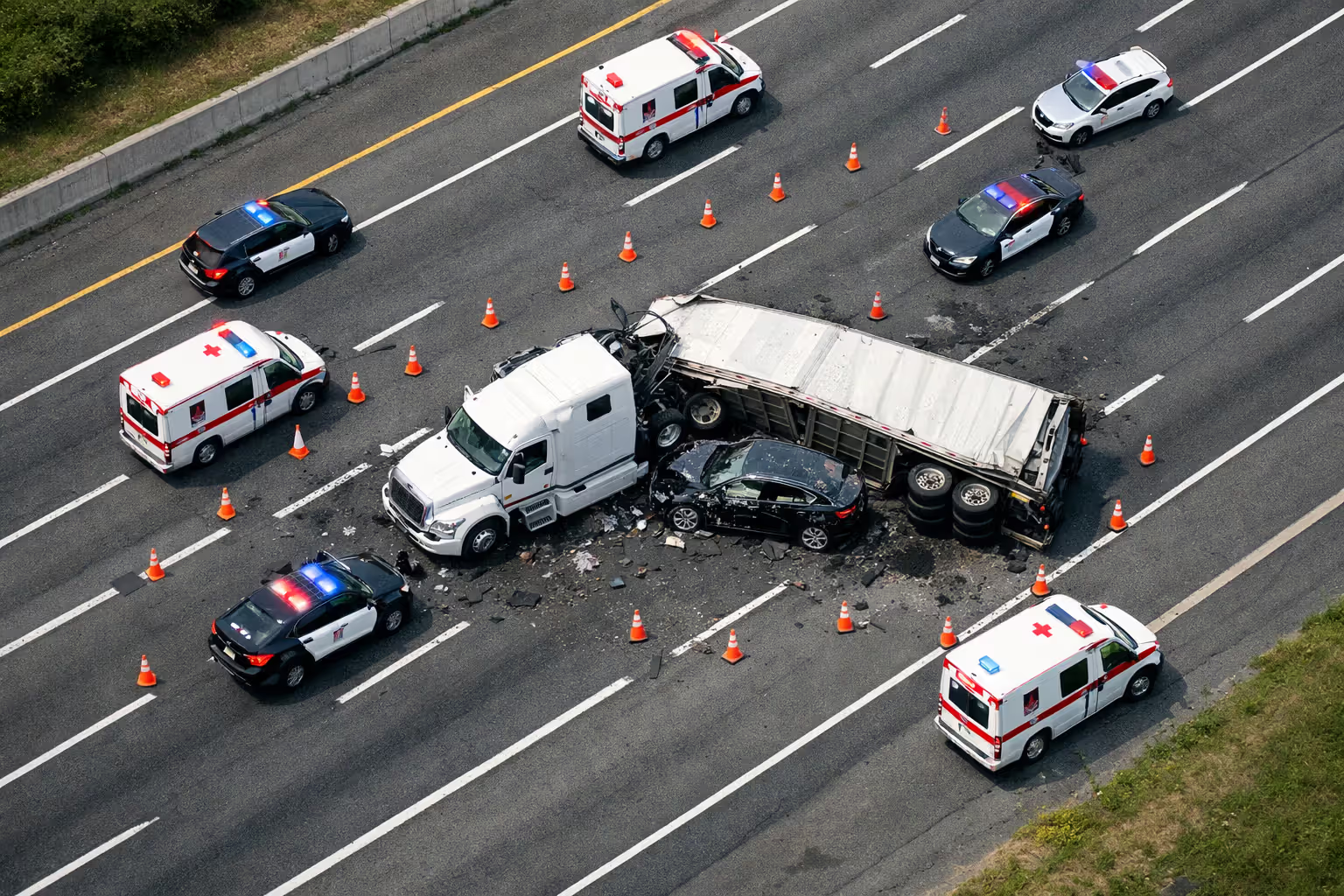
Author: Olivia Hartman;
Source: mannawong.com
How Federal Trucking Regulations Affect Fatal Crash Claims
The FMCSA didn't create its rulebook for fun. Every regulation represents crashes, injuries, and deaths that led regulators to say "never again." When companies violate these rules and someone dies as a result, they've ignored safeguards specifically designed to prevent that exact tragedy.
Current federal rules restrict drivers to 11 hours behind the wheel after coming on duty. They must rest for ten consecutive hours before driving again. Sounds simple, right? Yet drivers routinely exceed these limits under pressure from dispatchers who care more about delivery schedules than safety.
Electronic logging devices—installed in most commercial trucks since 2017—automatically record drive time. Unlike paper logbooks from years past (which drivers could falsify easily), these devices create tamper-resistant records. When investigators pull the data and find a driver operated 16 hours straight before a fatal crash, that violation doesn't just suggest negligence. In many states, it creates a legal presumption of negligence that companies must overcome. The burden shifts to them to prove the violation somehow didn't contribute to the death.
Maintenance rules under Part 396 demand systematic inspection and repair programs. Commercial trucks must undergo annual inspections by qualified mechanics, with detailed records kept for 14 months minimum. Brake systems, tires, coupling devices, steering mechanisms—each faces specific maintenance standards.
Consider what happens when investigators examine maintenance records after a fatal crash and discover the truck's brakes were noted as "grabbing" during an inspection four months earlier. The company sent it back on the road anyway. Those brakes eventually failed completely, causing a collision that killed two people. The maintenance violation isn't just evidence—it's a roadmap showing exactly how the company's disregard for safety led directly to preventable deaths.
Driver qualification files reveal whether companies followed federal standards for hiring. Medical examiners must certify that drivers don't have disqualifying conditions. Drug and alcohol testing happens at specific intervals. License verification ensures drivers hold valid commercial credentials. Criminal background checks identify dangerous patterns.
When families obtain these files through litigation, they sometimes discover companies employed drivers with:
- Diabetes that wasn't properly controlled (a disqualifying medical condition)
- Multiple DUIs that should have barred them from commercial driving
- Falsified employment histories hiding terminations for safety violations
Each of these qualification failures, when it contributes to a death, demonstrates that the crash wasn't unavoidable—it was the predictable result of cutting corners.
Pre-trip and post-trip inspection requirements create paper trails. Drivers must examine their vehicles before and after each day's work, documenting any defects. When a driver notes problems but the company sends the truck out anyway, they're making a calculated bet that nothing will go wrong. When that bet costs someone their life, the inspection records prove they knew about the danger.
Proving Negligence in Fatal Truck Crash Claims: What Evidence Matters
Your attorney's investigator will pursue specific evidence types that don't exist in regular car accident cases. Commercial trucks generate massive documentation trails—and that works in your favor.
Electronic control modules record everything happening inside the truck's systems. These "black boxes" capture second-by-second data: vehicle speed, throttle position, brake applications, cruise control status, seatbelt usage. In the 30 seconds before impact, you can see exactly what the driver did or failed to do.
One recent case showed the driver was traveling 68 mph when traffic ahead came to a complete stop. Black box data revealed he never touched the brakes—not even slightly—before slamming into stopped vehicles. That ruled out equipment failure and pointed directly to distraction or incapacitation.
Logbooks come in two forms now: electronic logs mandated by federal law, and paper logs some drivers still maintain. Discrepancies between them scream falsification. When electronic records show 14 hours of drive time but paper logs show only 9, somebody's lying. Cross-referencing logs against fuel receipts, weigh station records, and GPS data catches these fabrications.
Inspection records tell you whether the company took vehicle maintenance seriously or treated it as a checkbox exercise. But missing records matter just as much. Regulations demand documentation. When a company can't produce maintenance records for the past 14 months, you know they weren't following required procedures. That absence of records becomes evidence of systemic failure.
Toxicology testing reveals substance impairment. Commercial drivers face a 0.04% blood alcohol limit—half what regular drivers get. Any detectable amount of illegal drugs creates liability. Even prescription medications cause problems if they impair driving and the driver operated contrary to warnings. A driver taking sleep aids shouldn't be behind the wheel at 3 AM, period.

Author: Olivia Hartman;
Source: mannawong.com
Reconstruction specialists take physical evidence and work backward to understand crash dynamics. They examine crush damage patterns, analyze tire marks, calculate impact forces, and determine pre-crash speeds. Their conclusions often contradict what drivers claim happened. "I never saw them" doesn't hold up when reconstruction shows the other vehicle was visible for 400 feet and the truck had clear stopping distance.
Witness accounts from other motorists prove invaluable. Truck crashes often happen in traffic where multiple people observe the driver's behavior in the moments before impact. Witnesses report seeing drivers:
- Holding phones at eye level
- Eating with both hands off the wheel
- Reading paperwork propped on the steering wheel
- Drifting across lane markers repeatedly
- Traveling 20+ mph faster than surrounding traffic
These observations transform abstract negligence concepts into concrete proof of carelessness.
Damages Available in Trucking Liability Law Cases
Courts recognize several categories of harm when someone dies because of truck driver negligence. Understanding what you can claim helps ensure you don't settle for less than your family deserves.
Economic losses have price tags attached. Funeral and burial costs typically run $8,000 to $20,000 depending on location and choices made. Medical expenses before death can reach six figures—emergency transport, trauma surgery, intensive care, medications. These bills arrive exactly when families are least able to pay them.
Lost earnings represent the financial support your loved one would have provided. Economists calculate this by examining age, occupation, education, health, and work-life expectancy. A 38-year-old electrician earning $68,000 annually with 27 years until retirement represents roughly $1.8 million in lost income. Benefits like health insurance, retirement contributions, and pension accruals add substantially to this figure.
Lost household services often get overlooked. The deceased contributed to family life through childcare, home maintenance, financial management, yard work, vehicle upkeep, and countless other tasks. These services carry economic value. Replacing them costs money—whether by hiring help or family members sacrificing their own earning time to fill the gap.
Non-economic losses resist dollar quantification but deserve compensation nonetheless. How do you value 40 years of marriage that ended abruptly? What's the worth of a father's guidance through a child's entire upbringing? Courts instruct juries to award amounts that fairly acknowledge these irreplaceable losses.
Loss of companionship compensates spouses for the partnership they lost. Loss of parental guidance compensates children for the mentoring, support, and love they'll never receive. These aren't abstract concepts—they're daily realities that hit families during birthdays, holidays, graduations, and ordinary evenings when the person should be there but isn't.
Punitive damages become available in egregious cases. When companies knowingly violate safety regulations, falsify records, or ignore repeated warnings about dangerous conditions, courts allow juries to award extra damages designed purely to punish and deter. These awards often reach two to ten times compensatory damages.
A Southeastern trucking company recently faced $15 million in punitive damages after evidence showed executives knew a driver had falsified his medical certification but kept him driving anyway. Internal emails revealed they discussed the risk but decided potential fines cost less than hiring a replacement driver. When that driver's uncontrolled diabetes caused him to lose consciousness and kill someone, the jury made sure the company's cost-benefit calculation turned out very wrong.
Different Claim Types: What You Can Pursue
| Type of Claim | Who Files It | What It Compensates | The Point |
| Wrongful Death | Spouse, kids, parents, or whoever state law designates | Lost financial support, companionship, funeral bills, inheritance your family lost | Pays survivors for their losses from the death |
| Survival Claim | Estate representative, filing for the deceased person's estate | Medical treatment before death, the pain and suffering your loved one endured, wages lost between injury and death | Compensates what the victim personally went through |
Some states let you pursue both simultaneously. Others merge survival damages into the wrongful death case. The distinction affects who receives money and what losses get considered. Survival claims compensate the estate for what your loved one suffered. Wrongful death claims compensate you and other survivors for your own losses.
The Claims Process: Timeline and Key Steps After a Commercial Vehicle Accident Death
Pursuing compensation after a fatal truck crash follows a specific path with critical deadlines you cannot miss. Here's how it typically unfolds.
Every state imposes time limits for filing wrongful death lawsuits—statutes of limitations that create absolute deadlines. Miss them by even a single day and courts dismiss your case regardless of its merits. These limits typically range from one to three years, calculated from either the crash date or death date depending on your state.
California gives you two years. So does Texas. Florida allows two years. New York provides two years from death, or three from the accident if death occurred later. Georgia's limit sits at two years as well. These aren't suggestions or guidelines—they're hard cutoffs.
Why this matters: families often wait months before consulting attorneys, thinking they have "plenty of time." Then they discover the limitation period is already half gone. Investigation, expert retention, and case preparation take time. Attorneys need months, not weeks, to properly build your case.
Investigation begins the moment you hire counsel. Your attorney immediately sends preservation letters to the trucking company—formal demands that they preserve all evidence. Without these letters, companies routinely "lose" damaging documents, vehicles get sold or destroyed, and electronic data gets overwritten. These preservation demands have legal teeth; destroying evidence after receiving them creates serious consequences for companies.
Investigators photograph the crash scene before weather and traffic erase physical evidence. They identify and interview witnesses while memories remain fresh. They retain accident reconstruction experts who examine vehicles before they're repaired or scrapped. This phase happens fast—within days or weeks—because evidence doesn't wait.
Evidence in a fatal truck crash has a very short shelf life. Electronic data can be overwritten in days, physical evidence disappears from the scene within hours, and witnesses’ memories begin to fade almost immediately. The families who protect their rights most effectively are those who secure experienced legal counsel before that critical evidence is lost forever
— Lisa F. Tatum
Discovery lasts six months to a year in most wrongful death cases. Your attorney demands massive amounts of documents: the driver's complete qualification file, vehicle maintenance records going back years, company safety policies, internal communications about the crash, training records, and more. Companies resist producing damaging evidence, leading to court disputes over what must be disclosed.
Depositions follow document production. Your attorney questions the driver, dispatchers, safety directors, maintenance supervisors, and corporate executives under oath. These sessions, recorded by court reporters, lock witnesses into their stories. Contradictions between deposition testimony and trial testimony destroy credibility. Depositions often reveal what companies knew, when they knew it, and how they responded.
Settlement negotiations happen throughout this process, intensifying after discovery reveals case strength. Trucking insurers understand their exposure. They know which violations occurred, what evidence exists, and how juries in your jurisdiction typically respond. These factors inform settlement offers.
But here's the catch: initial offers almost always lowball claim value. Insurers count on families' financial desperation and lack of legal knowledge. They offer $150,000 when the case could be worth $3 million. They present these offers sympathetically, suggesting they're doing you a favor by avoiding litigation stress. Don't believe it. These offers serve the insurance company's interests, not yours.
Trials become necessary when settlement negotiations stall or offers remain inadequate. Wrongful death trials in trucking cases typically last one to three weeks. Juries hear from accident reconstruction experts, economic experts who calculate future losses, medical experts who explain injuries, and family members who describe their loss. These trials require substantial emotional strength—but they sometimes produce awards far exceeding settlement offers.
Many cases settle during trial. As evidence gets presented and juries see the defendant's conduct, insurance companies reassess their exposure. A case they wouldn't settle for $2 million before trial suddenly settles for $4.5 million on day three of testimony.
Common Mistakes Families Make When Filing Fatal Truck Accident Claims
Grief, shock, and financial pressure create vulnerability to errors that damage claims or eliminate them entirely. Knowing these pitfalls helps you avoid them.
Taking quick settlement money ranks as the costliest error families make. Insurers contact you within days—sometimes before you've even held the funeral. They express sympathy while offering immediate payment. Maybe $75,000. Perhaps $150,000. These amounts sound significant when you're overwhelmed and facing funeral bills.
But that same claim, properly developed with experienced counsel, might be worth $2 million. Or $5 million. The adjuster knows this. You don't—yet. Their offer includes releases barring all future claims. Sign that paperwork and you're done, even when you later discover the offer represented 5% of what you deserved.

Author: Olivia Hartman;
Source: mannawong.com
Real example: A family accepted $100,000 three weeks after their son died in a truck crash. Later, through friends, they learned similar cases in their state routinely settled for $1.5 to $3 million. The insurance adjuster had seemed so kind, so concerned. He neglected to mention his company was getting away with paying pennies on the dollar.
Missing deadlines destroys valid claims permanently. Families who delay hiring attorneys, thinking they have abundant time, sometimes discover the statute of limitations is approaching rapidly. An attorney hired eight months before the deadline can properly develop your case. One hired four weeks before the deadline faces impossible time constraints and may have to decline representation because they can't meet their ethical obligations with so little time.
Failing to preserve evidence lets crucial proof vanish. Photographs of vehicle damage, witness names and contact information, police reports—these need collection immediately. Families understandably focus on grief and funeral arrangements. Meanwhile, trucks get repaired, electronic data gets overwritten (typically after 30-60 days), and witnesses move or forget details.
Talking with insurance adjusters without counsel present creates problems you won't recognize until later. That adjuster seems sympathetic and helpful. They're actually building defenses against your claim. They ask whether your loved one had been stressed lately. Whether they'd been sleeping well. Whether they'd been distracted by work or personal issues. Your innocent answers become admissions that defense attorneys use to argue comparative fault.
"Well, he had been working long hours that week" becomes evidence that the victim was fatigued and contributed to the crash. "She mentioned feeling stressed about finances" becomes an argument that financial distress caused distraction. These adjusters record conversations. They take detailed notes. Everything you say can and will be used to minimize what the company pays your family.
Hiring general practice attorneys instead of trucking specialists leaves you underrepresented. That attorney who handled your real estate closing or your sister's divorce? They're unequipped for complex commercial vehicle litigation. These cases require knowledge of federal motor carrier safety regulations, familiarity with trucking industry practices, relationships with specialized experts, and experience fighting well-funded corporate defense teams.
Trucking companies don't hire general practitioners to defend them. They retain lawyers who handle nothing but trucking defense. Your attorney should have equivalent specialization and experience on the plaintiff's side.
Social media posts damage claims in ways families don't anticipate. You post vacation photos six months after the death because you took your kids somewhere to help them cope with grief. Defense attorneys present those photos to argue you're not experiencing the emotional suffering you claim. They screenshot Facebook posts showing you at a birthday party, suggesting you've "moved on" and don't deserve substantial non-economic damages.
Privacy settings don't protect you. Discovery demands can require production of all social media content. The safest approach: stop posting entirely until your case resolves. Tell extended family members not to tag you in photos or posts.
FAQ: Truck Accident Wrongful Death Claims
Nobody chooses this path. You're here because someone you loved died in a crash that probably didn't have to happen. That reality creates anger, grief, and a desperate need to understand how this could have occurred.
Pursuing accountability through wrongful death claims serves multiple purposes. Yes, financial compensation matters—you face immediate expenses and long-term loss of support that creates genuine hardship. But money represents only part of what these cases achieve.
Holding negligent companies responsible creates systemic change. A trucking company that faces an $8 million judgment for ignoring maintenance requirements suddenly finds religion about vehicle inspections. They implement better policies. They train dispatchers not to pressure drivers. They fire executives who prioritized delivery schedules over safety. Your case prevents future deaths by forcing companies to take safety seriously.
The legal process itself provides purpose during an otherwise helpless time. Many families report that pursuing their claim helped them feel they honored their loved one by ensuring their death meant something. It wasn't just an "unfortunate accident" dismissed and forgotten. It led to accountability, answers, and changes that protect other families.
Financial recovery provides stability when you need it most. Funeral expenses, medical bills, and sudden loss of income create crisis conditions. Compensation addresses practical realities—maintaining your home, funding kids' education, and achieving some measure of security moving forward.
Choosing the right attorney makes an enormous difference. You need someone who knows federal motor carrier safety regulations inside and out, has relationships with trucking experts and specialized investigators, understands commercial vehicle black box data, and has actually tried these cases to juries. General practitioners lack this specialized knowledge. The trucking company will hire defense firms that do nothing but trucking litigation—you need equal firepower on your side.
Time works against you despite your grief and shock. Evidence disappears. Witnesses forget details. Deadlines approach whether you feel ready or not. Reaching out to qualified counsel within days or weeks protects your rights while letting the attorney handle investigation and procedures during your most difficult period.
Your family's path forward involves both healing and pursuing justice. These aren't conflicting goals. Many families find that seeking accountability through the legal system supports emotional recovery by providing answers, ensuring their loved one's death receives proper recognition, and creating something positive from tragedy.
You didn't ask for this knowledge. You'd give anything to not need it. But since you're here, you deserve to understand your rights, the process ahead, and what your family can do to achieve both justice and financial security. That knowledge won't bring your loved one back, but it empowers you to move forward in the strongest possible position.