
Yellow hard hat lying on the ground near caution tape at a construction site
Workplace Accident Death Guide for Families

Content
No family expects to receive the call that a loved one has died at work. Yet in 2022, more than 5,400 workers lost their lives on the job in the United States—a figure that represents parents, spouses, children, and breadwinners whose sudden absence leaves families grappling with grief and financial uncertainty. When a workplace accident death occurs, surviving family members face an overwhelming maze of legal decisions, claim deadlines, and questions about their rights while simultaneously mourning their loss.
Understanding your options after a fatal workplace injury matters because the choices you make in the first weeks can determine whether your family receives adequate compensation or falls through gaps in the system. Workers' compensation provides baseline death benefits, but these payments rarely reflect the true economic and emotional impact of losing a wage earner. In cases where employer negligence or third-party actions contributed to the death, families may have additional legal remedies that significantly increase potential recovery.
This guide explains the compensation pathways available to families, identifies when employer negligence creates liability beyond standard workers' comp, and outlines the immediate steps that protect your claim while preserving your right to pursue maximum benefits.
Common Causes of Fatal Injuries on the Job
Fatal workplace accidents follow predictable patterns across industries. Recognizing these common scenarios helps families understand whether negligence played a role and which parties might bear responsibility.
Construction and Industrial Site Hazards
Construction sites account for roughly one in five workplace deaths annually. The "Fatal Four" hazards identified by OSHA—falls, struck-by incidents, caught-in/between accidents, and electrocutions—cause more than half of construction fatalities. A worker falls from scaffolding that lacks proper guardrails. A crane operator strikes a ground worker who entered an unmarked swing radius. An excavation trench collapses on workers because the contractor skipped shoring requirements to save time.
Industrial facilities present their own deadly risks: workers fall into unguarded machinery, become trapped in confined spaces without proper atmospheric testing, or suffer crushing injuries when equipment activates during maintenance. Many industrial accident death cases involve violations of lockout/tagout procedures that should prevent machines from starting while workers service them.
Equipment-Related Deaths

Author: Samantha Caldwell;
Source: mannawong.com
Forklifts, conveyor systems, agricultural machinery, and manufacturing equipment cause hundreds of deaths each year. A warehouse worker gets pinned between a reversing forklift and a loading dock because the vehicle lacks a functioning backup alarm. A maintenance technician loses his life when a hydraulic press activates without warning due to a bypassed safety interlock.
Vehicle accidents represent another major category, particularly for truck drivers, delivery workers, and those who operate heavy equipment. Rollovers, collisions, and workers struck by vehicles in yards or on roadsides create job site fatal injury scenarios that often involve multiple liable parties beyond the employer.
Exposure to Toxic Substances
Chemical exposure, asphyxiation, and toxic atmospheres kill workers in refineries, manufacturing plants, agricultural operations, and confined spaces. Unlike traumatic injuries, these deaths sometimes occur hours or days after exposure, complicating the investigation. A tank cleaner enters a vessel without air monitoring and collapses from hydrogen sulfide gas. A painter dies from acute solvent poisoning in an unventilated space.
Long-term exposures to asbestos, silica, and other carcinogens can also prove fatal years after employment ends, though these cases follow different legal frameworks than acute workplace accident death claims.
Safety is not an intellectual exercise to keep us in work. It is a matter of life and death. It is the sum of our contributions to safety management that determines whether the people we work with live or die
— Sir Brian Appleton
How Employer Negligence Contributes to Fatal Workplace Accidents
Most workplace deaths are preventable. OSHA investigations consistently find that employer negligence death cases share common features: known hazards left unaddressed, required safety equipment not provided, workers inadequately trained for dangerous tasks, and maintenance deferred until equipment becomes lethal.
"The vast majority of workplace fatalities are not accidents—they are preventable incidents that result from identifiable hazards and management failures to implement feasible controls." — Dr. David Michaels, former Assistant Secretary of Labor for OSHA
Negligence in workplace safety means an employer failed to exercise reasonable care to protect workers from foreseeable harm. This standard goes beyond simple mistakes. Examples include:
OSHA violations: When inspectors find serious or willful violations of safety regulations at a death scene, those citations provide direct evidence of negligence. An employer who receives citations for fall protection violations but fails to correct them before a worker falls demonstrates a disregard for safety that rises beyond ordinary negligence.
Inadequate training: Assigning workers to operate dangerous equipment or perform high-risk tasks without proper instruction creates foreseeable risk. A new employee killed while operating a power press he received no training on represents a failure in the employer's duty to prepare workers for job hazards.
Lack of required safety equipment: Federal and state regulations mandate specific protective equipment for particular tasks—harnesses for elevated work, respirators for toxic atmospheres, machine guards on rotating equipment. When employers skip this equipment to save money or time, they create the conditions for preventable deaths.
Failure to maintain equipment: Hydraulic systems that burst, electrical panels that arc, and structural components that collapse often do so after prolonged neglect. Maintenance records (or their absence) frequently become central evidence in unsafe workplace lawsuit cases.
Ignoring reported hazards: Workers or supervisors who report dangerous conditions create a paper trail. When employers dismiss these warnings and someone dies from the reported hazard, the negligence becomes harder to dispute.

Author: Samantha Caldwell;
Source: mannawong.com
The workers' compensation system typically shields employers from lawsuits even when negligence causes death, but exceptions exist. Understanding when employer conduct crosses the line from ordinary negligence into territory that permits a lawsuit requires examining the specific circumstances and your state's laws.
Author: Samantha Caldwell;
Source: mannawong.com
Workers' Compensation Death Benefits: Who Qualifies and What's Covered
Every state operates a workers' compensation system that provides benefits to families of workers killed on the job, regardless of fault. These benefits serve as a safety net but come with significant limitations.
Eligible Dependents and Beneficiaries
Workers compensation death benefits typically flow to dependents in a priority order established by state law. Surviving spouses usually receive benefits first, with children receiving concurrent or subsequent payments. The definition of "dependent" matters enormously—someone who relied on the deceased worker for financial support has a stronger claim than a family member who lived independently.
Most states recognize these categories:
Total dependents: A spouse who didn't work outside the home or children under 18 (sometimes extended to 23 if enrolled in college) typically qualify as wholly dependent. These beneficiaries receive the maximum benefit amounts.
Partial dependents: An elderly parent who received regular financial assistance from the deceased worker, or an adult child with disabilities, might qualify as partially dependent and receive proportional benefits.
No dependents: When a worker dies without qualifying dependents, some states provide limited benefits to cover funeral expenses and possibly a small payment to the estate or next of kin.
Unmarried domestic partners face significant hurdles in many states. Without marriage or a formal dependency relationship recognized by state law, a long-term partner may receive nothing even if they shared finances and a household with the deceased.
Calculating Benefit Amounts by State
Death benefit calculations vary dramatically by jurisdiction, but most states use a formula based on the deceased worker's average weekly wage before death. A common structure provides two-thirds of the worker's average weekly wage, subject to state maximum and minimum limits.
For example, if a worker earned $1,200 weekly, the death benefit might be $800 per week (two-thirds of earnings). However, if the state caps weekly benefits at $600, that becomes the actual payment regardless of earnings. These caps mean that families of higher-wage workers receive proportionally less replacement of lost income.
Payment duration also varies. Some states provide benefits until a surviving spouse remarries or dies, and until children reach adulthood. Others cap total benefits at a maximum dollar amount—say, $400,000—regardless of how long dependents need support. A surviving spouse who is 30 years old faces vastly different financial security under an unlimited-duration system versus a capped-total-benefit state.
Many states reduce or terminate spousal benefits upon remarriage, though some provide a final lump-sum payment when this occurs. Child benefits typically continue regardless of a parent's remarriage.
Funeral and Burial Expense Coverage
Workers' compensation includes a separate allowance for funeral and burial costs, though these amounts rarely cover modern funeral expenses. State allowances range from $5,000 to $15,000, while typical funeral costs often exceed $10,000 before considering cemetery plots, markers, and related expenses.
These funeral benefits are usually paid directly to the family or funeral home and don't reduce the ongoing death benefits paid to dependents. Families should submit itemized funeral bills promptly to the workers' comp carrier to secure reimbursement.
The workers’ compensation system was designed as a grand bargain — workers gave up the right to sue in exchange for guaranteed benefits. But when those benefits fall far short of a family’s actual losses, the bargain feels anything but grand
— Thomas A. Robinson
When You Can File an Unsafe Workplace Lawsuit Beyond Workers' Comp
The workers' compensation system provides benefits without requiring proof of fault, but it also generally prevents families from suing the employer for additional damages. This "exclusive remedy" rule has significant exceptions that allow families to pursue an unsafe workplace lawsuit when circumstances warrant.
Third-party liability: When someone other than the employer caused or contributed to the death, families can file a wrongful death lawsuit against that party while still collecting workers' comp benefits. Common third-party defendants include:
- Equipment manufacturers whose defective products caused the fatality
- Property owners (when the death occurred at a site the employer didn't own)
- Subcontractors or other companies working at the same location whose negligence created the hazard
- Drivers of vehicles not employed by the deceased worker's company
A construction worker killed by a defective aerial lift can trigger both workers' comp death benefits from his employer and a product liability lawsuit against the lift manufacturer. These claims proceed independently, though workers' comp carriers typically assert liens to recover their payments from third-party settlements.
Intentional conduct exceptions: Most states allow lawsuits when an employer's conduct was intentional or so reckless that it substantially exceeded ordinary negligence. The threshold is high—mere knowledge of a hazard usually isn't enough. But when an employer deliberately removes safety equipment, threatens to fire workers who refuse ultra-hazardous tasks, or continues operations after being warned of imminent danger, courts may find the conduct intentional.
For example, an employer who orders workers into a trench known to be unstable, after an engineer specifically warned of collapse risk, might face a lawsuit for intentional harm that bypasses workers' comp immunity.
Toxic exposure cases: Some jurisdictions permit lawsuits when employers knowingly expose workers to toxic substances and conceal the risks. These cases often involve occupational diseases rather than acute deaths, but when exposure causes death within the employment period, the family may have both workers' comp and lawsuit options.
Dual capacity doctrine: A handful of states allow suits when the employer occupied a second role beyond just being the employer—for instance, when the employer also manufactured the equipment that killed the worker. This doctrine has narrow application but creates lawsuit opportunities in specific scenarios.
Determining whether your situation permits a lawsuit requires analyzing state-specific exceptions and the particular facts of the death. Consulting an attorney who handles employer negligence death cases is essential because missing filing deadlines or making procedural mistakes can eliminate your right to sue.
Steps to Take Immediately After a Job Site Fatal Injury
The period immediately following a workplace accident death is emotionally devastating, yet critical actions during this time protect your family's legal rights. Missing deadlines or failing to preserve evidence can reduce or eliminate compensation.
Report the death to the employer: If you learn of the death before the employer does, notify them immediately. Most states require notice within 30 days, though some allow longer. Written notice is preferable—email or certified mail creates proof of when you reported.
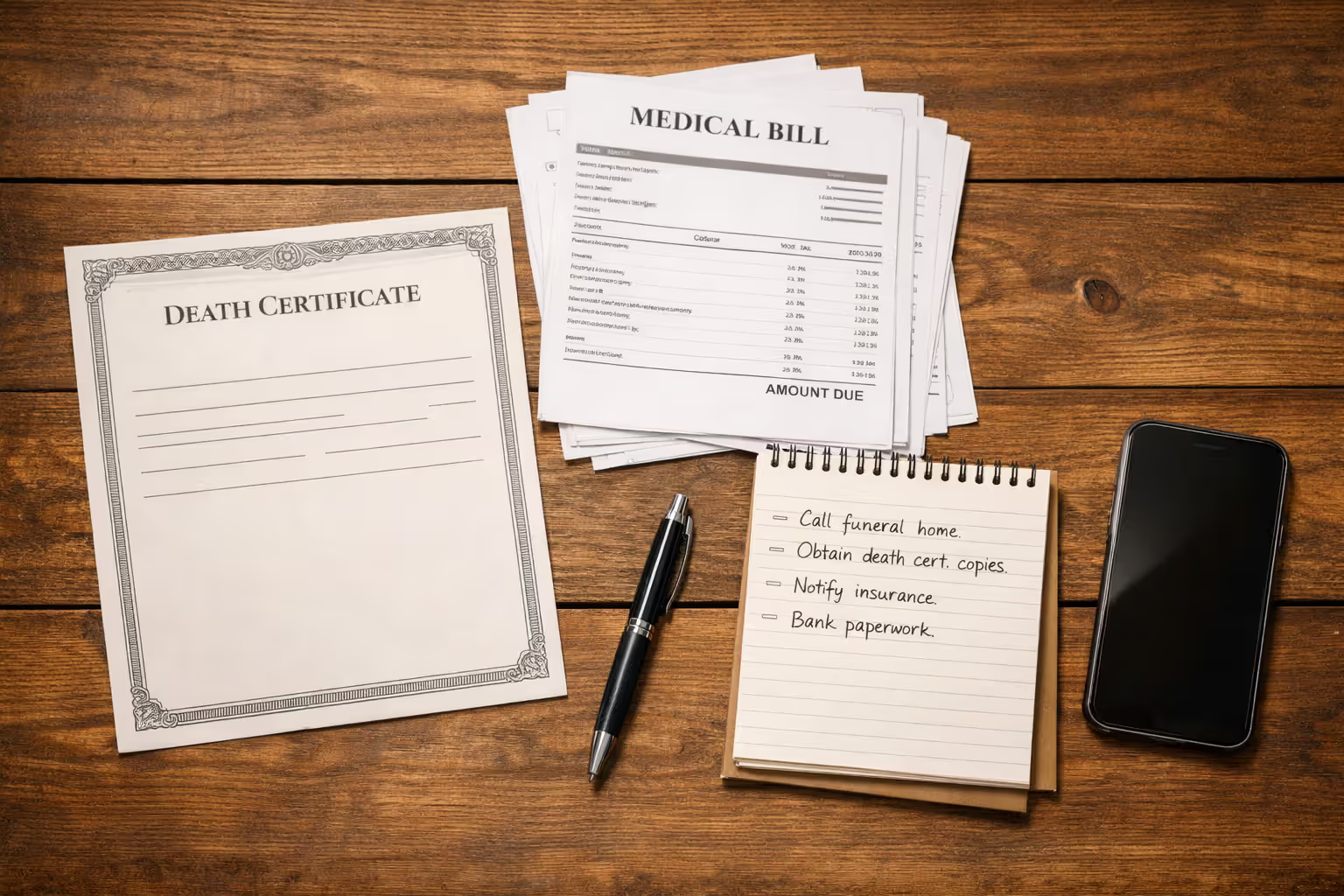
Obtain the death certificate: Request multiple certified copies. You'll need these for workers' comp claims, life insurance, Social Security survivor benefits, and potential lawsuits.
Document everything: Create a file for all documents related to the death—pay stubs, employment records, medical bills, police reports, and correspondence with the employer or insurers. If witnesses were present, write down their names and contact information while memories are fresh.
Preserve physical evidence: If you have access to work clothing, safety equipment, or other physical items from the accident scene, preserve them in a safe location. Don't clean or repair anything. Photographs of injuries, equipment, or the scene are valuable if available, though accessing accident sites may not be possible.
Notify the workers' comp insurance carrier: The employer should do this, but confirm that a claim has been filed. Most states require claims within one to two years of death, but filing promptly avoids disputes and starts benefit payments sooner.
Do not give recorded statements: Insurance adjusters may contact you quickly requesting recorded statements about the deceased worker's health, work history, or the accident. Politely decline until you've consulted an attorney. Adjusters use these statements to minimize claims.
Author: Samantha Caldwell;
Source: mannawong.com
Avoid early settlement offers: Workers' comp carriers sometimes offer lump-sum settlements shortly after death, often for amounts well below the present value of ongoing benefits. These offers can sound attractive when you're facing immediate expenses, but accepting them usually means waiving rights to future payments and potential lawsuits.
Consult an attorney within weeks: Most wrongful death and workers' comp death benefit cases are handled on contingency (the attorney receives a percentage of recovery only if you win), so consultations are typically free. An attorney can identify third-party claims, evaluate whether employer conduct permits a lawsuit, and ensure you meet all filing deadlines.
Contact OSHA: If you believe safety violations contributed to the death, file a complaint with OSHA. The agency has six months to inspect and cite violations. OSHA reports become valuable evidence in civil cases, and the investigation costs you nothing.
Apply for Social Security survivor benefits: Separately from workers' comp, surviving spouses and children may qualify for Social Security survivor benefits. Apply through the Social Security Administration as soon as possible.
How Much Compensation Can Families Recover? (Comparison of Claims Types)
The financial recovery available to families depends on which claims apply to your situation. Workers' compensation death benefits and wrongful death lawsuits compensate different categories of harm under different rules.
| Factor | Workers' Compensation Death Benefits | Wrongful Death Lawsuit |
| What's Covered | Portion of lost wages (typically 2/3 of average weekly wage); funeral expenses up to state limit; no pain and suffering | Full lost earnings and benefits over lifetime; loss of companionship and guidance; pain and suffering of survivors; funeral costs; punitive damages in some cases |
| Eligibility Requirements | Death arose out of and in the course of employment; claimant is a statutory dependent | Third-party negligence, or employer conduct that fits an exception to workers' comp exclusivity; claimant is a statutory wrongful death beneficiary (usually spouse, children, or parents) |
| Average Benefit Amounts/Caps | $200,000–$600,000 total depending on state caps, wage level, and dependent ages; weekly payments typically capped at state maximum ($600–$1,500/week) | $500,000–$5,000,000+ depending on deceased's age, earning capacity, degree of negligence, and available insurance; no statutory caps in most states |
| Time Limits to File | Notice to employer: 30 days–1 year; claim filing: 1–3 years (varies by state) | 1–3 years from date of death (varies by state); some states toll the deadline for minors |
Workers' compensation provides relatively quick, certain benefits without requiring proof of fault. A claim filed properly will almost always result in some payment within months. The trade-off is that benefit amounts are modest and don't compensate for non-economic losses like the emotional support a spouse or parent provided.
Wrongful death lawsuits offer potentially much higher compensation, including full wage replacement, loss of companionship, and in rare cases punitive damages meant to punish especially reckless conduct. The downside: these cases take years to resolve, require proving negligence or liability, and depend on whether the defendant has sufficient insurance or assets to pay a judgment.
When both claims are available—workers' comp from the employer and a lawsuit against a third party—families should pursue both. The workers' comp carrier will assert a lien against the lawsuit recovery to recoup what they paid, but families typically still net significantly more than workers' comp alone would provide.
Frequently Asked Questions About Fatal Workplace Accidents
Losing a family member to a workplace accident death creates profound grief that no amount of compensation can truly address. Yet the financial reality of lost income, mounting expenses, and an uncertain future demands that surviving families understand and pursue every available legal remedy. Workers' compensation death benefits provide a foundation, but they rarely replace the full economic and emotional value of a lost loved one.
When employer negligence, defective equipment, or third-party actions contributed to the death, additional compensation may be available through wrongful death claims that account for the full scope of your family's loss. The legal system cannot restore what was taken, but it can provide financial security and hold responsible parties accountable for preventable tragedies.
Act quickly to protect your rights. Document what happened, preserve evidence, and consult with an experienced attorney who handles workplace accident death cases before deadlines pass or evidence disappears. The steps you take in the difficult weeks after loss determine whether your family receives adequate support or struggles unnecessarily with financial hardship on top of grief.