Stethoscope placed on open legal case folder with medical records next to a judge gavel on a dark wooden desk
Expert Medical Testimony In Wrongful Death Cases
Content
A 52-year-old teacher walks into an emergency room complaining of chest pain. Three hours later, she's sent home with antacids. By morning, she's dead from a massive heart attack. Her family hires an attorney. That attorney calls a cardiologist who's never met the patient, never worked at that hospital, and lives 800 miles away. Over the next eighteen months, this cardiologist's medical opinions will determine whether the family receives $3 million or nothing.
That's how expert medical testimony works in death litigation. Doctors who specialize in translating medical events into courtroom language become the linchpin of wrongful death and malpractice cases. They analyze what happened during someone's final hours—or minutes—and explain whether negligence played a role. Without them, most death cases never make it past summary judgment.
The process isn't straightforward. Courts have built elaborate gatekeeping systems to filter out unreliable medical opinions. Meanwhile, attorneys on both sides spend tens of thousands vetting physicians, preparing testimony, and hoping their expert sounds more credible than the other side's. One weak answer during cross-examination can torpedo an entire case.
What Qualifies a Physician as an Expert Witness in Death-Related Cases
Not every physician with impressive credentials gets to testify. Trial judges act as bouncers, keeping out doctors whose qualifications don't match the specific medical issues being litigated. This gatekeeping has intensified over the past two decades as courts have grown skeptical of "experts" who stretch their credentials to cover unfamiliar territory.
Board Certification and Specialty Requirements
Here's what typically happens: A plaintiff's lawyer finds a physician willing to review a potential malpractice case. Before accepting the case, the lawyer checks whether that doctor holds active board certification in the relevant specialty. If the case involves a surgical death, they want a surgeon. Cardiac arrest? A cardiologist or emergency physician. Anesthesia complication? A board-certified anesthesiologist.
Why does this matter? Because most state laws now require that physician expert witnesses practice in the same specialty as the defendant doctor. Texas, for instance, mandates that the expert be certified by the same board or a substantially equivalent one. California goes further—requiring that the expert devoted most of their professional time to either clinical practice or teaching in that specialty during the previous five years.

Author: Daniel Whitford;
Source: mannawong.com
These rules prevent what used to happen regularly: retired pathologists opining on emergency medicine, or family doctors critiquing neurosurgical technique. Consider a 2019 Florida case where a plaintiff tried using a general surgeon to testify about vascular surgery. The judge excluded the testimony entirely. The surgeon had completed a vascular fellowship decades earlier but hadn't performed vascular procedures in fifteen years. That gap proved fatal to his qualifications.
Subspecialties create additional complexity. Cardiology alone has interventional cardiologists, electrophysiologists, and heart failure specialists. A plaintiff alleging that a cardiologist botched a cardiac catheterization needs an interventional cardiologist as an expert—someone who does caths regularly. A general cardiologist who reads stress tests won't cut it, regardless of board certification.
Experience Standards Courts Recognize
Credentials tell only part of the story. Judges also examine whether the proposed expert has hands-on experience with the specific medical condition and treatment at issue. A physician who trained in neonatal intensive care thirty years ago but now works in medical administration can't credibly testify about current NICU standards. Medicine evolves too rapidly.
The old "locality rule" has mostly disappeared. Courts used to require that experts practice in communities similar in size and resources to where the alleged malpractice occurred. That standard made sense in 1950 when a rural doctor might not have access to the same equipment as a Boston hospital. But medical education, board certification, and clinical guidelines have become nationalized. A cardiologist in Seattle applies the same American Heart Association guidelines as a cardiologist in Omaha.
Still, some nuances persist. If a case involves resource allocation decisions—say, whether a small community hospital should have transferred a patient to a tertiary center—the expert needs familiarity with how community hospitals operate. Pure academic physicians who've only worked at major teaching hospitals may lack credibility here.
Defense lawyers spend considerable time investigating potential plaintiff experts. They pull licensing records looking for disciplinary actions. They search legal databases for other cases where the expert testified, looking for inconsistent opinions or cases where judges excluded their testimony. They count how many times the expert has testified for plaintiffs versus defendants. An expert who testifies 95% of the time for plaintiffs—especially if they've testified in dozens of cases annually—becomes vulnerable to "hired gun" accusations.
How Medical Expert Testimony Establishes Causation in Wrongful Death Claims
Proving medical negligence caused a death requires connecting two distinct dots. First, showing the doctor deviated from accepted medical standards. Second, demonstrating that this deviation directly caused the patient's death. Both elements demand detailed causation medical analysis that only a qualified physician can provide.
Take a real scenario that played out in a Michigan wrongful death case: A 68-year-old diabetic man underwent routine knee replacement surgery. Post-operatively, nursing staff documented that he complained of chest pressure and shortness of breath. The orthopedic surgeon attributed these symptoms to anxiety and prescribed a sedative. Eight hours later, the patient coded and couldn't be resuscitated. Autopsy revealed a pulmonary embolism.
The plaintiff's cardiologist expert reviewed the records and built a causation argument in three layers. First, he established the standard of care: when a post-surgical patient develops chest pressure and dyspnea, physicians must rule out pulmonary embolism, especially in high-risk patients. Second, he showed the defendant violated that standard by dismissing symptoms without ordering a D-dimer test, CT angiography, or cardiology consultation. Third—and most critically—he explained causation. The expert reviewed the autopsy findings, calculated backward from the size of the embolism, and testified that if the surgeon had ordered appropriate testing within the first hour of symptoms, anticoagulation therapy would have prevented the fatal propagation of the clot. Without treatment, the embolism grew until it caused cardiovascular collapse.
Causation testimony walks a tightrope. Experts can't simply say negligence "might have" caused death. Legal standards require testimony to a "reasonable degree of medical probability" or "more likely than not." That means greater than 50% likelihood. If an expert testifies the patient had a 40% chance of survival even with proper treatment, causation fails.
In medical malpractice litigation, causation is the linchpin. Without credible expert testimony linking the defendant's conduct to the patient's injury or death, even the most egregious deviation from the standard of care will not result in liability
— Dr. Michael Baden
Competing causes complicate everything. Patients with terminal cancer, end-stage kidney disease, or advanced heart failure present causation challenges. Did the doctor's negligence cause death, or was the patient going to die anyway? Experts must parse through competing hypotheses, often relying on autopsy reports, toxicology, and peer-reviewed literature that quantifies survival probabilities with and without proper treatment.
Defense experts counter by arguing alternative causation theories. In the knee replacement case above, the defense expert testified that pulmonary embolisms can develop suddenly and prove fatal within minutes, giving no time for intervention. The jury had to decide which causation narrative was more credible—a classic battle of medical opinions that happens in virtually every contested death case.
The Process: From Case Review to Courtroom Testimony
The path from initial medical record review to a physician delivering malpractice testimony court stretches across months or years, involving distinct phases where the expert's analysis deepens and their opinions face escalating scrutiny.
Initial Medical Record Analysis
Attorneys send potential experts a case packet: incident reports, hospital charts, imaging studies, lab results, medication administration records, autopsy reports, and sometimes witness depositions. The expert receives a retainer check and begins their legal medical review, typically spending 10-20 hours on an initial assessment for complex death cases.
During this phase, the expert becomes a medical detective. They create timelines mapping every clinical decision, every vital sign change, every medication administered. They identify decision points where different choices might have altered the outcome. They pull clinical guidelines from professional societies—the American College of Cardiology, American College of Emergency Physicians, whoever's standards apply—and compare the defendant's actions against those benchmarks.
Many cases die here. If the expert concludes the care was reasonable or that causation can't be established, ethical experts tell the attorney they can't support the case. Some attorneys send cases to multiple experts hoping one will see merit, though this practice risks creating conflicting opinions that can haunt them later.
When an expert believes the case has merit, they draft a detailed report. These reports run 15-30 pages, methodically laying out: materials reviewed, the expert's qualifications, relevant medical background, the applicable standard of care, specific deviations from that standard, causation analysis, and conclusions. This document becomes the foundation for everything that follows. Defense attorneys will dissect every sentence during deposition.
Deposition Preparation and Execution
Once litigation begins in earnest, the opposing side will notice the expert's deposition—a sworn examination where defense lawyers probe every aspect of the expert's opinions. Smart attorneys spend 4-6 hours preparing their expert before deposition. They review potential impeachment material: medical literature that contradicts the expert's position, prior testimony where the expert said something different, gaps in the expert's analysis.
Depositions follow predictable patterns. First, defense counsel establishes the expert's compensation, number of cases worked, and percentage of time spent on plaintiff versus defense work. They're building a "hired gun" narrative. Next comes credentialing: where did you train, when did you last perform this procedure, how often do you see this condition? They're looking for qualification gaps.
Then the real work begins. Defense lawyers walk through the expert's report line by line, asking the expert to justify each opinion. "On page 12, you state that the standard of care required immediate intubation. What guidelines support that?" "Did you review Dr. Smith's deposition where he explained his reasoning?" "Are you aware of the 2018 study published in JAMA that found delayed intubation had no impact on mortality?"
Effective experts prepare by anticipating these challenges. They bookmark the sections of medical literature they'll cite. They rehearse explaining complex concepts in plain language. They practice saying "I don't know" when they genuinely don't know—jurors respect honesty more than experts who bluff.
The expert witness occupies a unique and sometimes uncomfortable position in the legal system: asked to render objective scientific opinions within a framework designed for adversarial combat. The best experts never forget that their duty is to the truth, not to the party writing the check. The moment credibility is lost, it can never be recovered
— Dr. Cyril Wecht
Depositions can last six to eight hours. Every answer is recorded, transcribed, and will be used at trial if the expert says anything inconsistent later. I've seen cases where a single poorly worded deposition answer—later contradicted by trial testimony—destroyed an expert's credibility completely.
Trial Testimony Delivery
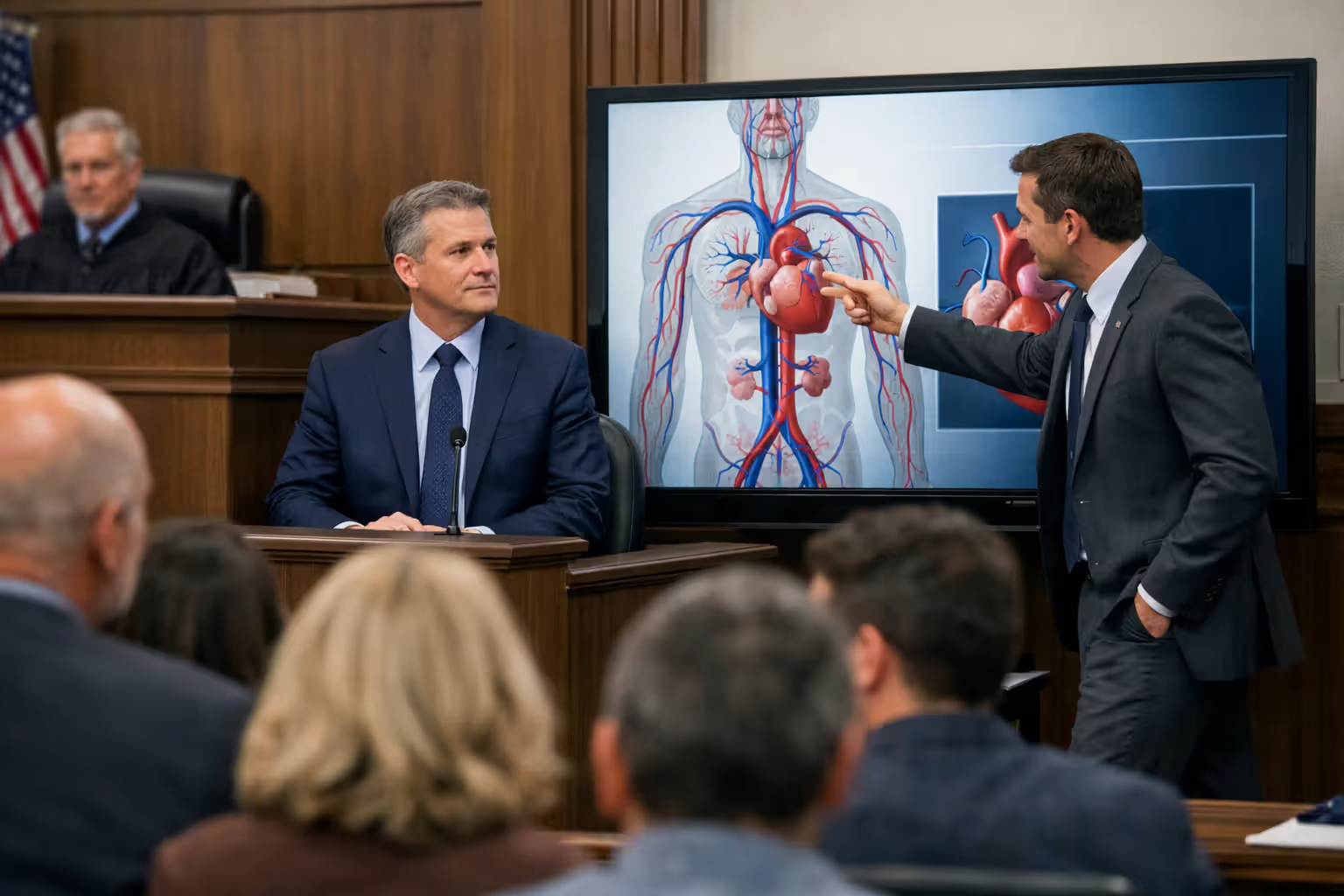
If settlement negotiations fail, the case proceeds to trial, and the expert takes the witness stand. Direct examination comes first, where the retaining attorney guides the expert through their qualifications, opinions, and reasoning. This portion is choreographed carefully. The attorney and expert have practiced it multiple times, refining how to present complex medical causation in ways jurors can understand.
Visual aids help enormously. Experts use anatomical charts, timelines, and sometimes medical animations showing what should have happened versus what actually happened. A cardiologist might display a CT image showing the pulmonary embolism, then walk the jury through how anticoagulation would have stopped it from growing.
Author: Daniel Whitford;
Source: mannawong.com
Cross-examination follows, and this is where trials are won or lost. Defense lawyers attack from multiple angles. They'll highlight the expert's lucrative testimony income, suggesting bias. They'll ask hypothetical questions designed to show the expert's opinions are inconsistent. They'll pull up medical textbooks with passages that contradict the expert's testimony, then ask the expert to explain the discrepancy.
The most damaging cross-examinations exploit prior inconsistent statements. "Doctor, in your deposition six months ago on page 143, you testified that the patient had a 60% chance of survival with proper treatment. Today you said 75%. Which is it?" Even small inconsistencies damage credibility because they suggest the expert is tailoring testimony rather than providing objective medical opinions.
Strong experts remain composed under hostile questioning. They answer only what's asked, avoiding the temptation to over-explain. They admit limitations without undermining their core opinions. When confronted with contrary literature, they explain why that study doesn't apply to this specific patient's circumstances. Jurors watch not just what experts say, but how they say it—defensive or evasive experts lose credibility fast.
Common Weaknesses That Undermine Medical Expert Credibility
Even highly qualified physicians stumble when their testimony contains certain vulnerabilities. Opposing lawyers and judges have developed sophisticated techniques for identifying and exploiting these weaknesses, particularly under the reliability standards federal courts established in Daubert v. Merrell Dow Pharmaceuticals.
The Daubert framework transformed expert testimony. Before 1993, courts generally admitted expert testimony if the expert was qualified and the testimony would help the jury. Daubert added reliability requirements. Now judges must evaluate whether the expert's methods are scientifically valid and properly applied to the facts. This gatekeeping function has resulted in thousands of experts being excluded before trial.
Five factors guide Daubert analysis: Can the expert's theory be tested? Has it been peer-reviewed? What's the error rate? Do standards exist controlling the methodology? Is the approach generally accepted in the relevant scientific community? An expert who bases opinions solely on personal experience—"In my 30 years of practice, I've never seen..."—without citing peer-reviewed literature or accepted guidelines, risks exclusion.
The "professional witness" problem plagues death litigation. Some physicians earn $500,000 annually from expert testimony, testifying in 40-50 cases per year, almost exclusively for one side. Defense lawyers exploit this. "Dr. Jones, you've testified in 47 malpractice cases over the past three years. In how many did you support the defendant physician? Zero? And you've earned approximately $420,000 from plaintiff testimony during that period?" This line of questioning suggests the expert prioritizes income over objectivity.
Specialty drift creates another vulnerability. A physician who specialized in trauma surgery but shifted to administrative medicine a decade ago lacks current knowledge of evolving trauma care standards. If challenged on recent developments—new hemostatic protocols, revised guidelines for massive transfusion—their outdated knowledge becomes obvious. Effective experts maintain active clinical practice or teaching roles specifically to avoid this problem.
Medical literature cuts both ways. If authoritative studies or clinical guidelines contradict the expert's opinions, defense lawyers will confront them with those sources during cross-examination. "Doctor, you testified that the standard of care required immediate surgery. But the American College of Surgeons guidelines recommend 12-24 hours of medical stabilization first. Were you aware of those guidelines?" An expert who hasn't thoroughly researched the literature gets demolished.
Finally, opinion shopping leaves trails. When attorneys send cases to multiple experts looking for favorable opinions, those other experts sometimes surface. "Doctor, before the plaintiff hired you, did they send this case to Dr. Williams? And Dr. Williams declined, correct? Do you know why?" If a more qualified expert rejected the case, that fact severely undermines the testifying expert's credibility.
Cost Factors: What Law Firms Pay for Death Case Medical Experts
Hiring a qualified medical expert requires substantial financial investment, particularly in wrongful death and medical malpractice cases where comprehensive causation medical analysis is essential. Law firms handling cases on contingency must carefully budget these expenses, knowing they won't recover costs unless the case settles or produces a favorable verdict.
Hourly rates for physician expert witnesses vary dramatically based on specialty, experience, reputation, and geographic market. A family medicine physician in a small Midwestern city might charge $275-350 per hour for record review. A board-certified forensic pathologist with extensive courtroom experience in New York or Los Angeles might command $750-900 per hour. Highly sought specialists—those with impeccable credentials who've withstood multiple Daubert challenges—sometimes charge over $1,000 hourly.
Most experts require retainers before beginning work. These upfront payments typically range from $3,500 for straightforward cases to $15,000 for complex multi-defendant litigation. The retainer gets drawn down as the expert bills hours, with the law firm receiving periodic invoices and making additional payments as needed.

Author: Daniel Whitford;
Source: mannawong.com
Deposition time carries premium pricing. Experts typically charge half-day minimums (4 hours) or full-day rates regardless of actual deposition length. If a deposition scheduled for a full day settles that morning, the expert still bills for the time they blocked off. These rates often run 1.5 to 2 times the standard hourly rate. Travel time to depositions is usually billed at half the normal rate.
Trial testimony represents the most expensive phase. Experts charge daily rates—often $4,000 to $12,000 per day—plus preparation time, travel, lodging, and meals. A trial lasting five days with the expert on standby can generate bills exceeding $30,000 just for that expert's time, not counting months of prior work.
Report preparation involves intensive work: reviewing records, researching literature, consulting guidelines, drafting detailed analysis. Experts typically bill 10-20 hours for initial reports in death cases, sometimes more for cases involving multiple defendants or complex causation issues. At $500-800 per hour, a comprehensive expert report can cost $5,000 to $15,000 before the expert has given a single minute of testimony.
| Case Type | Junior Expert (Hourly) | Senior Expert (Hourly) | Deposition Fee | Trial Testimony (Per Day) | Report Preparation |
| Wrongful Death | $325–$475 | $575–$850 | $2,200–$3,800 | $4,500–$7,500 | $1,800–$4,500 |
| Medical Malpractice | $375–$525 | $625–$950 | $2,800–$4,500 | $5,500–$9,500 | $2,200–$5,500 |
| Product Liability | $425–$575 | $675–$1,150 | $3,200–$5,500 | $6,500–$11,500 | $2,800–$6,500 |
Additional expenses accumulate quickly. Law firms pay for copying and organizing medical records, courier services for time-sensitive document delivery, travel expenses when experts must examine physical evidence or visit incident locations, and sometimes consulting fees to subject-matter specialists who help identify appropriate testifying experts.
In a contested wrongful death case that proceeds through trial, total expert-related costs commonly reach $60,000 to $125,000. Complex cases involving multiple specialties—say, a surgical death requiring both surgical and anesthesiology experts—can double those figures. Product liability death cases, which might require engineering experts in addition to medical experts, sometimes generate expert costs exceeding $200,000.
These expenses explain why many plaintiff firms decline potentially meritorious cases with damages below certain thresholds. If a case will cost $100,000 in expert fees and other litigation expenses, the firm needs confidence the case will produce a settlement or verdict sufficient to justify that investment. This economic reality means that some legitimate death cases—particularly those involving elderly patients with limited economic damages—never get litigated despite clear negligence.
Frequently Asked Questions About Medical Expert Testimony in Death Cases
Medical expert testimony in death litigation occupies the intersection where clinical judgment meets legal accountability. Physicians who enter this arena shoulder responsibility that extends beyond their typical medical practice—their analysis can bring closure to families devastated by preventable loss or protect healthcare providers from baseless allegations that could destroy careers.
Effective expert testimony requires more than deep medical knowledge. It demands the ability to explain complex physiology to jurors unfamiliar with medical terminology, the composure to withstand aggressive cross-examination designed to expose weaknesses, and the integrity to decline cases where the evidence doesn't support the desired conclusion. Attorneys selecting experts must look beyond impressive CVs to find physicians whose qualifications precisely match the medical issues in dispute, whose methodology will withstand Daubert scrutiny, and whose credibility will resonate with jurors.
The financial investment in qualified experts reflects their importance. Law firms routinely spend $50,000 to $150,000 on expert testimony in complex death cases, recognizing that credible medical opinions often determine outcomes. Cutting costs by hiring marginally qualified experts invites disaster—exclusion orders, impeachment, and lost cases.
For families seeking answers about how a loved one died, and for healthcare providers facing allegations that challenge their professional judgment, the quality of expert medical testimony often determines whether justice prevails. Understanding the rigorous qualification standards courts impose, the detailed causation analysis required, the multi-stage process from record review through trial, and the vulnerabilities that undermine credibility—these insights empower everyone involved to pursue resolution grounded in reliable medical science rather than speculation.