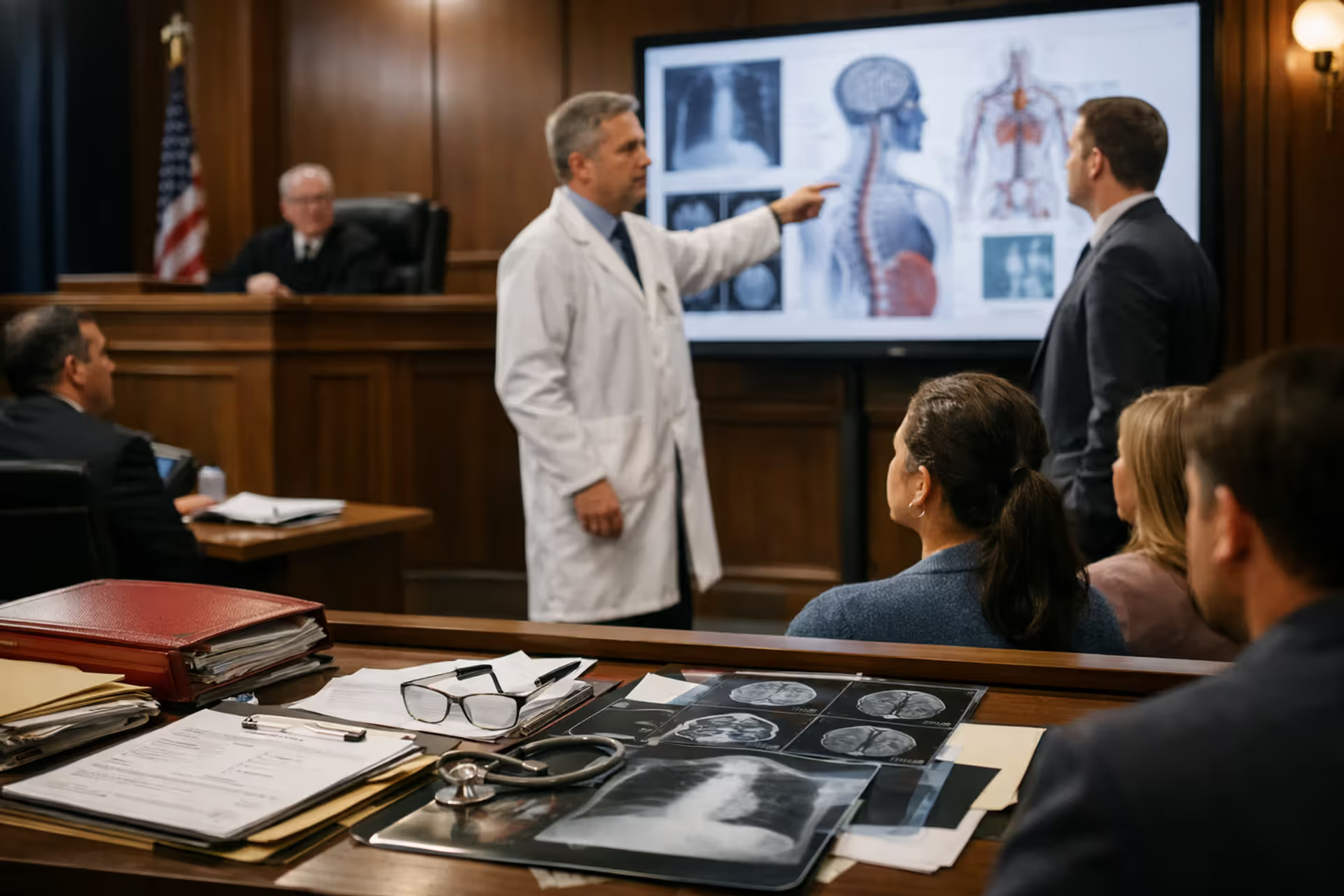
Expert medical witness presenting forensic evidence on a screen in a modern courtroom while jury members listen attentively
What Is an Expert Witness in Wrongful Death Cases
Content
Picture a courtroom where a family's attorney insists that a pharmaceutical company's drug killed their father. The company's lawyers counter with alternative explanations—heart disease, smoking history, age. Without someone who can dissect autopsy findings, explain drug metabolism, and definitively link the medication to cardiac arrest, that family's case evaporates.
The technical nature of wrongful death litigation creates a problem: neither attorneys nor jurors typically understand biomechanics, pathology, actuarial science, or crash dynamics. A mid-career accountant died in a workplace fall—what would she have earned over 28 more years? Did the safety harness fail, or was it improperly attached? These questions demand specialized knowledge that falls outside what most people know.
Enter the expert witness. They're the bridge between complex evidence and courtroom understanding, translating medical records, financial projections, and accident physics into testimony a jury can actually use.
Why Expert Testimony Determines the Outcome of Wrongful Death Claims
Three hurdles face every wrongful death plaintiff: showing the defendant caused the death, proving that conduct was negligent, and putting a dollar figure on the loss. Juries can't clear these hurdles alone.
Take a malpractice case. The family says their mother died because surgeons nicked her bowel during a routine procedure, then missed the complication for 18 hours. That's a story, not proof. You need a surgeon who can walk through operative reports, explain what standard technique looks like, identify where this surgeon went wrong, and show how earlier detection would have prevented sepsis. Without that testimony wrongful death cases become dueling narratives with no way for jurors to pick a winner.
Author: Michael Thornton;
Source: mannawong.com
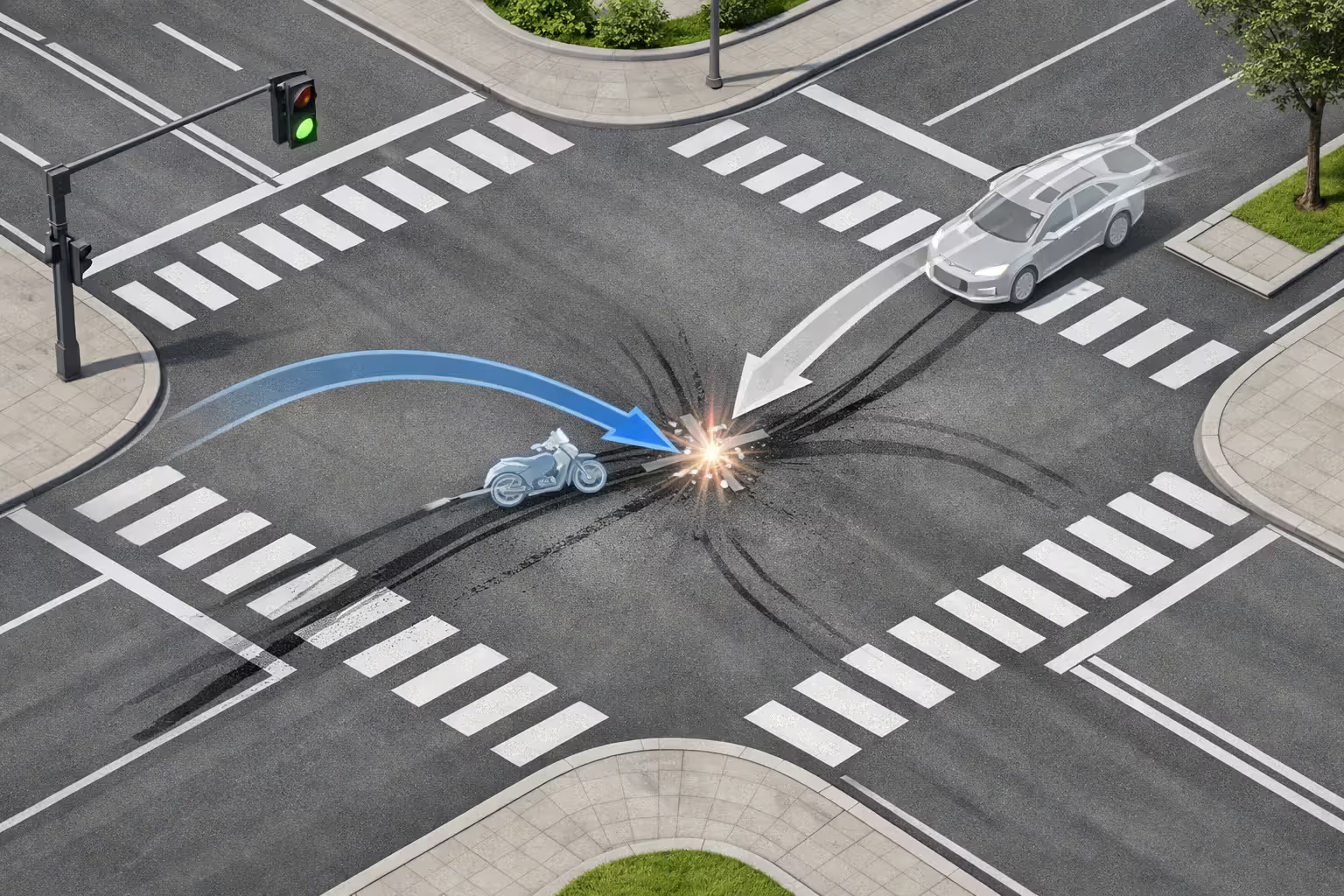
Or consider a motorcycle fatality at an intersection. Police reports show the rider had the green light, but the turning driver claims he never saw the bike. Was the motorcycle visible? Could the driver have seen it if he'd checked properly? An accident reconstruction expert measures sight lines, calculates approach speeds, and determines the bike was in the driver's view for 4.2 seconds before impact—plenty of time to react if he'd been paying attention.
Medical causation gets especially tricky when the deceased had pre-existing conditions. A 58-year-old man with controlled diabetes dies three days after a rear-end collision. Defense argues he died from diabetic complications unrelated to the crash. The family needs a pathologist who can review tissue samples, blood work, and injury patterns to show the trauma triggered a cascade that killed him—not his diabetes.
Courts demand this kind of specificity. Most jurisdictions won't let a jury decide causation without expert testimony meeting certain reliability standards. The legal expert evidence needs to demonstrate causation "to a reasonable medical probability" or similar phrasing. Family members testifying about what they observed doesn't cut it.
In wrongful death litigation, the expert witness doesn't just provide an opinion—they provide the scientific foundation that allows a jury to understand what happened, why it happened, and who bears responsibility. Without that foundation, even the most compelling emotional testimony cannot establish the legal elements required for recovery.
— Dr. Michael Baden
Damages create another expert-dependent challenge. Sympathy for a widow doesn't tell jurors whether to award $500,000 or $5 million. Economic experts build those figures from data: salary history, career trajectory, benefits packages, household contributions. They project earnings across decades, account for raises and promotions, then calculate present value. These aren't guesses—they're structured analyses based on labor statistics, actuarial tables, and economic modeling.
Medical Experts Who Testify in Wrongful Death Litigation
Medical professionals anchor most wrongful death cases, especially those involving healthcare mistakes, dangerous products, or traumatic injuries. Different specialists tackle different questions, and complicated cases might need testimony from three or four medical experts court proceedings.
Pathologists and Forensic Medical Examiners
What killed the person? That fundamental question belongs to pathologists. They examine autopsy results, study tissue under microscopes, review toxicology screens, and trace the biological sequence that ended in death. Their testimony wrongful death trials establishes the foundation everything else builds on.
Consider a case where someone dies two weeks after elective knee surgery. The hospital claims blood clots killed the patient—a known surgical risk they couldn't prevent. A forensic pathologist examines clot formation patterns, reviews anticoagulation protocols, and determines the clots formed because staff ignored signs of deep vein thrombosis for 36 hours. That's the difference between an unfortunate complication and fatal negligence.
Timing matters enormously in these cases. If a patient crashes during surgery but dies three days later in the ICU, what actually killed them—the surgical error or subsequent treatment decisions? Pathologists trace causation through lab values, vital signs, and tissue examination to pinpoint when irreversible damage occurred and what caused it.
Treating Physicians and Specialists
The doctors who actually cared for the deceased before death bring firsthand knowledge that outside experts can't match. They know the patient's history, what treatments were tried, how the person responded. That familiarity carries weight with juries.
A cardiologist who'd treated someone for coronary disease for eight years can explain how a T-bone collision's force caused an aortic dissection that wouldn't have occurred in someone with healthy arteries—but that doesn't make the collision any less the cause of death. This connects pre-existing conditions to trauma in ways that establish liability rather than defeat it.
Specialists also set the standard-of-care baseline. What should a competent emergency room physician have done when a patient arrived with certain symptoms? An ER doctor with 20 years' experience and board certification can detail protocols, explain what red flags should have triggered specific interventions, and show where the defendant's care fell short. They'll reference medical literature, practice guidelines, and their own training to build that standard.

Author: Michael Thornton;
Source: mannawong.com
Life Care Planners and Economic Damage Experts
This seems counterintuitive in death cases, but life care planners sometimes project what medical care the deceased would have needed if they'd survived with catastrophic injuries. Why does that matter when they died? It affects damages calculations—specifically, comparing the cost of lifetime care (if survival occurred) against economic losses from death. This factors into settlement negotiations and jury instructions in some jurisdictions.
Medical professionals with economic training also value household services. A parent who handled childcare for three kids, cooked meals, managed schedules, maintained the home, and ran errands contributed real economic value. Medical experts assess the physical demands of those tasks—hours spent lifting children, standing while cooking, driving—then work with economists to calculate replacement costs over the years that person would have performed them.
| Type of Expert | What They Actually Do | Credentials That Matter | Cases Where You Need Them |
| Forensic Pathologist | Pinpoint biological cause of death and connect it to defendant's actions | Board-certified in forensic pathology; extensive autopsy experience | Virtually every wrongful death case, particularly with medical issues or causation disputes |
| Accident Reconstruction Expert | Recreate crashes and incidents using physics, engineering, and evidence analysis | Engineering background; specific training in collision reconstruction and biomechanics | Vehicle crashes, construction accidents, falls, equipment failures |
| Economic Damages Specialist | Project lost income, benefits, and household contributions over time | Advanced degree in economics; forensic economics experience | Every case requiring financial loss calculations beyond immediate medical bills |
| Industry-Specific Professional | Define safety standards and practices in specialized fields | Field-specific certifications; practical experience in the relevant industry | Workplace deaths, professional malpractice, technical equipment cases |
Accident Reconstruction Specialists and Their Investigative Methods
These experts don't just eyeball a crash scene and make guesses. They're essentially working backward from the aftermath—vehicle damage, debris patterns, tire marks—to figure out exactly what happened in the seconds before impact.
The process starts with documentation. They'll photograph everything from multiple angles, measure skid marks and scrub marks, note road grade and surface texture, document sight distances and visual obstructions. If the vehicles have event data recorders (the automotive equivalent of black boxes), they'll pull that data showing speed, braking, steering input, and throttle position from the five seconds before collision.
Then comes the physics. Using momentum calculations, energy dissipation formulas, and crush analysis, they determine vehicle speeds, impact angles, and driver actions. They might conclude that a pickup was traveling 52 mph in a 25 mph school zone based on how far the struck vehicle traveled after impact. They can determine whether brake lights were working based on filament examination. They can show whether a motorcyclist was properly positioned in their lane from scuff marks and final rest positions.
This analysis extends well beyond traffic accidents. A construction worker falls 30 feet from scaffolding—was the equipment properly erected? Did it meet manufacturer specifications and OSHA requirements? An accident reconstruction expert with construction safety expertise examines the scaffolding design, calculates load capacities, reviews assembly procedures, and determines whether the collapse resulted from defective equipment, improper assembly, or overloading.
Product liability deaths demand experts who can spot design flaws and manufacturing defects. When a table saw's blade guard fails and kills a worker, litigation specialists examine the guard mechanism, test similar units, review engineering drawings, and determine whether the design created unreasonable risks. They'll compare the product against industry standards and competitor designs to show whether safer alternatives existed.
Workplace incidents involving machinery require experts who understand both the equipment and safety protocols. A factory worker gets caught in a conveyor belt—did the emergency stop button work? Were lockout/tagout procedures followed? Was required guarding in place? Industrial safety experts review equipment maintenance logs, OSHA compliance records, and industry standards to determine where safety systems failed.
The expert witness serves as the translator between two worlds — the world of science and the world of law. Jurors are asked to make decisions about things they’ve never studied. It is the expert who gives them the lens to see the truth buried inside technical evidence, crash data, and medical records that would otherwise remain incomprehensible
— Dr. Henry Lee
Economic and Vocational Experts: Calculating Lost Earnings and Future Damages
Raw salary multiplied by working years remaining doesn't come close to accurate damages calculations. These experts dig far deeper, accounting for career progression, wage inflation, benefits, taxes, and personal consumption patterns.
Vocational experts establish earning capacity first. For someone employed when they died, this involves projecting career trajectory. That 32-year-old associate at a law firm making $110,000 wasn't going to earn that same salary for 35 years. The vocational expert reviews partnership tracks at similar firms, the deceased's performance evaluations, and industry data to project realistic advancement. Maybe partnership at age 38 with $250,000 earnings. Equity partner by 45 at $450,000. Those projections need support—not speculation.
Non-working individuals create bigger challenges. A college junior studying computer science—what would she have earned? Vocational experts examine degree completion rates, entry-level salaries for CS graduates, career advancement patterns in tech, and labor market projections. They'll look at the student's GPA, internship experience, and school reputation to refine estimates. A Stanford CS major with a 3.8 GPA has different earning potential than someone at a regional school with a 2.5.

Author: Michael Thornton;
Source: mannawong.com
Young children require even broader projections. Experts might calculate earning capacity across several scenarios based on education level—high school graduate, bachelor's degree, advanced degree—weighted by demographic probabilities. Courts vary on how much speculation they'll allow for very young decedents.
Economic experts translate these earnings projections into present value—the lump sum needed today to equal future earnings if conservatively invested. This requires assumptions about investment returns (typically tied to Treasury rates), inflation, and discount rates. A million dollars in earnings 25 years from now isn't worth a million today. The economist calculates that equivalent present value.
Benefits beyond salary can exceed base pay for high-level employees. Stock options, retirement contributions, health insurance, bonuses, company cars—these all have calculable value. Economic experts review employment agreements, benefit plan documents, and compensation statements to capture everything. An executive with significant equity compensation might have benefits worth more than salary.
Household services valuation requires detailed analysis of what the deceased actually did and what replacement costs. An expert might determine someone provided 50 hours weekly of childcare (valued at current nanny rates), 12 hours of cooking ($25/hour for meal prep services), 6 hours of cleaning ($30/hour professional cleaning rates), plus home maintenance, financial management, and transportation. That adds up quickly—potentially $60,000+ annually in economic value that must now be purchased or absorbed by surviving family members who already work full-time.
How Attorneys Vet and Retain Qualified Litigation Specialists
Impressive credentials are everywhere. Finding expert witnesses wrongful death attorneys can actually win with—people who'll survive cross-examination, explain clearly, and maintain credibility under pressure—takes real work.
Most attorneys start by asking colleagues who they've used successfully. Published articles in medical or technical journals signal expertise, but courtroom performance matters more. Several databases track experts who've testified previously, sometimes including transcripts.
Credentials and Courtroom Experience That Matter
Board certifications and academic appointments establish baseline credibility. But testimony experience separates effective experts from academics who fall apart when challenged aggressively. Review the CV carefully. Does this person testify exclusively for plaintiffs or defendants? That suggests bias rather than objective analysis. Do they maintain active clinical or field practice, or have they become full-time litigation specialists who haven't actually practiced medicine or engineering in years? Courts sometimes exclude professional witnesses who've lost touch with current standards.
Past testimony deserves scrutiny. Request transcripts from previous cases. How did the expert handle tough questions? Did they acknowledge legitimate limitations in their analysis, or insist on absolute certainty about everything? Did they stay within their expertise or opine on subjects beyond their training? An orthopedic surgeon who testified about psychiatric causation creates problems.
Daubert challenges have become standard in serious cases. These motions ask courts to exclude expert testimony as unreliable or irrelevant. Judges evaluate whether the methodology is scientifically sound, whether it's been tested and peer-reviewed, whether it has known error rates, and whether it's generally accepted in the field. Your expert needs to articulate not just conclusions, but how they reliably reached those conclusions. "It's my opinion based on my experience" won't survive Daubert scrutiny.
Geography plays a role. Local experts understand state-specific standards of care and protocols. But nationally recognized specialists from major medical centers or research institutions often carry more weight with juries, even if they practice across the country.
Common Mistakes When Selecting Expert Witnesses
Waiting too long tops the list. Quality experts need months to review records, conduct analysis, and prepare thorough reports. Scrambling to find someone 45 days before trial forces you to take whoever's available, which usually means settling for weaker witnesses.
Prioritizing credentials over communication ability backfires. A brilliant physician who can't explain concepts clearly to laypeople becomes useless at trial. During vetting, ask the expert to explain something complex as if you know nothing about the subject. Still confused? That expert won't work with a jury.
Some attorneys hunt for experts who'll say whatever the case needs. This explodes spectacularly when opposing counsel exposes inconsistencies between the expert's testimony and published science—or worse, the expert's own prior statements and publications. Credible experts sometimes deliver opinions that aren't entirely favorable to your case. That honesty actually enhances their credibility on the crucial points.
Cheap experts cost more in the long run. Hourly rates for qualified litigation specialists run $400-$1,000+, with deposition fees of $1,500-$3,000 for half a day, and trial testimony at $5,000-$15,000 daily. A complex wrongful death case might require $50,000-$150,000 total across multiple experts. Cut-rate experts get excluded or shredded on cross-examination, which costs far more than hiring qualified people initially.
Credibility is the only currency an expert witness carries into the courtroom. Degrees and publications open the door, but it is the ability to withstand rigorous cross-examination while communicating with clarity and honesty that ultimately determines whether a jury trusts your opinion enough to act on it
— Judge Richard A. Posner
What to Expect: The Expert Witness Process from Deposition to Trial
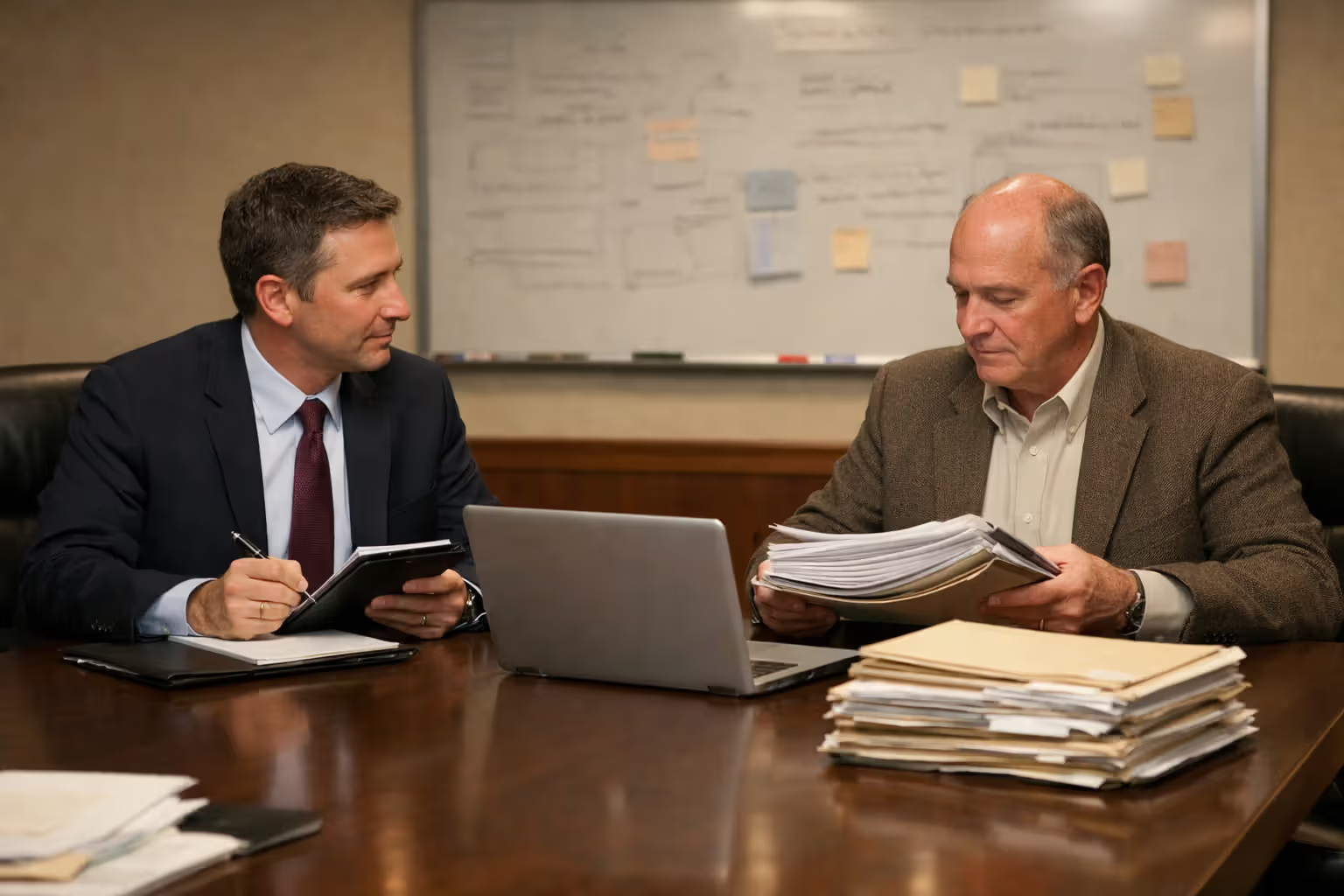
After hiring, the expert starts with record review—medical charts, accident reports, employment files, financial documents, physical evidence. Depending on complexity, this takes weeks or months. Expect requests for additional materials as questions arise during analysis.
Written reports come next, detailing opinions, supporting basis, and reviewed materials. Federal rules (and many state rules) require detailed disclosure of qualifications, compensation, and the specific facts supporting each conclusion. These reports become blueprints for both your direct examination and the defense's cross-examination strategy.
Author: Michael Thornton;
Source: mannawong.com
Depositions follow report production. Opposing counsel questions the expert under oath, probing for weaknesses, bias, and inconsistencies. Good experts prepare thoroughly—re-reviewing everything before the deposition and meeting with retaining counsel to discuss probable questions and defensive strategies.
During deposition, balance matters. Absolute certainty about every minor detail looks defensive and unrealistic. Acknowledging small uncertainties or limitations actually strengthens credibility on major points. An economist might concede their wage growth projection could vary by 0.5% annually, while maintaining confidence the deceased would have earned at least $3 million over their career.
Between deposition and trial, experts often refine opinions based on new evidence or opposing expert reports. They'll prepare demonstrative exhibits—diagrams, animations, models—to help juries grasp complex concepts. A pathologist might enlarge microscope images showing tissue damage. An accident reconstructionist might create animated simulations of the collision sequence.
Direct examination at trial lets the expert present opinions narratively. Retaining counsel asks open questions letting the expert explain background, methodology, and conclusions. Effective experts make eye contact with jurors, avoid jargon when possible, and use analogies connecting abstract concepts to everyday experience. Explaining crush dynamics by comparing it to dropping a soda can works better than citing momentum equations.
Cross-examination tests everything—knowledge, credibility, opinions. Defense counsel highlights inconsistencies between trial testimony and deposition answers, prior testimony in different cases, or published literature. They'll suggest bias based on compensation or history of testifying only for plaintiffs. They'll construct hypothetical scenarios designed to show opinions rest on incomplete information or flawed assumptions.
Strong experts stay calm and professional during aggressive cross-examination. They don't argue with opposing counsel or get defensive. They answer the specific question asked without volunteering extra information. When confronted with legitimate criticisms, they acknowledge them while explaining why core conclusions remain sound.
Redirect examination lets retaining counsel rehabilitate the expert after damaging cross. The attorney might ask the expert to provide context for statements taken out of context, or clarify technical points opposing counsel deliberately confused.
Frequently Asked Questions About Expert Witnesses in Wrongful Death Cases
Wrongful death litigation demands more than legal arguments—it requires translating specialized knowledge into persuasive proof that establishes liability and quantifies loss. Expert witnesses bridge technical facts and legal conclusions, giving juries the foundation they need to reach informed verdicts. Success often hinges on expert selection, preparation, and presentation quality.
Families pursuing these claims should understand that expert costs represent investment in case success, not wasteful spending. Qualified experts transform raw evidence into compelling narratives that honor the deceased while securing fair compensation for survivors. Attorneys who recognize expert testimony's strategic importance—and who invest necessary time and resources retaining and preparing the right specialists—give clients the best shot at justice.
The expert witness process from initial vetting through trial testimony requires months of preparation and coordination. But when a qualified pathologist explains precisely how negligence caused death, when an accident reconstructionist demonstrates recklessness through physics and engineering, and when an economist quantifies decades of lost support and companionship, juries gain tools they need to deliver verdicts reflecting both law and the full measure of loss.