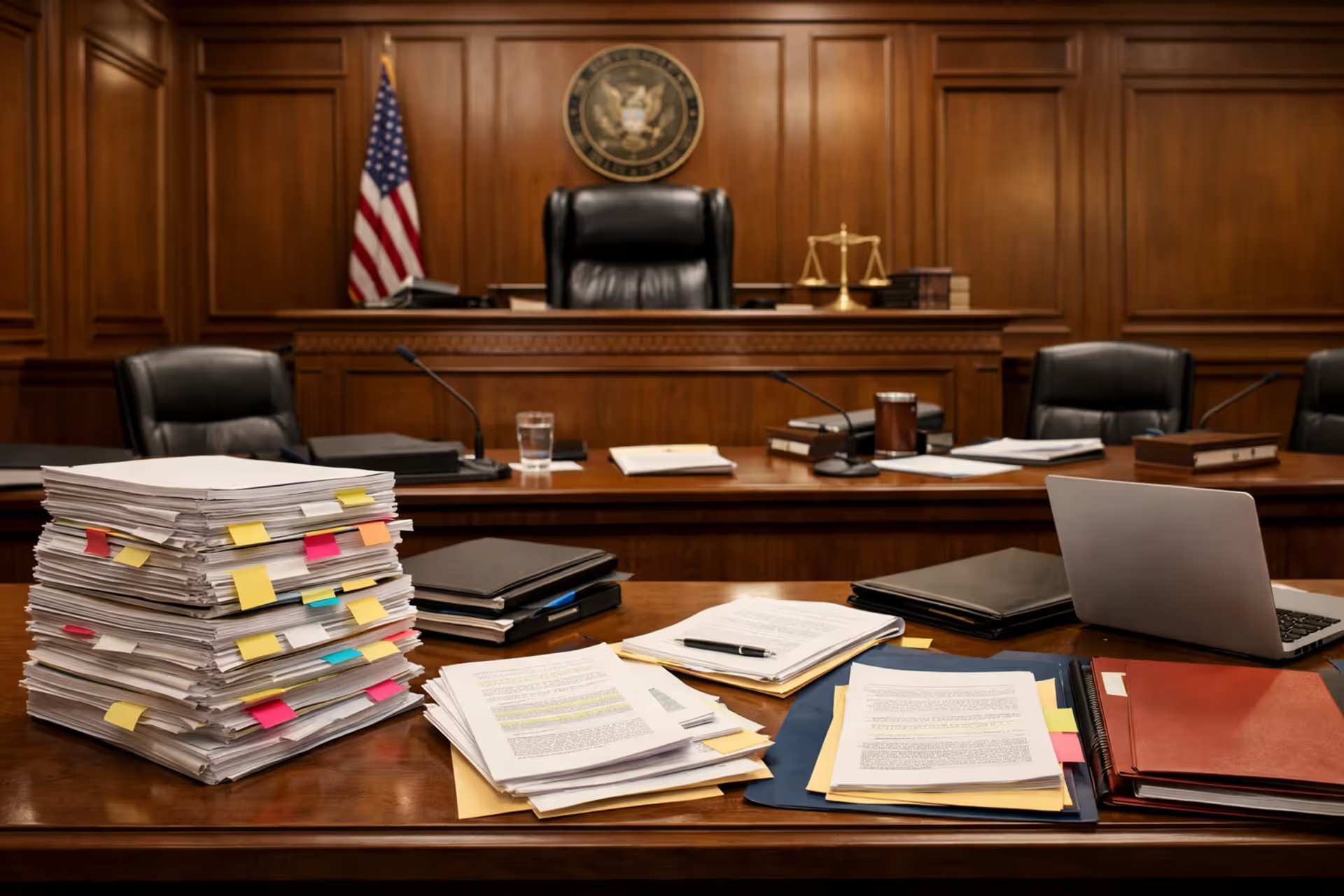
Courtroom setting with legal documents, folders, and laptop on attorney table, judge bench and American flag in background
What Is Discovery in a Lawsuit and How It Works

Content
When parties file a lawsuit, the courtroom drama you see on television represents only a fraction of what actually happens. Most civil litigation unfolds during a phase called discovery—a structured period where opposing sides exchange information, documents, and testimony before trial. This phase determines which evidence will surface, shapes settlement negotiations, and often decides whether a case even reaches a jury.
Discovery exists because the American legal system rejects trial by ambush. Both sides deserve to know what evidence exists, who witnessed relevant events, and what the opposing party claims happened. Without this evidence exchange lawsuit mechanism, trials would devolve into surprise attacks rather than fair proceedings based on facts.
The legal discovery process follows specific rules, timelines, and methods. Understanding how these work protects your interests whether you're a plaintiff seeking damages or a defendant facing claims.
What Happens During Discovery in a Lawsuit
Discovery begins after the complaint and answer are filed—typically within 30 to 90 days of the defendant's response, depending on jurisdiction and case complexity. A scheduling conference often sets deadlines: when discovery must conclude, when expert witnesses must be disclosed, and when dispositive motions are due.
During this phase, attorneys use formal procedures to gather facts. They send written questions, request documents, take sworn testimony, and ask parties to admit or deny specific statements. Judges rarely supervise routine discovery unless disputes arise.
The scope is broad. Federal Rule of Civil Procedure 26(b)(1) allows discovery of "any nonprivileged matter that is relevant to any party's claim or defense and proportional to the needs of the case." This means you can request information that wouldn't be admissible at trial if it might lead to admissible evidence.
For example, in a slip-and-fall case at a grocery store, the plaintiff can request maintenance logs even if those logs contain hearsay. Why? Because those logs might reveal when floors were last inspected, leading to testimony from the maintenance supervisor about the store's cleaning schedule.
Discovery concludes when the court's deadline arrives or when parties stipulate they've gathered sufficient information. Most cases settle during or shortly after discovery once both sides understand the evidence's strength.

Author: Daniel Whitford;
Source: mannawong.com
Five Types of Discovery Methods Courts Allow
Courts authorize five distinct methods for gathering information. Each serves different strategic purposes and comes with specific procedural requirements.
Written Interrogatories and How to Respond
Interrogatories are written questions one party sends to another, requiring written answers under oath. They work well for gathering basic facts: names of witnesses, chronologies of events, damage calculations, or identification of documents.
Federal rules limit parties to 25 interrogatories including subparts, though many judges impose lower limits. State courts vary—some allow 35, others restrict parties to 15 or fewer.
Responses are due within 30 days. Each answer must be complete and based on reasonably available information. "I don't know" isn't acceptable if records exist that would reveal the answer. Parties must investigate their files, ask employees, and review documents before claiming ignorance.
Attorneys often use interrogatories in wrongful death cases to establish the decedent's earning capacity, employment history, and family relationships. A typical interrogatory might ask: "State the decedent's gross income for each of the five years preceding death, identifying all sources of income and attaching supporting tax returns."
Requests for Production of Documents
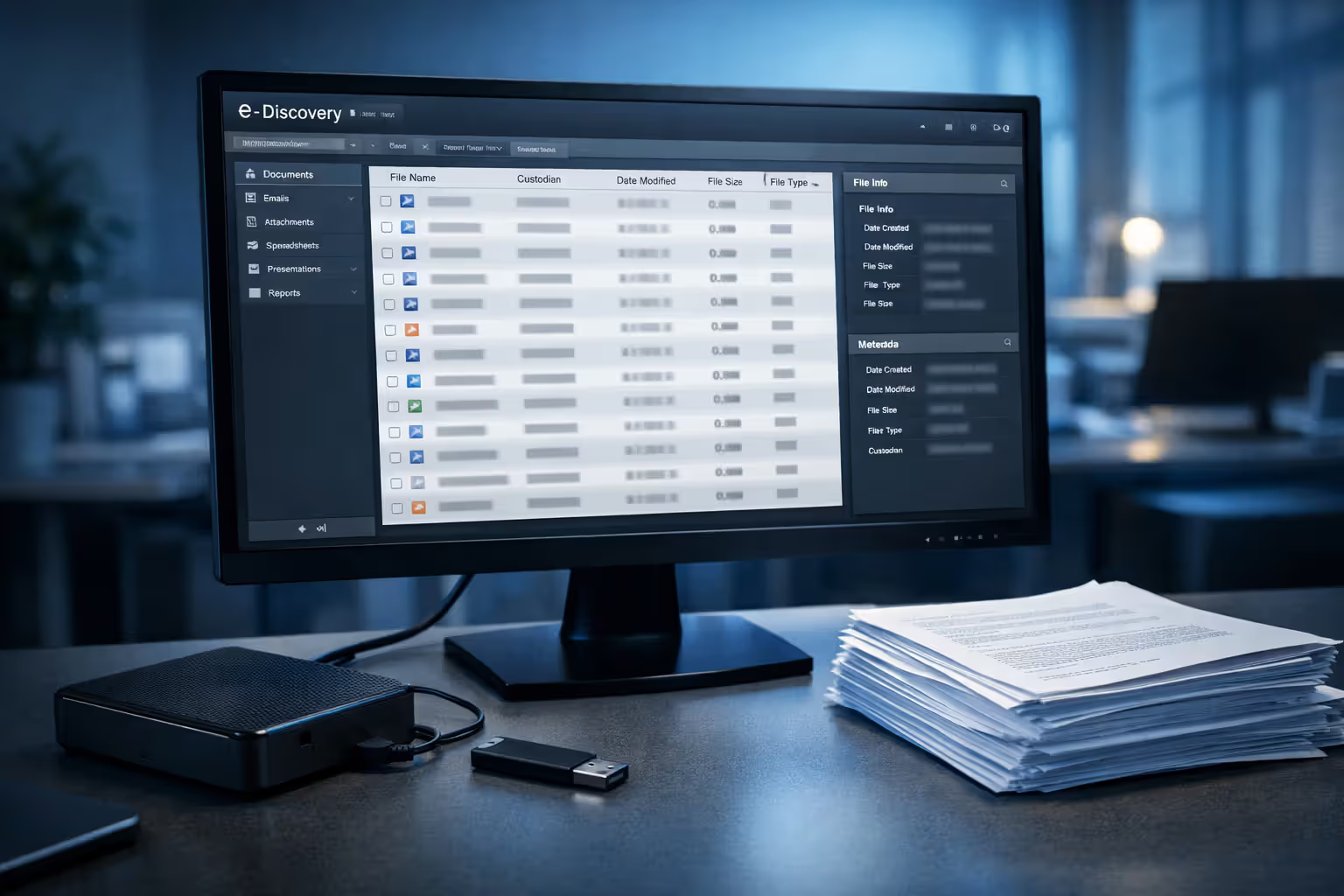
Document requests demand that parties produce papers, electronic files, photographs, videos, or other tangible items for inspection and copying. Modern litigation involves massive volumes of electronically stored information (ESI)—emails, text messages, database records, and metadata.
Requests must describe categories of documents with reasonable particularity. "Produce all documents related to the accident" is too vague. Better: "Produce all photographs taken at the accident scene, all incident reports completed by store employees, and all maintenance logs for the six months preceding the incident."
Parties have 30 days to respond under federal rules. They must either produce documents or object, citing specific grounds like privilege, undue burden, or irrelevance. Document production law requires parties to produce items as they're kept in the ordinary course of business or organized to correspond with request categories.
Depositions Under Oath
A deposition is live questioning of a witness under oath, with a court reporter transcribing every word. Attorneys for all parties attend and ask questions. Though conducted outside court, deposition testimony carries the same legal weight as trial testimony.
Depositions reveal not just what witnesses know but how they'll perform under pressure. Do they contradict prior statements? Do they seem credible? Will they help or hurt at trial?
Federal rules limit each side to 10 depositions, with each deposition lasting no more than seven hours. Attorneys must provide reasonable notice—usually 10 to 14 days—allowing witnesses time to prepare.
Depositions cost significantly more than written discovery. Court reporters charge $3 to $7 per page for transcripts, and a day-long deposition can generate 200 to 400 pages. Rush transcripts cost even more.
Discovery is the engine of justice in civil litigation. It is the process by which parties move from accusation to evidence, from suspicion to proof. Without robust discovery, the courtroom becomes a theater of speculation rather than a forum for truth. Every document produced, every deposition taken, brings us closer to a fair resolution grounded in facts, not rhetoric
— Hon. William G. Young
Requests for Admission
These requests ask the opposing party to admit or deny specific facts or the authenticity of documents. Admitted facts require no further proof at trial, streamlining proceedings.
A request might state: "Admit that on March 15, 2023, you operated a motor vehicle that struck the plaintiff's vehicle." If the defendant admits this, the plaintiff need not call witnesses or introduce evidence proving the collision occurred.
Parties have 30 days to respond. Failure to respond means the matter is automatically admitted—a trap for unwary litigants. Even if you deny a request, you must do so in good faith. Denying obvious facts can result in sanctions.
Physical and Mental Examinations
When a party's physical or mental condition is in controversy, the opposing party can request an independent medical examination (IME). This applies primarily to personal injury, wrongful death, and disability cases.
Unlike other discovery methods, examinations require court approval unless parties stipulate. The examining physician must be qualified, and the examination must be reasonable in scope. A defendant can't demand that a plaintiff with a knee injury undergo psychiatric evaluation unless mental health is genuinely at issue.
Examination reports must be exchanged. If the defendant obtains an IME, they must provide a copy to the plaintiff. In return, the plaintiff must provide reports from their own examining physicians.
| Method | Response Time | Typical Cost | Best For | Limitations |
| Interrogatories | 30 days | $500–$2,000 (attorney time) | Basic facts, witness identification, damage calculations | Limited number; can't assess credibility |
| Document Production | 30 days | $2,000–$20,000+ (review, copying, ESI processing) | Obtaining records, emails, contracts, photos | Burden of review; privilege disputes common |
| Depositions | 10–14 days notice | $3,000–$10,000 per deposition | Assessing witness credibility; pinning down testimony | Expensive; limited number allowed |
| Requests for Admission | 30 days | $300–$1,000 (attorney time) | Narrowing issues; authenticating documents | Automatic admission if ignored |
| Physical/Mental Exams | By court order or stipulation | $1,500–$5,000 per exam | Verifying injury claims; assessing damages | Requires court approval; limited to parties |
Federal vs. State Discovery Rules: Key Differences That Matter
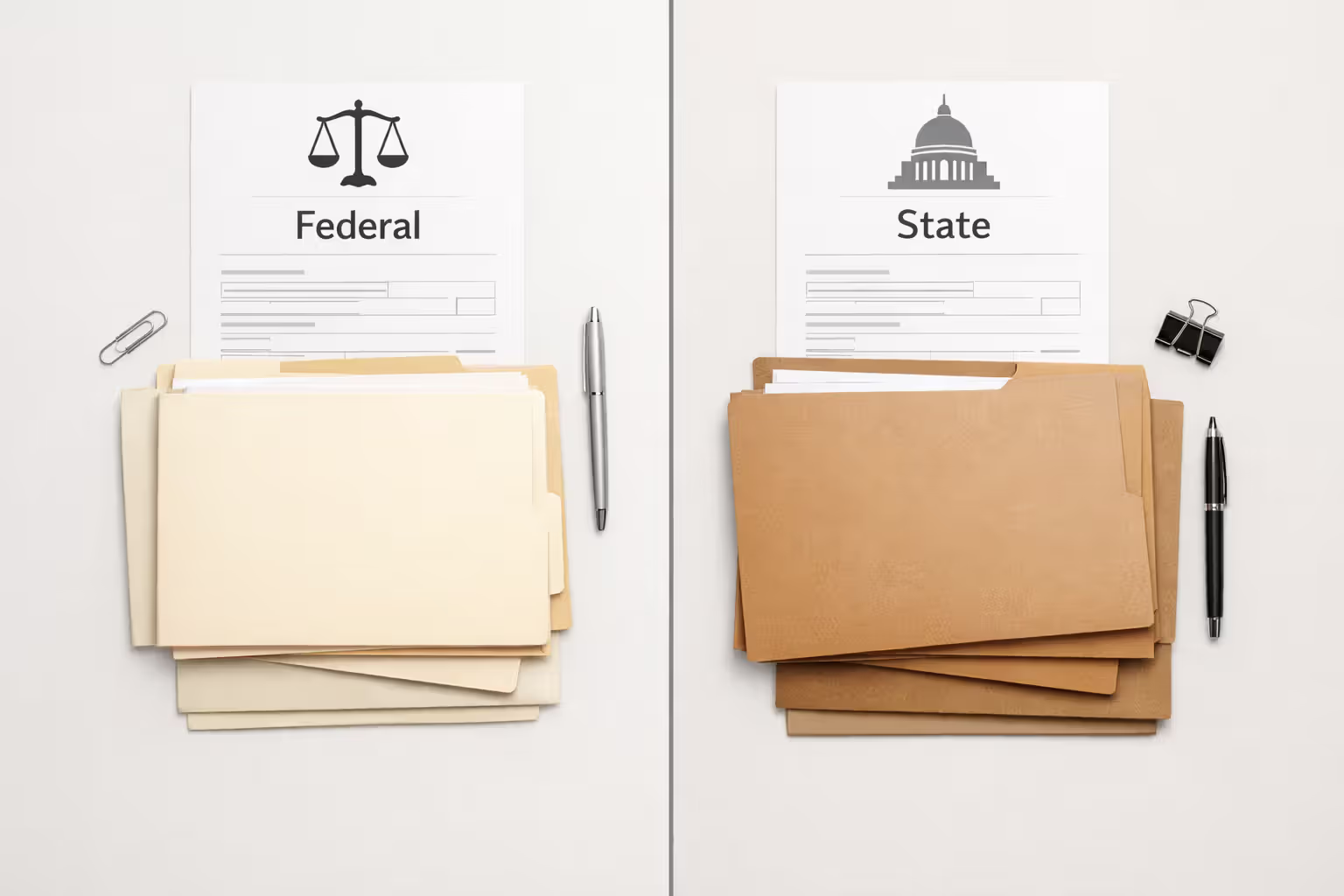
The Federal Rules of Civil Procedure govern discovery in federal courts, but state courts write their own rules. While most states model their rules on the federal system, meaningful differences exist.
Federal Rule 26 requires automatic disclosures early in litigation. Without any request, parties must exchange information about witnesses, documents, damage calculations, and insurance agreements. Many states reject automatic disclosure, requiring formal discovery requests for everything.
Numerical limits vary significantly. Federal courts allow 25 interrogatories per party. California permits 35. Texas limits parties to 25 but counts each subpart separately—turning one question with five parts into five interrogatories. New York's limits depend on case type.
Proportionality plays an increasing role in federal litigation discovery rules. The 2015 amendments to Rule 26 emphasized that discovery must be proportional to the case's needs, considering factors like the amount in controversy, parties' resources, and the importance of issues at stake. Some state courts have adopted similar proportionality standards; others haven't.
E-discovery rules differ substantially. Federal rules specifically address ESI, including provisions for inaccessible data and procedures when information is lost. Some states have comprehensive e-discovery rules; others rely on general discovery provisions written before email existed.
Deposition length limits also vary. Federal rules cap depositions at seven hours. California allows depositions to continue until complete, though courts can impose limits. Florida restricts each side to 10 hours total for all depositions in smaller cases.
Author: Daniel Whitford;
Source: mannawong.com
Document Production Requirements and Common Disputes
Modern litigation drowns in documents. A straightforward car accident case might involve thousands of text messages, emails, and electronic records. Complex commercial litigation can generate millions of documents.
Parties must produce documents in their "possession, custody, or control." This extends beyond physical possession. If you have the legal right to obtain documents—even if they're held by a third party like your accountant or cloud storage provider—you must produce them.
ESI creates unique challenges. Metadata—hidden information about when files were created, modified, or accessed—can be crucial evidence. Parties must preserve ESI once litigation is reasonably anticipated. Deleting emails or allowing automatic deletion systems to run after a dispute arises can result in severe sanctions.
Author: Daniel Whitford;
Source: mannawong.com
Privilege objections are the most common discovery dispute. Attorney-client communications and attorney work product are protected from disclosure. But privilege is narrow. Copying your lawyer on an email to your business partner doesn't make the entire email privileged. The communication must be primarily for the purpose of seeking or giving legal advice.
Proportionality has become a battleground. Defendants in modest cases increasingly argue that burdensome discovery requests are disproportional to what's at stake. A plaintiff seeking $50,000 in damages can't demand that the defendant spend $200,000 reviewing emails. Courts must balance the need for information against the burden of production.
Producing parties must organize documents logically and label them with unique identifiers (Bates numbers). Dumping 10,000 unsorted pages on the requesting party violates discovery rules. Documents should be organized by category or as kept in the ordinary course of business.
The discovery process is the great equalizer in litigation. It allows parties with fewer resources to obtain evidence held by powerful opponents, ensuring that cases are decided on facts and law rather than information asymmetry. However, the explosion of electronically stored information has transformed discovery from a truth-seeking tool into a potential weapon of attrition. Courts must vigilantly enforce proportionality to prevent discovery from becoming more expensive than the underlying dispute justifies.
— Judge Shira Scheindlin
Discovery in Wrongful Death and Personal Injury Cases
Wrongful death and personal injury litigation involves specific discovery patterns. Plaintiffs must prove damages—medical expenses, lost earnings, pain and suffering, loss of companionship—requiring extensive documentation.
Interrogatories in wrongful death cases typically ask about the decedent's education, employment history, earnings, benefits, and family relationships. Sample interrogatory: "For the five years preceding death, state each employer's name, position held, dates of employment, and annual compensation including all benefits and bonuses."
Medical records requests are exhaustive. Defendants seek complete medical histories to identify pre-existing conditions that might have contributed to injuries or death. Plaintiffs often object, arguing that records from decades ago aren't relevant to a recent accident. Courts usually side with defendants, reasoning that complete medical histories are necessary to assess causation and damages.
Expert witness disclosure follows strict timelines. Federal Rule 26 requires parties to disclose expert identities, their qualifications, opinions, bases for opinions, and compensation. Expert reports must be comprehensive—not mere summaries. The report must contain "a complete statement of all opinions the witness will express and the basis and reasons for them."
In wrongful death cases, both sides typically retain economic experts who calculate lost future earnings. These experts review employment records, tax returns, industry wage data, and economic projections. Their reports often differ by hundreds of thousands of dollars, reflecting different assumptions about career trajectory, retirement age, and discount rates.
Life care plans are common in catastrophic injury cases. Medical experts project future care needs—surgeries, therapy, medications, adaptive equipment—and their costs over the plaintiff's lifetime. These plans can exceed millions of dollars in severe injury cases.

Author: Daniel Whitford;
Source: mannawong.com
Common Discovery Mistakes That Weaken Your Case
Failure to preserve evidence is the most damaging mistake. Once litigation is reasonably foreseeable, parties must suspend document destruction policies and preserve relevant information. A company that continues its routine email deletion after receiving a demand letter faces sanctions ranging from adverse inference instructions to case dismissal.
The obligation to preserve and produce evidence is not merely a procedural formality — it is a moral imperative of the adversarial system. Parties who obstruct discovery do not simply violate rules; they undermine the very foundation upon which courts dispense justice. Sanctions exist because the system cannot tolerate those who hide the truth
— Hon. Lee H. Rosenthal
Incomplete responses undermine credibility. Answering "I don't recall" to every interrogatory when records clearly exist signals bad faith. Courts can compel better responses, award attorney fees, or draw negative inferences at trial.
Missing deadlines creates multiple problems. Automatic admissions from ignored requests for admission can devastate a case. Late responses waive objections, forcing production of information you could have legitimately withheld.
Over-objecting is counterproductive. Attorneys who object to every discovery request as "overly broad, unduly burdensome, harassing, and not reasonably calculated to lead to admissible evidence" lose credibility with judges. Specific, targeted objections carry more weight.
Failing to meet and confer before filing motions to compel angers judges. Courts expect attorneys to resolve discovery disputes cooperatively. Filing motions without genuine attempts to compromise wastes judicial resources and often results in sanctions against the filing party.
Inadequate privilege logs create problems. When withholding documents based on privilege, parties must provide logs describing each document, its author, recipients, date, and the privilege claimed. Generic descriptions like "email between attorney and client regarding litigation" don't suffice. Courts may find privilege waived if logs lack sufficient detail.
Poor deposition preparation shows. Witnesses who contradict their prior written discovery responses or seem unfamiliar with key documents damage their case. Attorneys should review all discovery responses, relevant documents, and anticipated questions with witnesses before depositions.
FAQ: Discovery Process Questions Answered
The legal discovery process shapes civil litigation outcomes more than any courtroom argument. Evidence gathered during discovery determines settlement values, summary judgment motions, and trial strategies. Understanding the five discovery methods—interrogatories, document requests, depositions, requests for admission, and examinations—allows parties to gather information efficiently while managing costs.
Federal and state litigation discovery rules differ in meaningful ways, from numerical limits on interrogatories to proportionality standards. These differences affect strategy, particularly in choosing between federal and state court when jurisdiction permits either.
Document production law has evolved dramatically with electronic information. Parties must preserve ESI, produce metadata when relevant, and balance disclosure obligations against privilege protections. In wrongful death and personal injury cases, specific patterns emerge: extensive medical records requests, detailed interrogatories about damages, and expert witness battles over economic losses and future care needs.
Avoiding common mistakes—preservation failures, incomplete responses, missed deadlines, and over-objecting—protects your case from sanctions and credibility damage. The evidence exchange lawsuit phase demands attention to detail, strategic thinking, and procedural compliance.
Whether you're pursuing claims or defending against them, discovery determines what evidence reaches the jury and, more often, what leverage exists during settlement negotiations. Most cases settle once discovery reveals the strength of each side's evidence, making this phase the true crucible where cases are won or lost.