Four illuminated chain links in blue green orange and red colors in front of a blurred American courthouse building representing four elements of negligence
What Proves a Negligence Claim in Court Under US Law

Content
Want to win your negligence lawsuit? You'll need more than photographs of your injuries and a compelling story. American courts demand proof of four separate components, each supported by admissible evidence that meets strict legal standards. Think of these elements as links in a chain—break any single link, and your entire case falls apart, even if the defendant clearly acted irresponsibly.
What Courts Require: The Four Elements of a Negligence Claim
American negligence law operates on a four-part test: duty, breach, causation, and damages. You'll find these same four elements whether you're filing a slip-and-fall lawsuit, a car accident claim, or a medical malpractice case. The specific facts change, but the underlying structure stays constant.
Here's what makes these elements challenging: you must prove all four by a "preponderance of the evidence." That's legal terminology meaning you need to show each element is more likely true than false—think of it as 51% versus 49%. Sounds easy, right? It's not. Defendants know they only need to poke holes in one element to walk away victorious.
This four-element framework didn't appear overnight. It evolved through hundreds of years of court decisions, starting with English common law and adapting to American legal principles. State legislatures have tweaked certain aspects through statutes, but the core structure remains remarkably consistent nationwide.
Judges typically provide juries with standardized instructions explaining these elements in straightforward language. Jurors must then decide whether you've satisfied your burden on each component. Defense lawyers will attack whichever element seems weakest in your case—that's why understanding this framework before you file helps you spot vulnerabilities early.
Establishing Duty of Care: Who Owes What to Whom
Courts won't hold someone liable for negligence unless that person owed you a legal duty in the first place. This concept trips up many plaintiffs who assume that bad behavior automatically creates liability. It doesn't.
The "reasonable person" standard serves as the measuring stick for most duties. When you drive a car, you must exercise the same care that a reasonably prudent driver would use under similar conditions. Store owners must keep their premises as safe as reasonable merchants would. This hypothetical reasonable person isn't perfect—courts recognize that mistakes happen—but they exercise ordinary care to avoid foreseeable risks.
Special relationships trigger heightened duties. Bus companies must protect passengers with the utmost care, not just reasonable care. Landlords can't rent apartments with broken locks or exposed wiring. Employers must provide equipment that meets basic safety standards. These enhanced duties reflect the trust and dependency inherent in these relationships.
Sometimes no duty exists at all, which surprises people. You're generally not legally required to rescue a drowning stranger, though pulling them from the water creates a duty to act carefully during that rescue. Property owners usually don't owe trespassers anything beyond refraining from deliberately harming them. Most states don't hold social hosts liable when guests drive drunk, though bars and restaurants face dram shop liability for over-serving patrons.

Author: Michael Thornton;
Source: mannawong.com
Common Duty of Care Scenarios in Personal Injury Cases
Premises liability cases revolve around whether the property owner knew (or should have known) about dangerous conditions. A customer slips on water in a grocery store. Did an employee spill it seconds before, or had that puddle sat there for three hours? The timing dramatically affects whether the owner had constructive knowledge—meaning the condition existed long enough that a reasonable inspection program would have caught it.
Traffic accidents involve duties codified in vehicle codes and common-law safe driving principles. Texting while driving breaches your duty to other motorists. So does tailgating, speeding through school zones, or blowing through stop signs. These duties exist whether or not you technically violated a specific statute.
Medical malpractice gets complicated because the standard of care varies by specialty and sometimes by geography. A rural family doctor isn't held to the same expectations as a Manhattan neurosurgeon. You'll need expert testimony to establish what duty the doctor owed—a general practitioner can't perform the same procedures as a specialist, and courts account for these differences.
Product defect claims involve manufacturers' duties to design safe products, warn consumers about non-obvious dangers, and maintain quality control during manufacturing. These duties extend through the distribution chain, even reaching consumers who never had direct contracts with manufacturers.
The duty to exercise reasonable care is not a duty to insure against every conceivable risk. It is a duty to take precautions that a reasonable person would take in light of all the circumstances, balancing the probability and gravity of harm against the burden of adequate precautions
— Judge Learned Hand
Demonstrating Breach: How to Show Someone Failed Their Legal Obligation
Once you've established duty, you must show the defendant fell short of that standard. This is where your case becomes concrete. What did they actually do (or fail to do), and how did that conduct diverge from what a reasonable person would have done?
The most powerful evidence is direct proof—video footage, eyewitness accounts, or the defendant's own statements. Dashboard cameras that capture a driver drifting into your lane while looking down at their lap. Surveillance video showing a maintenance worker ignoring a spill. The defendant's deposition admission that they hadn't inspected their staircase handrail in five years despite knowing it was loose.
When direct evidence isn't available, circumstantial evidence fills the gap. Accident reconstruction experts analyze skid marks, vehicle crush patterns, and road conditions to determine pre-collision speeds and driver behavior. Metallurgical engineers examine failed components to determine whether manufacturing defects caused the failure. The absence of safety records can be as telling as records showing violations.
Expert witnesses become mandatory in professional negligence cases. You can't convince a jury that a surgeon committed malpractice based on common sense—you need another physician in the same specialty explaining how the defendant's treatment deviated from accepted protocols. Engineering cases need engineers. Accounting malpractice needs accountants. These experts must establish credentials showing they're qualified to critique the defendant's professional conduct.
Negligence per se offers a shortcut: when defendants violate safety statutes, courts may treat that violation as automatic breach. A building code requires carbon monoxide detectors in rental units. Your landlord didn't install them. That statutory violation establishes breach without needing expert testimony about reasonable landlord behavior. You still must prove the other three elements, but breach becomes much easier.
Res ipsa loquitur—"the thing speaks for itself"—handles situations where accidents don't occur absent negligence, the defendant controlled whatever caused harm, and you didn't contribute to the problem. Surgery patients don't normally wake up with sponges sewn inside them. Elevators don't typically plummet without negligent maintenance. These situations let juries infer breach without detailed proof of exactly what went wrong.

Author: Michael Thornton;
Source: mannawong.com
Proving Causation: Connecting the Defendant's Actions to Your Injury
Causation splits into two separate hurdles: actual cause and proximate cause. Both must be proven. Many strong cases collapse at this stage because plaintiffs assume causation is obvious when it's not.
Actual causation asks a factual question: did the defendant's breach physically cause your injury? The "but for" test provides the answer: but for the defendant's negligence, would you have been harmed? A distracted driver rear-ends your vehicle at a stoplight. Your neck hurt afterward. But for their distraction, that collision wouldn't have occurred. The causal link is straightforward.
Now imagine you have pre-existing degenerative disc disease. The collision aggravated it. Suddenly causation becomes murky—did the accident cause new damage, or just temporarily worsen an existing condition? You'll need medical experts comparing before-and-after imaging, reviewing symptoms, and distinguishing accident-related damage from pre-existing degeneration.
Multiple causes muddy the analysis. Suppose two factory owners each negligently release pollutants that combine in a river and kill your fish farm. Either pollutant alone would have caused the same damage. The "but for" test fails because you can't prove that but for either individual defendant's conduct, the harm wouldn't have occurred—the other defendant's pollution would have killed the fish anyway. Courts instead ask whether each defendant's conduct was a "substantial factor" in producing harm.
Proximate cause asks a legal question: even if the defendant actually caused your injury, should the law hold them responsible for this particular harm? Foreseeability drives this analysis. Defendants typically answer only for reasonably foreseeable consequences of their negligence.
Actual Cause vs. Proximate Cause: Why Both Matter
Actual cause establishes the physical chain of events linking breach to injury. Medical experts testify that the forces involved in your collision could and did cause your herniated disc. Biomechanical engineers explain how the specific impact produced your particular injury pattern. Toxicologists establish that exposure levels were sufficient to cause your illness. This is scientific, factual testimony.
The proximate cause of an injury is that cause which, in natural and continuous sequence, unbroken by any efficient intervening cause, produces the injury, and without which the result would not have occurred. Foreseeability is the cornerstone of proximate cause analysis in American tort law
— Justice Roger Traynor
Proximate cause prevents liability from spiraling infinitely outward. Imagine a minor parking lot fender-bender. The other driver suffers whiplash, gets prescribed pain medication, becomes addicted, loses their job due to addiction, and commits suicide years later. Did the negligent driver actually cause that suicide? Possibly—the causal chain exists. But was suicide a foreseeable consequence of a minor collision? Courts say no, cutting off liability at some reasonable point in the chain of consequences.
Intervening causes sometimes break the causal chain. Your parked car gets hit. While it's at the body shop, a tornado destroys the shop and totals your vehicle. The tornado is a superseding intervening cause—an independent, unforeseeable event that produces harm the original defendant shouldn't answer for. They're liable for collision damage, not tornado damage.
Foreseeable intervening causes don't break causation, though. Medical malpractice during treatment of your accident injuries doesn't let the original defendant off the hook—negligent medical care while treating trauma is a foreseeable risk. Similarly, if your injuries lead to depression and suicide, many courts find that foreseeable enough to maintain liability, particularly when injuries are severe and permanently disabling.
The eggshull skull rule (sometimes called the thin skull rule) says defendants take plaintiffs as they find them. Your negligence causes what seems like a minor bump to someone's head, but they have a rare clotting disorder and suffer catastrophic bleeding. You're liable for the full extent of harm, even though the average person would have walked away with a small bruise. This applies to psychological vulnerabilities too—you're liable for severe PTSD even if most accident victims wouldn't develop it.
Documenting Damages: What Evidence Courts Accept as Proof of Harm
You must prove damages with reasonable certainty. Speculation doesn't count. "My back might need surgery someday" won't convince juries—you need orthopedic surgeons testifying that future surgery is reasonably probable based on objective findings, not mere possibility.
Economic damages include quantifiable financial losses: hospital bills, prescription costs, physical therapy invoices, lost paychecks, property repair estimates. These should be simple to prove, yet plaintiffs regularly lose money by failing to document everything. That $30 prescription you paid cash for? Without a receipt, you can't recover it. The week of work you missed? Without employer documentation, the jury may not believe you.
Medical records serve double duty—they prove both injury existence and treatment costs. Emergency department records capture initial injury assessment. Radiology reports show objective findings like fractures or disc herniations. Surgical reports detail procedures performed. Physical therapy notes document ongoing treatment and progress. Prescription records list medications. Bills show costs incurred.
Treatment gaps raise red flags. You claim severe, disabling pain but didn't see a doctor for six weeks after the accident? Defense attorneys will hammer you, suggesting injuries weren't actually serious. Sometimes legitimate reasons explain gaps—you lacked insurance, hoped symptoms would resolve, or couldn't get appointments. Document those reasons, but understand that gaps still damage credibility.
Lost income requires baseline earnings documentation (pay stubs, W-2s, tax returns), medical evidence supporting work restrictions (doctor's notes stating you couldn't work or could only work part-time), and math connecting the two. Self-employed plaintiffs face steeper challenges—profit-and-loss statements and tax returns become crucial, sometimes requiring forensic accountant testimony to explain income calculations.
Property damage needs repair estimates from licensed shops, replacement value assessments, or diminished value appraisals (for vehicles worth less after repairs despite proper work). Photographs taken immediately after damage occurs preserve evidence before repairs alter or eliminate it.

Author: Michael Thornton;
Source: mannawong.com
Future damages always require experts. Economists project lifetime lost earning capacity based on your age, education, work history, and injury-imposed limitations. Life care planners catalog future medical needs and costs for catastrophically injured plaintiffs—wheelchairs, home modifications, attendant care, medications, surgeries. Vocational rehabilitation experts assess whether you can retrain for different work and what that work would pay.
Non-economic damages—pain and suffering, emotional distress, loss of life's enjoyment—lack objective measurement tools. You can't present a pain bill. Attorneys use various approaches: multipliers (take medical expenses and multiply by 2-5 depending on severity), per diem calculations (assign a daily dollar value to pain, multiply by days affected), or simply ask juries to award "fair and reasonable" compensation. Your testimony about pain levels, activity restrictions, and emotional impact matters. Family testimony about personality changes, lost hobbies, and relationship strain adds weight.
The mitigation doctrine requires plaintiffs to take reasonable steps minimizing damages. Refuse recommended surgery that would significantly improve your condition? Expect reduced damages. Fail to look for work within your post-injury restrictions? Lost wage claims get cut. Defendants must prove failure to mitigate, but don't give them ammunition.
Evidence Strategy: Building Your Negligence Case for Maximum Impact
Civil cases require proof by "preponderance of the evidence"—50.01% probability that each element exists. This falls well below criminal law's "beyond reasonable doubt" standard, but don't mistake "preponderance" for "easy." Plenty of plaintiffs with legitimate injuries lose because they couldn't assemble sufficient proof.
Witness testimony provides the foundation. You'll testify about how the accident happened and how injuries affected your life. Eyewitnesses describe what they observed. Family members explain how your injuries changed you. Lay witnesses generally can't offer expert opinions, but they can testify about facts they personally perceived and, in narrow circumstances, give opinions based on those perceptions.
Expert witnesses bridge the knowledge gap between specialized fields and average jurors. Accident reconstructionists analyze physical evidence and explain collision dynamics. Physicians explain injury mechanisms, treatment approaches, and prognoses. Engineers assess product defects or building code violations. Experts must establish qualifications through education, training, and experience. Their opinions must rest on reliable methodologies applied properly to your case facts, not speculation or junk science.
Physical evidence includes photographs, video, damaged items, and diagnostic imaging. Photographs taken at accident scenes before cleanup preserve conditions. Surveillance footage might capture the incident. Damaged vehicles, defective products, or torn clothing serve as tangible proof. Medical imaging (X-rays, MRIs, CT scans) shows objective injury evidence.
Documentary evidence encompasses contracts, maintenance records, safety inspection reports, emails, text messages, and business records. These often qualify under hearsay exceptions as records kept in the regular course of business, making them admissible despite being created outside court.
Discovery forces evidence disclosure before trial. Written interrogatories require sworn answers to questions. Document requests compel production of relevant papers and electronic records. Depositions involve sworn testimony transcribed by court reporters—these lock in witness statements, preventing trial testimony surprises. Use discovery aggressively to uncover facts, pin down opponent testimony, and identify case weaknesses.
Demonstrative evidence helps juries grasp complex information. Diagrams illustrate accident scenes. Timeline charts organize events chronologically. Medical illustrations show anatomy and injury locations. Day-in-the-life videos demonstrate how injuries affect daily activities. Animations recreate accidents. These tools don't independently prove facts but make other evidence more understandable.
Chain of custody matters when physical evidence is critical. You must show the item presented at trial is the same item collected from the scene, stored properly, and not altered. Product defect cases particularly require careful chain of custody—if you can't prove the brake assembly you're showing the jury actually came from the defendant's car, the evidence gets excluded.
Common Mistakes That Weaken Negligence Claims in Court
Waiting too long to see a doctor torpedoes cases regularly. You claim excruciating pain and permanent disability, yet your first doctor visit occurred three weeks post-accident? Juries assume serious injuries drive people to seek immediate treatment. Insurance companies exploit treatment delays, arguing injuries must be minor or unrelated if you didn't urgently seek care. Sometimes legitimate reasons explain delays—no insurance, inability to leave work, hoping symptoms would resolve. These explanations help, but treatment gaps still damage cases significantly.
Contradictory statements destroy credibility faster than anything. Your deposition says the accident happened on Tuesday; your complaint says Wednesday. You told doctors you never had back problems before; your medical records show three prior back injury visits. You testified you can't lift your child; your Facebook shows you lifting moving boxes. Defense attorneys hunt for these inconsistencies in depositions, medical records, social media, and recorded statements. Even minor contradictions about peripheral details make juries doubt your entire story.
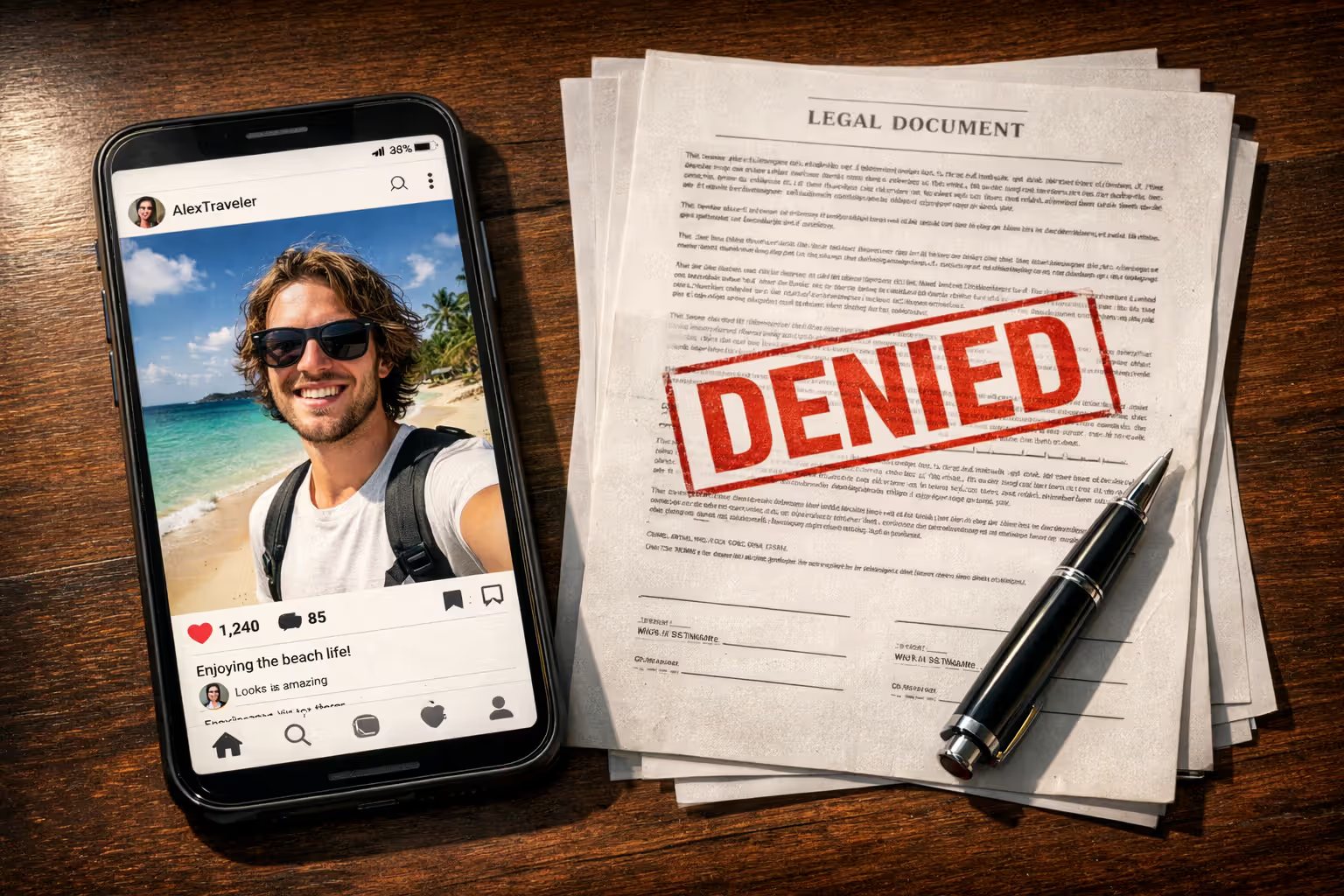
Social media posts have become gold mines for defense attorneys. You post vacation beach photos while claiming you can't leave home? Case damaged. You check in at a gym while claiming total disability? Settlement value plummets. You complain on Facebook that your "ambulance-chasing lawyer" isn't getting you enough money? Goodbye credibility. Privacy settings provide zero protection—social media content is discoverable. Assume everything you post online will appear on a screen in front of the jury.
Statute of limitations deadlines kill otherwise viable cases daily. Every state imposes time limits for filing lawsuits, typically one to six years depending on claim type and jurisdiction. Personal injury claims commonly have two or three-year limits. Medical malpractice often has shorter windows. Once the deadline passes, you're permanently barred from filing regardless of how strong your case might be. Discovery rules sometimes extend deadlines when you couldn't reasonably have known about injuries initially, but that's an exception, not a rule. Don't count on it.
Author: Michael Thornton;
Source: mannawong.com
Weak causation proof leaves juries guessing, and juries don't guess in plaintiffs' favor. Showing someone acted negligently doesn't win cases—you must connect their negligence to your specific injuries through credible evidence. Pre-existing conditions complicate this enormously. You had arthritis before the accident; now it's worse. Is that worsening accident-related or natural disease progression? Generic medical testimony that the accident "could possibly" have aggravated your condition won't cut it. You need specific testimony distinguishing accident-caused damage from pre-existing problems.
Comparative negligence reduces recoveries in most states (and eliminates them entirely in a few). If the jury finds you partially at fault, your damages get reduced by your fault percentage. Pure comparative negligence states let you recover even at 99% fault (you'd get 1% of damages). Modified comparative negligence states bar recovery if you're 50% or 51% at fault, depending on the specific jurisdiction. Alabama, Maryland, North Carolina, Virginia, and Washington D.C. still follow contributory negligence—any plaintiff fault whatsoever, even 1%, eliminates recovery completely. Failing to anticipate and counter comparative negligence arguments costs plaintiffs millions annually.
Sloppy damages documentation leaves money unclaimed. Every medical bill matters. Every prescription receipt counts. Mileage logs for medical appointments add up. Keep injury journals documenting pain levels and activity restrictions. Photograph visible injuries as they evolve. Get written employer statements confirming missed work. The more documentation you compile, the harder defendants fight questioning your damages claims.
Unrealistic expectations about case value cause poor settlement decisions. A soft tissue strain with complete recovery after six weeks doesn't merit a million-dollar settlement. It merits medical bills plus modest pain and suffering compensation—maybe $10,000-30,000 depending on jurisdiction and specific facts. Catastrophic injuries with permanent disability, extensive future care needs, and significant lost earnings justify six or seven-figure verdicts. Understanding realistic value ranges for your specific injury type helps you evaluate settlement offers rationally rather than emotionally.
Comparison Table: The Four Elements of Negligence – What You Must Prove
| Element | Legal Definition | Plaintiff's Burden | Common Evidence Types | Typical Challenges |
| Duty | A legal obligation requiring defendant to act (or refrain from acting) with reasonable care toward plaintiff | Establish that a relationship, circumstance, or legal rule created a duty running from defendant to plaintiff | Applicable statutes and regulations; prior case law establishing similar duties; expert testimony about industry or professional standards; proof of special relationships (landlord-tenant, doctor-patient, etc.) | Defendant argues no duty existed under these circumstances; parties dispute the scope of any duty owed; public policy considerations cut against finding duty |
| Breach | Defendant's conduct fell short of the required standard of care | Show the defendant's actions or inactions diverged from what a reasonable person would have done under identical circumstances | Eyewitness accounts; photographic or video documentation; defendant's own statements or admissions; expert testimony about proper conduct; statutory or regulatory violations | Defendant claims their conduct met reasonable standards given the circumstances; competing expert opinions about proper conduct; incomplete evidence of what actually occurred |
| Causation | Defendant's breach directly caused plaintiff's injuries, both factually (actual cause) and legally (proximate cause) | Demonstrate the injury wouldn't have occurred "but for" the breach, and the harm was a foreseeable consequence of defendant's negligence | Medical causation experts linking breach to specific injuries; accident reconstruction showing how breach led to incident; temporal connections between breach and injury; elimination of alternative causes | Pre-existing medical conditions complicate causation; multiple potential causes exist; intervening events occurred between breach and injury; scope-of-foreseeability disputes about whether particular harm should be defendant's responsibility |
| Damages | Plaintiff suffered actual, quantifiable harm or loss | Prove losses with reasonable certainty using documentation and testimony | Medical bills, records, and reports; lost wage documentation from employers; property damage repair estimates and invoices; expert projections of future losses; plaintiff and family testimony about pain, suffering, and life impact | Gaps in medical treatment suggest less serious injuries; pre-existing conditions make isolating accident-caused harm difficult; disputes over whether treatment was necessary or reasonable; challenges to future damages as speculative; claims lack supporting documentation |
Frequently Asked Questions
Winning negligence cases requires methodical preparation, strategic evidence gathering, and thorough understanding of what courts actually require. The four elements—duty, breach, causation, and damages—provide structure, but success demands more than mechanically checking boxes. You're telling a story backed by evidence that survives cross-examination, expert scrutiny, and the jury's common sense.
Start documenting immediately after injuries occur. Seek medical treatment promptly and follow prescribed care plans without gaps. Preserve physical evidence through photographs and proper storage. Collect witness contact information while memories are fresh. Avoid posting anything about your case or activities on social media. Consult attorneys before providing recorded statements to insurance adjusters—those statements will haunt you at trial.
Understanding courtroom requirements helps you realistically evaluate case strengths and weaknesses. Not every injury results from actionable negligence. Not every careless act creates legal liability. The causation element filters out claims where defendant carelessness didn't actually produce your harm. The damages requirement ensures courts compensate real losses rather than speculative ones.
Remember that you bear the entire proof burden. Defendants need only create reasonable doubt about one element to defeat your claim entirely. This reality makes thorough preparation essential rather than optional. Identify potential weaknesses early and develop evidence addressing them. Anticipate defense arguments and prepare counter-evidence. Work with qualified experts who can withstand withering cross-examination.
State-specific rules matter enormously. Procedural requirements, statute of limitations periods, and comparative fault laws vary significantly. What succeeds in California may fail in Virginia due to different contributory negligence rules. The framework outlined here applies nationwide, but details determine outcomes. Consult local counsel familiar with your jurisdiction's specific requirements and precedents.
Negligence law balances competing interests: compensating injured victims while avoiding crushing liability for honest mistakes. The reasonable person standard recognizes that perfection is impossible, holding defendants accountable for failing to exercise ordinary care rather than demanding errorless conduct. Understanding this balance helps set realistic expectations about case value and success likelihood. Strong cases with clear liability, serious injuries, adequate insurance coverage, and thorough documentation settle favorably. Weak cases with disputed liability, minor injuries, significant comparative fault, or documentation gaps may not justify litigation expenses and risks.