Lawyer desk with legal documents, gavel, stethoscope, and glasses representing wrongful death case preparation
How To Prove Wrongful Death In A Civil Lawsuit

Content
Losing a family member is devastating. Losing them because someone else screwed up? That creates a different kind of pain—one mixed with anger, confusion, and a desperate need for answers. You suspect negligence killed your loved one, but suspicion doesn't win court cases. Evidence does.
Here's what nobody tells you upfront: building a wrongful death case means transforming your grief into documentation. You'll need medical files, witness accounts, expert analysis, and financial records—all assembled within tight deadlines that don't pause for mourning. Skip one critical document, miss one filing deadline, or fail to prove one legal element, and your case collapses regardless of how obvious the negligence seems to you.
The legal system places the entire burden on your shoulders. You must show the death could have been prevented and pinpoint exactly whose actions (or inactions) caused it. Courts won't assume negligence occurred just because the outcome was tragic.
What Qualifies as Wrongful Death Under US Law
A wrongful death claim exists when someone's negligence, recklessness, or intentional actions cause another person to die. Every state recognizes this type of lawsuit, though the specific rules differ significantly depending on where you file.
The core principle is straightforward: if careless or malicious behavior kills someone, the responsible party owes compensation to survivors. But the legal technicalities get complicated fast.
Who gets to file? You can't just be upset about the death—you need legal standing. Each state creates its own list of eligible plaintiffs. Spouses almost always qualify. So do children and the parents of unmarried adult children. After that, it varies. California and Texas allow domestic partners in some situations. Florida extends rights to anyone who depended financially on the deceased. A few states let siblings or more distant relatives file if no closer family exists.
Estate representatives can also bring claims on behalf of qualified beneficiaries, which matters when family members disagree about pursuing legal action or when the deceased person's children are minors.
The legal burden of proof death cases demand isn't what you'd see in criminal court. Prosecutors must prove criminal guilt "beyond a reasonable doubt"—a high bar requiring roughly 95% certainty. Your wrongful death claim only needs to meet "preponderance of the evidence," meaning you must show it's more likely than not (just over 50%) that the defendant caused the death. This lower standard means evidence that couldn't convict someone criminally might still win your civil case.
You'll see wrongful death claims arise from car crashes caused by drunk or distracted drivers, medical mistakes during surgery or diagnosis, construction site accidents where companies ignored safety rules, defective products that malfunctioned fatally, nursing home neglect that led to preventable infections or injuries, and premises liability incidents where dangerous property conditions caused fatal accidents. The specific circumstances vary wildly, but the legal framework remains consistent across all scenarios.
The Four Elements You Must Prove in a Wrongful Death Case
Courts won't just take your word that negligence killed your family member. You must establish four distinct legal elements. Fail on even one, and your entire case gets dismissed—regardless of how compelling your other evidence might be.
Duty of Care
First, you need to show the defendant owed your deceased family member a legal duty of care. This obligation changes based on the relationship and context.
A surgeon performing an operation? Clear duty to that patient. A motorist behind the wheel? They owe everyone else on the road a duty to drive safely. Someone who owns a grocery store owes shoppers a duty to keep floors reasonably safe. Manufacturers owe consumers products that won't randomly kill them.
But a random person walking down the street doesn't owe you any special duty beyond not intentionally harming you. The relationship determines everything.
Establishing this duty is usually the easiest part of your case. If a doctor agreed to treat your family member, operated on them, or prescribed medication, a duty existed. If a truck driver shared the road with your loved one, duty existed. The challenge comes with the next three elements.
Breach of Duty (Negligence)
Now you must prove the defendant violated their duty by failing to act reasonably. This is where negligence proof examples become crucial. What does "reasonable" mean? It means acting like a sensible person would under similar circumstances.
A driver scrolling through Instagram while operating a vehicle? That's a breach—reasonable drivers don't text and drive. A nursing home that leaves immobile residents in the same position for days, causing bedsores that become fatally infected? That's a breach of their duty to provide basic care.
Evidence of regulatory violations helps enormously here. When a construction company ignores OSHA's fall protection requirements and a worker falls to their death, that violation demonstrates breach. When a pharmaceutical company skips FDA-mandated safety testing and someone dies from the drug, that regulatory failure proves negligence.

Author: Samantha Caldwell;
Source: mannawong.com
Expert witnesses often explain what "reasonable" looked like in your specific situation. A medical expert might testify that competent doctors would have ordered different tests or prescribed different treatment. An engineering expert could explain how responsible manufacturers would have designed safer products.
Causation
This element trips up more cases than people realize. You need two types of causation: actual and proximate.
Actual causation (also called "cause-in-fact") asks a simple question: would your family member still be alive if not for the defendant's negligence? If the answer is yes, you don't have causation. If the answer is no, you've established actual cause.
Proximate causation asks whether the death was a foreseeable result of the defendant's negligence. Sometimes negligent acts trigger bizarre chains of events that lead to death, but courts won't hold defendants responsible for completely unforeseeable consequences.
Michael Chen, a trial attorney with 20 years of wrongful death experience, puts it bluntly: "Establishing causation separates real cases from wishful thinking. Proving negligence happened is one thing. Proving that specific negligence directly caused this specific death through a clear, traceable chain of events? That's entirely different. Many families don't realize how much expert analysis this requires."
Consider a drunk driver who runs a red light and hits a pedestrian, killing them instantly. Causation is obvious—the drunk driving directly caused the death, and fatal accidents are exactly what we expect from drunk driving.
Now consider a patient who dies three days after routine surgery. Was death caused by a surgical mistake, by the underlying disease that made surgery necessary, or by an unrelated complication nobody could have prevented? Answering that question requires autopsy findings, medical expert testimony, detailed treatment records, and careful timeline analysis. Without clear proof connecting the surgical error to the death, your case fails even if you prove the error occurred.
Damages
Your final element requires proving the death caused quantifiable harm to survivors. Courts divide these into economic and non-economic categories.
Economic damages include every dollar the death cost you: medical bills before death, funeral and burial expenses, the income your loved one would have earned over their expected lifetime, lost benefits like health insurance or retirement contributions, and the value of household services they provided.
Proving economic damages requires extensive documentation—tax returns, pay stubs, employment contracts, benefits statements. You'll typically need an economist to calculate lifetime earning capacity based on age, health, education, and career trajectory. A 35-year-old engineer with decades of earning potential represents far more lost income than a 70-year-old retiree.
Non-economic damages compensate for losses that don't have price tags: the loss of companionship, guidance, and emotional support your loved one provided. A parent's guidance to children. A spouse's partnership and intimacy. These damages are subjective but equally valid under the law. Courts consider the strength of family relationships, the deceased person's role in the family, and the impact their absence creates.
Types of Evidence That Strengthen Wrongful Death Claims
Building a persuasive case requires assembling evidence wrongful death attorneys rely on to reconstruct events and establish each required element.
Categories of Evidence in Wrongful Death Cases: What Courts Accept
| Type of Evidence | What It Proves | Where to Obtain It | Strength Level |
| Medical records and autopsy findings | Cause of death, treatment timeline, whether errors occurred | Hospitals, coroner's office, treating doctors | Strong |
| Police reports and accident investigations | Initial findings, circumstances, witness accounts | Law enforcement agencies, DMV | Strong |
| Expert witness testimony | Standards of care, causation links, damages calculations | Retained medical, engineering, or economic specialists | Strong |
| Eyewitness accounts | What actually happened, defendant's behavior, victim's final moments | People present at scene, coworkers, family members | Moderate to Strong |
| Physical evidence | Defective equipment, dangerous conditions, safety violations | Scene preservation, defendant's property | Strong |
| Employment and financial documents | Lost income, earning potential, benefits | Employers, IRS records, pay stubs | Strong |
| Photographs and videos | Scene conditions, injuries sustained, defendant's actions | Surveillance systems, witnesses, hired investigators | Strong to Moderate |
| Digital records | Text messages, location tracking, electronic health records | Phone providers, email accounts, medical portals | Moderate |
| Safety inspection documentation | Regulatory compliance failures, known hazards, maintenance lapses | OSHA, state agencies, company files | Strong |
| Defendant's own statements | Admissions, contradictions, consciousness of guilt | Depositions, social media posts, recorded conversations | Moderate to Strong |
Medical records form the foundation of most claims. These files establish what treatment occurred, what symptoms presented, what conditions existed, and ultimately what caused death. But gaps in medical documentation create serious problems—unexplained hours or days raise questions about what really happened during those critical periods.
Expert witnesses translate technical complexity into language judges and juries understand. A forensic pathologist interprets autopsy results and explains how specific injuries caused death. A biomechanical engineer uses physics to demonstrate how a vehicle defect created fatal crash forces. An economist reviews tax returns and employment history to calculate what the deceased would have earned over their expected lifetime. Courts place enormous weight on well-credentialed experts who explain concepts clearly and survive aggressive cross-examination.
Physical evidence preservation matters more than most families realize. The mangled vehicle from a fatal crash? The defective ladder that collapsed? The medication bottle with the wrong dosage label? These tangible items provide concrete proof of what went wrong. Once someone throws them away or repairs them, that evidence vanishes forever. Photographs help but can never fully replace the actual items that caused death.
Digital evidence has revolutionized court evidence requirements over the past decade. Text messages showing a truck driver ignored mandatory rest breaks. GPS data proving a delivery company pressured drivers to exceed speed limits. Electronic health records revealing systematic understaffing at a hospital. Social media posts where defendants admitted wrongdoing or showed recklessness. Twenty years ago, none of this existed. Today, it's often the most damaging evidence in wrongful death cases.

Author: Samantha Caldwell;
Source: mannawong.com
Documentation Required to File a Wrongful Death Claim
Courts and insurance companies demand extensive documentation death claim processes require before your case can proceed. Assembling these materials immediately prevents costly delays.
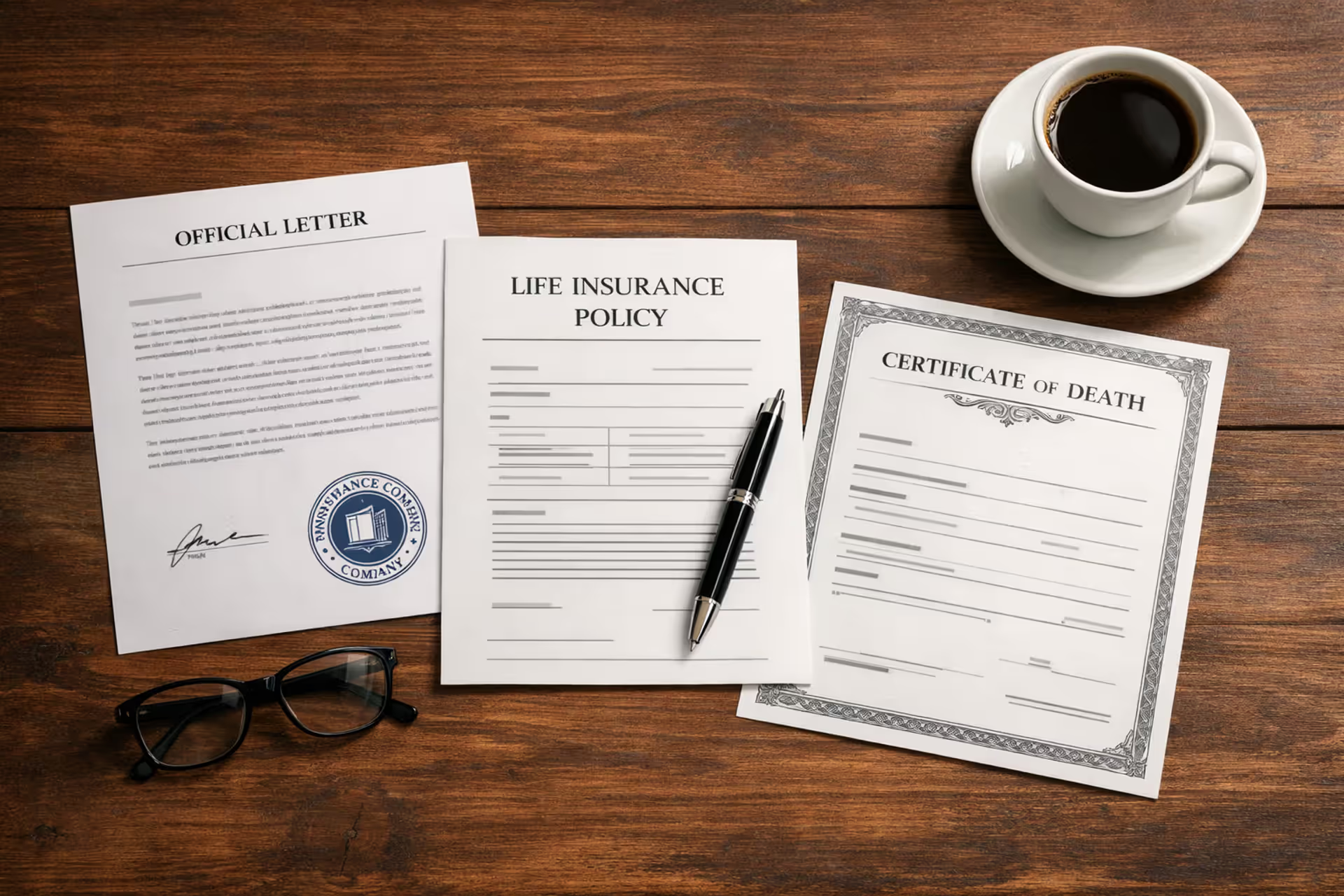
The death certificate comes first—non-negotiable. This official document confirms death occurred and identifies the immediate cause. Order multiple certified copies because you'll need them for insurance claims, estate proceedings, and court filings. If the listed cause seems wrong or incomplete (for example, it says "cardiac arrest" when you believe medical malpractice caused the cardiac arrest), you may need to challenge it or obtain an independent autopsy.
Complete medical records from every provider who treated your family member before death are essential. Emergency room notes, hospital admission records, surgical reports, medication administration logs, diagnostic imaging results, and physician orders all matter. Request these in writing as soon as possible—hospitals charge fees and often take weeks to compile comprehensive files. Some states permit medical record destruction after certain time periods, meaning delays can result in permanent loss.
Police or incident reports document official findings about what happened. If law enforcement responded, their report captures initial observations, witness statements made at the scene, and preliminary conclusions about fault. Accident reconstruction experts build on these foundational reports. Contact the investigating agency to request copies, and be prepared to pay fees or wait until active investigations close.
Financial documentation proves the economic component of your damages. Gather at least three to five years of tax returns, recent pay stubs, employment contracts, benefits statements showing health insurance and retirement contributions, and account statements. If your loved one owned a business, you'll need business tax returns and financial statements. These records allow economists to calculate lost earning capacity—the financial contributions your family member would have made over their expected remaining life.
Insurance policies held by the deceased or relevant defendants significantly impact your case. Life insurance provides some compensation but doesn't prevent wrongful death claims—you can receive both. The defendant's liability insurance often determines practical recovery limits regardless of what a jury awards. Homeowner's policies, commercial liability coverage, professional malpractice insurance, and auto policies might all apply depending on how the death occurred.
Proof of your relationship to the deceased establishes your legal standing to file. Marriage certificates, birth certificates, adoption papers, or other legal documents demonstrate you qualify as an eligible plaintiff under your state's law. Without proving this relationship, courts dismiss claims no matter how strong the evidence of negligence might be.
Timeline considerations create hard deadlines you cannot miss. Most states impose statutes of limitations ranging from one to three years from death date. Some jurisdictions "toll" (pause) this deadline if defendants fraudulently concealed their wrongdoing. Others start the clock from when you discovered or reasonably should have discovered the negligence rather than from the death date itself. Missing these deadlines permanently bars your claims with extremely limited exceptions.
Common Mistakes That Weaken Your Burden of Proof
Even compelling cases collapse due to preventable errors during evidence collection.
Waiting too long to start gathering evidence causes more damage than any other mistake. Witnesses forget details with each passing week. Companies destroy documents after their retention periods expire (often just a few years). Physical evidence gets thrown away, lost, or deteriorates beyond usefulness. Surveillance footage gets automatically overwritten. Begin preserving evidence immediately after death—before you've even consulted attorneys—because delays create gaps you can never fill later.
The tragedy of wrongful death litigation is not the complexity of the law — it is the race against time. Evidence degrades, witnesses forget, documents get destroyed. Families who wait even a few weeks to begin preserving proof often find that the strongest pieces of their case have already vanished forever
— Robert A. Clifford
Failing to preserve physical evidence causes irreparable harm. That malfunctioning space heater that caused a fatal house fire? If you dispose of it, proving the defect becomes nearly impossible. The vehicle involved in the fatal crash should be stored intact and untouched until experts examine it thoroughly. Defendants sometimes move incredibly fast to repair or destroy damaging evidence, making your prompt action critical to preserving what you need.
Not obtaining expert witnesses early enough creates multiple problems. High-quality experts maintain busy schedules and may be unavailable if you wait six months to retain them. Early expert involvement guides your entire investigation—experts know which evidence matters and which questions to ask of other witnesses. A biomechanical engineer hired six months after a fatal workplace accident can identify what evidence should have been preserved but is now permanently lost.
Incomplete financial documentation undermines your damages claims substantially. If you cannot prove your loved one's actual earning capacity because you lack sufficient tax returns or employment history, courts may award only minimal economic damages. Gathering comprehensive financial evidence takes significant time—waiting until shortly before trial creates last-minute scrambles and inevitable gaps in documentation.
Missing the statute of limitations is the ultimate catastrophic mistake. No matter how overwhelming your evidence of negligence appears, filing even a single day late typically results in permanent dismissal. Different deadlines may apply to different defendants in the same case, and some government entities require formal notice within just months of death. Calendar all deadlines with multiple advance reminders and build in substantial safety margins—never cut it close.
Posting on social media about the case or your deceased loved one's lifestyle regularly backfires. Defense attorneys scour plaintiffs' social media accounts hunting for contradictory statements or evidence suggesting the deceased contributed to their own death. A Facebook post mentioning your loved one's alcohol consumption might support a defense argument that intoxication, not defendant's negligence, caused the fatal accident.
Accepting early settlement offers without fully understanding damages often results in grossly inadequate compensation. Insurance adjusters rush to offer quick settlements before you've calculated lifetime earning losses or fully comprehended the extent of the deceased person's pain and suffering. These offers almost always include releases that permanently bar you from seeking additional compensation—even if you later discover the death circumstances were far worse than initially understood.

Author: Samantha Caldwell;
Source: mannawong.com
How Courts Evaluate Evidence in Wrongful Death Cases
Understanding how judges and juries assess your evidence helps you present the strongest possible case.
The preponderance of evidence standard requires plaintiffs to show it's more likely than not (greater than 50% probability) that defendants caused the death through negligence. Contrast this with criminal cases requiring proof beyond reasonable doubt (roughly 95%+ certainty). Practically speaking, this means evidence that creates reasonable doubt in criminal proceedings might still fully support civil liability.
Admissibility rules strictly govern what evidence courts will even consider. Hearsay—statements made outside court offered to prove the truth of what they assert—generally gets excluded unless specific exceptions apply. Medical records qualify under the business records exception. Dying declarations (statements the deceased made about the cause of their impending death) are specifically admissible in wrongful death cases despite normally being hearsay.
Expert testimony must meet stringent reliability standards under frameworks like Daubert or Frye, depending on your jurisdiction. Courts evaluate whether the expert's methodology is scientifically sound, whether it's been subjected to peer review, what its known error rate is, and whether it's generally accepted in the relevant scientific field. "Junk science" experts who lack proper credentials or use unreliable methods get excluded entirely, potentially destroying cases that depend heavily on their testimony.
Judges serve as evidentiary gatekeepers, ruling on what juries can see and hear. If your expert witness fails admissibility standards during pre-trial hearings, the judge may exclude their entire testimony. If crucial documents qualify as inadmissible hearsay without any applicable exception, juries never see them. Understanding these rules fundamentally shapes investigation strategy—gathering evidence courts won't allow accomplishes nothing.
Credibility assessments by juries ultimately determine case outcomes. Jurors watch witnesses testify, evaluate their demeanor and body language, assess whether their stories make logical sense and remain consistent, and decide who to believe. Testimony that's well-documented and consistent carries substantial weight. Witnesses who contradict themselves or clearly lack firsthand knowledge lose credibility fast. Expert witnesses who clearly explain complex concepts and withstand aggressive cross-examination persuade juries effectively; those who seem obviously biased or use confusing jargon don't.
Juries don’t decide wrongful death cases on sympathy alone. They decide on clarity. The families who win are the ones whose attorneys translate overwhelming grief into organized, credible evidence that tells an undeniable story from duty to damages
— Thomas A. Moore
Circumstantial evidence absolutely can prove wrongful death despite defense attorneys arguing otherwise. Direct evidence (like eyewitness testimony that a doctor personally administered the wrong medication) is powerful but frequently unavailable. Circumstantial evidence (the wrong medication vial was found in the patient's room, only this doctor had access during the relevant timeframe, and the doctor cannot explain the discrepancy) creates equally compelling inferences. Courts routinely accept circumstantial evidence chains that make defendant's liability the most reasonable explanation for what occurred.
Burden-shifting sometimes occurs in specific legal contexts. If you prove a surgical instrument was left inside your deceased family member during surgery, the burden may shift to defendants to explain how this possibly occurred without negligence. The doctrine of res ipsa loquitur ("the thing speaks for itself") applies when injuries don't ordinarily happen without negligence, defendants had exclusive control over the situation, and plaintiffs didn't contribute to the injury. This doctrine significantly helps plaintiffs when direct evidence of exactly what went wrong simply doesn't exist.
Author: Samantha Caldwell;
Source: mannawong.com
Frequently Asked Questions About Proving Wrongful Death
Proving wrongful death demands both emotional resilience and methodical evidence assembly. The legal system requires clear documentation showing someone's negligence killed your family member and created measurable damages. This burden rests entirely on your shoulders—defendants need only create reasonable doubt about one element to escape liability.
Start preserving evidence immediately, even before hiring an attorney. Take photographs of scenes and conditions. Secure physical evidence before it disappears. Identify witnesses while their memories remain fresh. Request records promptly before they're destroyed or become unavailable. Every day of delay makes evidence harder to obtain and memories less reliable.
Recognize that strong cases require substantial expert support. Medical specialists, accident reconstructionists, economists, and other professionals translate complex facts into clear proof of negligence and damages. Their involvement isn't optional in most wrongful death claims—it's absolutely essential to meeting your legal burden of proof.
Understand the trade-offs between accepting quick settlements and thoroughly developing your case. Early offers often seem attractive when you're grieving and facing financial pressure, but they rarely reflect full damages. Once you accept settlement funds and sign releases, you typically forfeit any right to seek additional compensation—even if you later discover the negligence was far more egregious than initially understood.
The path from wrongful death to successful claim involves assembling medical records establishing cause of death, expert testimony proving negligence, financial documentation quantifying economic losses, and witness statements corroborating your account of what happened. Fail to establish any critical element, and even the most sympathetic case can collapse.
Statutes of limitations create inflexible deadlines that grief and extenuating circumstances rarely extend. Calendar these dates, set multiple early reminders, and never assume you have more time than you actually do. The legal system offers zero remedy for claims filed even hours too late.
Your family member's death may have been entirely preventable. Proving that legal reality requires transforming your grief into admissible evidence, your memories into sworn testimony, and your loss into quantified damages. The process is neither quick nor simple, but it's how our legal system determines when someone must answer for causing death through negligence or wrongful conduct.