
Wooden gavel and scales of justice on dark polished desk with legal books in background representing punitive damages in wrongful death cases
Punitive Damages in Wrongful Death Cases Explained

Content
A family loses someone to a drunk driver with four prior DUIs. A nursing home resident dies from infected bedsores after staff ignored her deteriorating condition for weeks. A manufacturer's product kills dozens, and internal emails show executives knew about the defect two years earlier.
In these situations, compensatory damages feel inadequate. Sure, they cover funeral costs, replace lost wages, and acknowledge emotional suffering. But they don't address the elephant in the room: some defendants deserve more than just paying for the damage they caused.
That's where punitive damages enter the picture. Not every wrongful death case qualifies for them—in fact, most don't. But when someone's behavior crosses from negligence into something worse, courts can impose financial penalties aimed squarely at punishment and prevention. Think of them as the legal system's way of saying "that was inexcusable, and we're making sure you never do it again."
The rules surrounding these awards vary wildly depending on where you file your lawsuit. Some states prohibit them entirely in death cases. Others cap them at specific amounts. A few let juries award whatever they deem appropriate.
What Qualifies as Punitive Damages in Wrongful Death Claims
Here's what compensatory damages do: they add up medical expenses incurred before death, funeral bills, the income your loved one would've earned over their lifetime, and put a dollar figure on losing their companionship. It's imperfect math—no spreadsheet captures what a parent, spouse, or child truly means. But courts try to make families financially whole within those constraints.
Punitive damages wrongful death awards operate on completely different logic. They're not about making you whole. They're about making the defendant hurt.
Courts hand down these penalties when a defendant's actions were so reckless, so consciouslessly dangerous, that society itself demands accountability beyond mere compensation. The message isn't just "pay for what you broke." It's "what you did was unacceptable, and here's a financial consequence severe enough that you—and anyone watching—will think twice before doing it again."
You can't get an exemplary damages claim approved simply because someone screwed up badly. A driver who glances at their phone for three seconds and causes a fatal crash acted negligently, even tragically. But that momentary lapse doesn't trigger punishment damages in most jurisdictions. Courts need evidence of something worse.
What crosses that line? Three categories typically qualify:
Willful misconduct happens when defendants know their actions create serious risks but barrel ahead anyway. Picture a pharmaceutical company whose testing reveals a medication causes fatal heart attacks in 2% of users. They calculate that lawsuits will cost less than pulling the drug from shelves. That's willful—they understood the danger, weighed it against profits, and chose wrong.
Gross negligence means such extreme carelessness that it borders on intentional. Say a trucking company has drivers log 18-hour shifts despite federal regulations limiting them to 11 hours. One exhausted driver falls asleep at the wheel and crashes, killing three people. The company didn't intend those deaths, but their systematic flouting of safety rules shows conscious disregard for obvious dangers.
Actual malice involves intent to harm, though it's rare in wrongful death litigation since intentional killings typically trigger criminal prosecution first.

Author: Samantha Caldwell;
Source: mannawong.com
The twin goals stay constant regardless: punish conduct proportional to its egregiousness, and create deterrence meaningful enough to change behavior industry-wide. Slapping a $25,000 penalty on a multinational corporation accomplishes neither. Courts need to scale these awards so they actually sting.
Juries typically decide first whether the defendant's conduct warrants punishment, then deliberate on how much. Judges review those amounts afterward, checking for constitutional problems or excessive awards that violate due process standards.
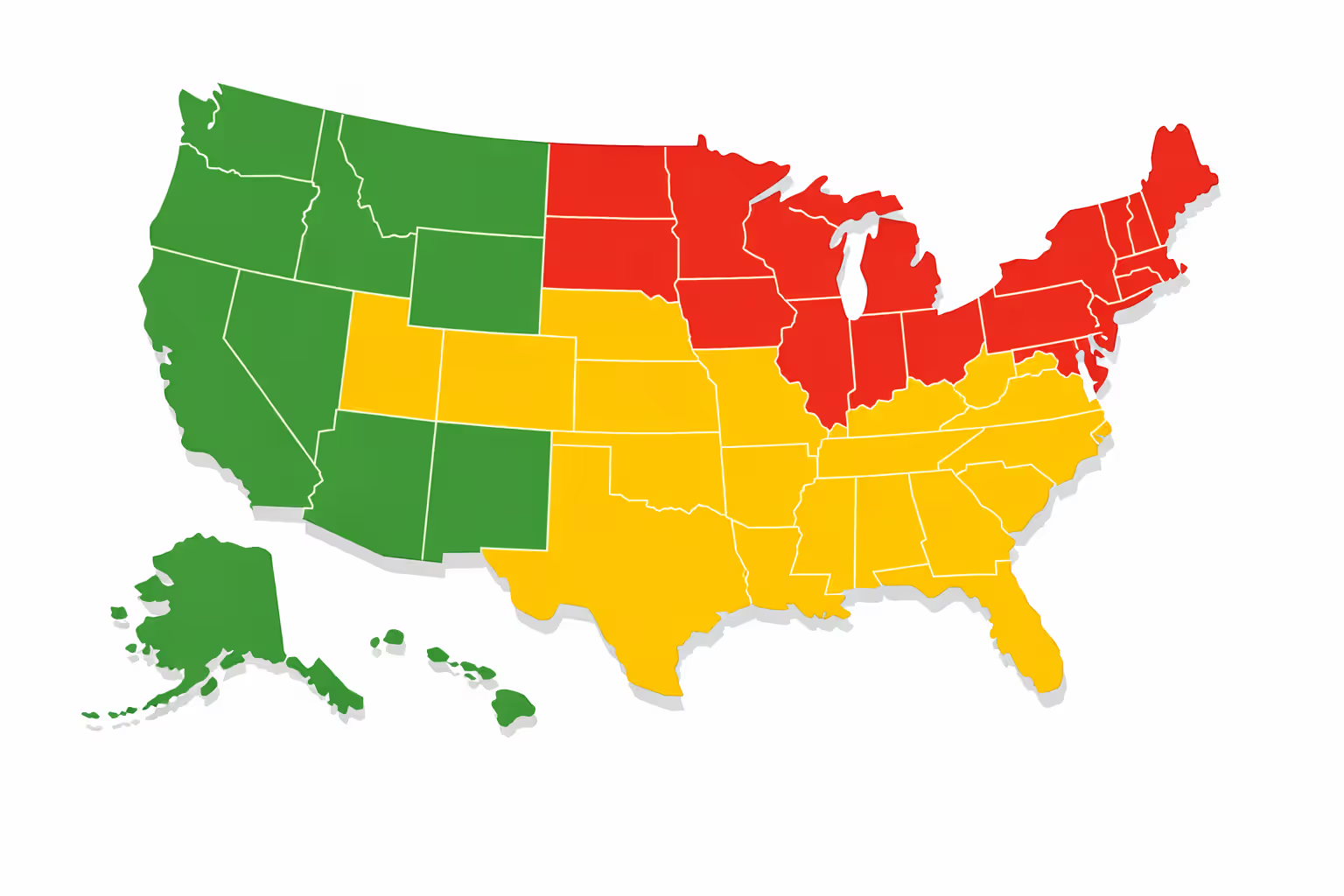
State-by-State Variations: Where Punitive Damages Are Allowed
Every state lets families sue when negligence or intentional acts cause death. But ask whether they allow punishment damages law in those cases? You'll get fifty different answers.
Some states view wrongful death lawsuits as purely compensatory vehicles—designed only to replace what the family lost financially and emotionally. Others recognize that certain conduct demands accountability beyond compensation. Several jurisdictions ban these awards outright in death cases, while many others impose caps ranging from $250,000 to several million depending on circumstances.
| State | Awards Permitted? | How Much? | What Must Plaintiffs Prove? |
| California | Yes | No cap under state law | Clear and convincing evidence of malice, fraud, or oppression |
| Florida | Yes | Triple the compensatory award or $500,000 (whichever's larger); jumps to $2M if financial motivation proven | Clear and convincing showing of gross negligence or intentional misconduct |
| Texas | Yes | Double the economic damages plus up to $750K non-economic, or $200K minimum—whichever's greater | Clear and convincing evidence standard applies |
| Georgia | Yes | Capped at $250,000 except when products liability involved | Must meet clear and convincing threshold |
| Michigan | No | State statute bars these awards in death cases | Doesn't apply |
| New Hampshire | No | Wrongful death law doesn't authorize punishment | Doesn't apply |
| Virginia | Yes | Cannot exceed $350,000 | Clear and convincing proof required |
| Illinois | Yes | No statutory maximum imposed | Preponderance standard (easier than most states) |
| Ohio | Yes | Limited to twice the compensatory damages awarded | Clear and convincing evidence necessary |
| Nevada | Yes | $300K when compensatory stays under $100K; otherwise triple the compensatory amount | Clear and convincing standard |
States That Prohibit Punitive Damages in Wrongful Death
A handful of jurisdictions take the firm position that death statutes exist exclusively to compensate survivors—punishment isn't part of their legislative purpose. Michigan, New Hampshire, and Massachusetts typically fall in this camp, though nuances exist in case law.
Michigan's wrongful death statute specifically limits recovery to economic losses suffered by survivors. The law simply doesn't authorize courts to impose penalties, regardless of how outrageous the defendant's behavior was. Families can recover lost financial support and medical expenses, but even if the defendant's conduct was deliberately reckless, the wrongful death claim itself won't produce punishment damages.
That doesn't necessarily mean defendants walk away unscathed. Many states recognize "survival actions"—separate lawsuits representing claims the deceased could've filed if they'd survived their injuries. These actions compensate the estate for pain and suffering experienced before death. Some jurisdictions permit punitive damages within survival actions even when their wrongful death statutes forbid them. It's a technical distinction, but it matters.
States With Damage Caps and Limitations
Constitutional worries about excessive fines and due process have pushed many state legislatures to cap court damage awards. These limits attempt to balance society's interest in punishing and deterring bad conduct against defendants' rights to fair treatment and economic predictability.
Florida uses a tiered system. Standard situations cap awards at three times whatever compensatory damages the jury awarded, or $500,000—whichever number is bigger. But plaintiffs who prove the defendant acted specifically for financial gain unlock a higher ceiling of $2 million. This structure acknowledges that corporate defendants who deliberately choose profit over safety deserve harsher treatment than individuals who simply behaved recklessly.
Texas employs a formula that looks complicated at first glance. Punitive damages can't exceed the larger of two calculations: either double the economic losses plus non-economic damages up to $750,000, or a $200,000 floor. For deaths involving minimal economic losses—say, a retired person with no dependents—but truly horrific conduct, that $200,000 minimum ensures some meaningful penalty despite limited compensatory damages.
Georgia's $250,000 cap covers most scenarios but carves out exceptions for product liability cases, where manufacturers' choices affect potentially thousands of consumers. Legislators recognized that mass-market dangers need stronger deterrents than isolated incidents of individual misconduct.
Author: Samantha Caldwell;
Source: mannawong.com
Proving Gross Negligence or Reckless Conduct in Death Cases
Qualifying for a reckless conduct lawsuit requires substantially more proof than ordinary negligence. Simple carelessness—like failing to check a blind spot before changing lanes—meets the standard for compensatory damages. It won't get you punitive damages even if the result was fatal.
Gross negligence death cases demand evidence showing the defendant substantially deviated from reasonable care standards. Courts use phrases like "conscious indifference to consequences" or "reckless disregard for safety." The defendant either knew their actions created serious risks, or the risks were so obvious that any reasonable person would've recognized them.
Consider a specific example: A nursing home gets complaints over six months about one aide's rough treatment of patients. Three residents in that employee's care show unusual bruising. Family members raise concerns twice in writing. Management does nothing—no investigation, no supervision changes, no discipline. When that aide's abuse eventually causes a resident's death from internal injuries, the facility's pattern of ignoring blatant warning signs elevates their conduct well beyond ordinary negligence.
The distinction between ordinary negligence and gross negligence is not merely academic—it is the dividing line between compensation and accountability. When a defendant’s conduct reveals a pattern of deliberate indifference to known dangers, the law must respond with more than economic restoration. Punitive damages exist precisely for those cases where the defendant’s moral culpability demands a response proportional to the gravity of their disregard for human life
— Justice Richard A. Posner
Evidence that persuades juries in these cases includes:
Documents proving defendants knew about risks. Internal emails where executives discuss safety concerns but decide fixes cost too much. Meeting minutes showing managers debated whether to recall a dangerous product. Memos revealing prior complaints that were ignored. These create powerful narratives because they're the defendant's own words.
Pattern evidence showing repeated dangerous choices. A bar that's overserved visibly drunk patrons who then caused three prior fatal crashes demonstrates a pattern. Each incident alone might look like an isolated mistake. Together, they prove systematic indifference.
Expert testimony explaining how far conduct deviated from standards. A construction safety expert might testify that requiring workers on a tenth-floor ledge without fall protection violates literally every industry standard and regulation. That gap between what the defendant did and what any competent professional would do helps juries see the recklessness.
Financial motive documentation. Evidence that defendants calculated injury settlements would cost less than safety improvements is particularly damning. When companies explicitly weigh human lives against profit margins in writing, juries react strongly.
The proof burden sits at "clear and convincing evidence"—meaningfully higher than the "more likely than not" standard used for compensatory damages, but not as stringent as the "beyond reasonable doubt" bar in criminal cases. You need to show it's highly probable, not just slightly more likely than the alternative, that gross negligence occurred.
This elevated threshold protects defendants from punishment based on thin evidence while ensuring that genuinely inexcusable conduct faces consequences. Families pursuing these claims typically need extensive documentation, multiple witnesses, and often inside access to corporate records through aggressive discovery.
Common Scenarios Where Courts Award Exemplary Damages
Certain situations appear repeatedly in cases where juries decide defendants deserve financial punishment beyond just compensation. While every case turns on its specific facts, these scenarios share characteristics courts find especially deserving of deterrent penalties.
Drunk drivers with prior convictions. Compensatory damages address the family's losses in any drunk driving death. But when the driver has three prior DUIs, was driving at 0.18 BAC (more than double the legal limit), and crashed leaving a bar at 2 a.m., that pattern shows the conscious disregard courts target. This isn't someone who misjudged their impairment once—it's someone systematically choosing to endanger others despite multiple warnings from the legal system.
Institutional neglect in care facilities. Nursing homes that deliberately understaff to boost profit margins, ignore pressure ulcers until they become gangrenous and fatal, or hire caregivers with abuse histories without supervision create conditions juries view as grossly negligent. When corporate ownership prioritizes quarterly earnings over minimum care standards and preventable deaths result, awards often run into millions.
Product defects companies knew about and concealed. Manufacturers who discover fatal flaws through internal testing, calculate that recalls would damage profits more than litigation costs, and continue selling dangerous products face some of the harshest punishment. The infamous Ford Pinto case—where internal memos valued human lives at $200,000 each and compared that figure to recall costs—exemplifies the kind of calculated indifference courts find most reprehensible.
Workplace safety violations after repeated citations. Employers who accumulate OSHA fines, receive stop-work orders, yet continue forcing employees into obviously dangerous conditions demonstrate willful disregard. A construction company that's been cited four times for trench collapse risks but keeps leaving workers in unsupported excavations eighteen feet deep shows the pattern that triggers punitive awards when someone eventually dies.
Medical misconduct beyond ordinary malpractice. Most medical negligence doesn't warrant punishment damages—doctors make judgment errors, misdiagnoses happen, complications occur. But extreme cases qualify: surgeons operating while intoxicated, physicians altering medical records to hide fatal mistakes, hospitals employing doctors they know lost licenses in three other states for dangerous practices. These situations cross from negligence into reckless disregard.
Assault and intentional violence. Though criminal courts handle murder prosecutions, families can pursue parallel civil claims. When defendants acted with malice—targeting victims out of hatred, for financial gain through murder-for-hire, or during commission of felonies—civil courts readily impose substantial punitive damages alongside whatever criminal penalties apply.
The common thread? Defendants who recognized serious risks their conduct created yet proceeded anyway, often motivated by financial considerations or exhibiting extreme indifference to probable consequences.

Author: Samantha Caldwell;
Source: mannawong.com
How Courts Calculate Punishment Damage Awards
After a jury decides conduct deserves punishment, they face a harder question: how much? Unlike compensatory damages that tie to specific financial losses, court damage awards for punishment involve inherently subjective judgments about several factors.
How reprehensible was the conduct? Courts examine whether defendants acted with indifference to others' safety or showed reckless disregard for life. Did the conduct involve repeated actions across months or years, or was it an isolated incident? Did defendants conceal evidence, lie about dangers, or manipulate data? Did the harm cause physical injuries and death rather than mere economic losses? A tobacco company spending forty years denying smoking dangers while its own research confirmed fatal health effects scores at the maximum reprehensibility level.
What's the defendant's financial condition? A $150,000 penalty might bankrupt a family-owned business with three employees. That same amount means literally nothing to a pharmaceutical company with $5 billion in annual revenue. Juries hear evidence about defendants' net worth, yearly profits, and financial health specifically to scale awards that actually accomplish deterrence. This explains why punitive awards against corporations often reach eight or nine figures while those against individuals rarely exceed low six figures.
What's the ratio between compensatory and punitive awards? The Supreme Court has suggested ratios exceeding 9:1 raise constitutional red flags, though no absolute rule exists. A 9:1 ratio generally survives appellate scrutiny. A 145:1 ratio faces serious challenges. Courts acknowledge that particularly egregious conduct involving small actual damages might justify higher ratios—if a defendant's willful misconduct caused $10,000 in economic losses but threatened thousands of lives, limiting punishment to $90,000 wouldn't deter much. Still, extreme multiples require strong justification.
What do comparable penalties look like? Judges compare punitive awards to penalties statutes impose for similar behavior. If federal regulations fine companies $75,000 for the same safety violation, a $15 million civil punitive award seems potentially disproportionate. This factor prevents juries from imposing penalties wildly inconsistent with legislative judgments about appropriate sanctions for comparable conduct.
Punitive damages in wrongful death cases must walk a constitutional tightrope. The award needs sufficient weight to punish wealthy defendants and deter future misconduct—a $50,000 penalty against a Fortune 500 company accomplishes neither goal. But it can't be so excessive that it violates due process by imposing arbitrary punishment. Courts must calibrate these awards to the defendant's culpability and financial circumstances, ensuring meaningful consequences without crossing into unconstitutional territory.
— Professor Catherine Sharkey, New York University School of Law, Yale Law Journal
Juries receive detailed instructions about these factors but retain substantial discretion in setting amounts. Trial judges then review awards using those same criteria, often reducing amounts they find excessive through post-trial motions. Defendants almost always appeal, and appellate courts independently review punitive damages using constitutional standards.
The relationship between compensatory and punitive amounts varies dramatically in practice. Cases involving young high-earners whose deaths generate $8 million in lost future income might see only a 1:1 punitive ratio because even that produces substantial deterrence. Cases involving elderly retirees with no dependents—meaning modest economic losses—but absolutely horrific conduct might justify 8:1 or 9:1 ratios to ensure adequate punishment despite the small compensatory base.

Author: Samantha Caldwell;
Source: mannawong.com
Challenges and Limitations When Pursuing These Claims
Families considering exemplary damages claims face obstacles that go well beyond typical wrongful death litigation challenges. The elevated proof burden alone eliminates many potential claims, but other barriers compound the difficulty significantly.
Constitutional limits create unpredictability. The Due Process Clause constrains punishment damages. Awards can't be arbitrary or grossly excessive relative to legitimate punishment goals. Defendants routinely challenge large verdicts as unconstitutional, forcing plaintiffs into years of appellate litigation defending amounts juries awarded. You might win a $10 million verdict at trial, then watch appeals courts reduce it to $3 million three years later, then see another court adjust it to $4.5 million after remand. This uncertainty makes settlement negotiations incredibly complex.
Insurance typically won't cover these awards. Most liability policies explicitly exclude punitive damages, reasoning that coverage would defeat the punishment purpose. Many states prohibit such coverage as contrary to public policy—if insurance pays the penalty, defendants don't feel consequences, making deterrence impossible. When individual defendants lack personal assets beyond insurance coverage, families may win substantial verdicts but collect nothing. Corporate defendants usually have resources to pay, but individuals often don't. Attorneys must investigate assets thoroughly before investing substantial effort in potentially uncollectible claims.
Meeting proof standards requires resources. Clear and convincing evidence demands more than typical negligence cases need. Families need extensive discovery to obtain internal corporate documents, expert witnesses charging $500-800 per hour, document review that can run six figures in complex cases, and trial time that extends weeks rather than days. Defense lawyers fight discovery requests for internal communications tooth and nail, forcing lengthy motion practice. The financial and temporal investment substantially exceeds standard wrongful death litigation.
Post-trial proceedings extend for years. Even after favorable jury verdicts, defendants file motions requesting judges reduce awards (remittitur motions) and appeals challenging both liability findings and damage amounts. Appellate courts scrutinize punishment damages far more carefully than compensatory awards, frequently ordering reductions. Supreme Court due process jurisprudence gives defendants strong appellate arguments. Many initially large awards shrink 40-60% through post-trial proceedings.
Pursuing punitive damages is an act of endurance as much as advocacy. Families must sustain their resolve through years of appeals, procedural obstacles, and defense tactics designed to erode both evidence and willpower. Yet these cases serve a purpose far beyond the individual plaintiff—they establish boundaries of acceptable corporate conduct that protect entire communities from future harm.
— Professor John C.P. Goldberg
Upfront costs create screening incentives. Most wrongful death attorneys work on contingency fees—they collect a percentage of recovery rather than hourly fees. But they advance litigation costs that can reach $200,000-300,000 in complex cases involving corporate defendants. If the case fails, attorneys absorb those losses entirely. This economic reality means lawyers carefully screen potential cases, rejecting claims without extremely compelling facts regardless of how much accountability families want.
Procedural requirements vary by state. Some jurisdictions require bifurcated trials—completely separate proceedings for determining liability plus compensatory damages, then a second trial phase addressing punitive damages if plaintiffs win the first phase. This doubles trial time and expenses substantially. Other states require plaintiffs to obtain pretrial court approval before they can even mention punitive damages to juries, forcing early disclosure of evidence and legal theories that might be better saved for trial.
Juries remain unpredictable despite strong evidence. Some juries enthusiastically punish corporate misconduct after seeing internal emails showing callous disregard for safety. Others resist imposing large penalties even when conduct clearly warrants punishment. Defense attorneys emphasize how punitive awards will impact innocent employees who'll lose jobs if penalties are too severe, or harm communities where defendants operate facilities. Those arguments sway jurors despite strong liability evidence. Identical facts might produce a $12 million award from one jury and nothing from another in the next county.
Despite these substantial hurdles, families with compelling evidence of truly egregious conduct usually find experienced attorneys willing to pursue claims. The potential for meaningful awards justifies the investment when facts clearly demonstrate gross negligence or willful misconduct that deserves more than mere compensation.
FAQ: Punitive Damages in Wrongful Death Lawsuits
Families who lose loved ones to conduct that goes beyond carelessness face difficult decisions about pursuing accountability that extends past compensation. Punitive damages wrongful death claims offer a mechanism to hold defendants responsible for behavior that crosses the line from ordinary negligence into conscious disregard for human safety. These cases require substantial evidence, patience through extended litigation often lasting years, and acceptance that ultimate recovery amounts remain uncertain until all appeals conclude.
The legal system acknowledges that certain deaths result from such reckless disregard for life that society's interests extend beyond compensating individual families. Punishment and deterrence protect everyone by discouraging similar conduct going forward. When manufacturers deliberately prioritize quarterly profits over consumer safety, when corporations systematically ignore dangers their own studies identified, when individuals act with conscious indifference to probable fatal consequences, the law provides accountability mechanisms that transcend economic restoration.
Success demands careful case evaluation by experienced attorneys, substantial resources for litigation costs and expert witnesses, and facts demonstrating conduct that clearly crossed from negligence into gross negligence or willful misconduct territory. Not every tragic, preventable death qualifies for these awards, nor should they. But when evidence supports claims of genuinely reprehensible behavior—the kind that shocks the conscience and threatens public safety broadly—families working with skilled lawyers can pursue justice that acknowledges the full scope of wrongdoing while potentially preventing future deaths through meaningful financial deterrence.