
Negotiation table with legal documents, calculator, insurance folder, and scales of justice tilted to one side in a corporate conference room
Wrongful Death Settlement Negotiation Guide for Families

Content
When you're up against a major insurance carrier after losing someone you love, you're facing an opponent who does this every single day. They've got playbooks, they've got budgets, and they've got time. What makes the difference between walking away with $200,000 versus $2 million? It's not just having a solid case—it's knowing exactly when to push, when to pull back, and when to make it crystal clear you're prepared to let a jury decide.
Here's what catches most families off guard: roughly 19 out of 20 wrongful death claims never see the inside of a courtroom. But settling early doesn't automatically mean you're getting a fair shake. Adjusters bank on your grief, mounting bills, and lack of experience to wrap things up fast and cheap. When attorneys who actually take cases to trial start handling negotiations differently, settlement offers can jump by six or even seven figures.
Understanding the Settlement Landscape in Wrongful Death Cases
What you're fighting for breaks down into two buckets. First, there's the concrete stuff you can calculate: the paychecks your loved one would've brought home, health insurance they provided, retirement contributions they were making, the fair market value of household work they did, and burial expenses. Then there's the intangible loss—what it means that your kids won't have their mom at graduation, that your spouse won't be there for your retirement years, that Sunday dinners will have an empty chair.
That second category? It's often where the real money is, because there's no spreadsheet that captures what you've actually lost.
Here's how the math works out in practice. Take a 38-year-old electrician making $75,000 annually with three kids under ten. You're looking at potentially 30 years of lost income, plus benefits—that's north of $2 million in pure economic loss before you even discuss what those kids lost in guidance and support. Compare that to an 82-year-old retiree with adult children, where economic damages might total $50,000 in funeral costs and minimal lost household services.
Medical malpractice deaths consistently produce higher settlements than traffic accidents—not because one life matters more, but because surgical errors by board-certified physicians create clearer liability trails and these defendants carry $1-3 million policy minimums. Construction site deaths where OSHA cited violations? Those create extra leverage because defendants also face regulatory penalties and potential criminal charges.
Your state's laws reshape the entire negotiation landscape. California doesn't cap non-economic damages in most wrongful death cases, while Texas limits them to $500,000 per defendant in medical malpractice claims. Some states allow punitive damages when someone acted recklessly—that's when settlements really spike because defendants want to avoid angry juries hearing about their misconduct.
How Insurance Companies Approach Wrongful Death Claims
Insurance adjusters learn specific tactics designed to exploit predictable vulnerabilities in grieving families. Recognizing their playbook matters because once you see the game, you stop falling for it.
The delay game works like this: they'll request your loved one's complete medical history going back 20 years. Then they need employment records. Then they'll schedule an independent medical examination, cancel it twice, reschedule for six weeks out. They take 17 days to respond to straightforward questions. Meanwhile, your mortgage payment is due, the funeral home wants their $12,000, and you've been out of work for three weeks dealing with all this. That $150,000 offer that seemed insulting two months ago? Starts looking more reasonable when you're drowning.

Author: Daniel Whitford;
Source: mannawong.com
On liability, even slam-dunk cases get challenged. Drunk driver crossed the center line and hit your wife head-on? They'll suggest she could've swerved more aggressively. Doctor left a surgical instrument inside your dad? They'll claim his pre-existing diabetes would've caused complications anyway. These arguments wouldn't survive five minutes in front of a jury, but they don't need to—they just need to plant enough doubt that you'll discount your own case value.
The damage minimization playbook is particularly cynical. They'll argue your 45-year-old husband probably would've been downsized in the next recession. Your teenager's relationship with her father was "already strained" according to some Facebook post they dug up. Your six-year-old is "too young to remember" his mother. Every tactic aims to knock 20-40% off specific damage categories.
The Initial Offer: Why It's Almost Always Too Low
First offers typically land between one-fifth and two-fifths of what your case is actually worth. Why? Because it works. Some percentage of families accept them, saving insurers massive payouts. Even when you reject a lowball offer, it anchors the negotiation—every increase feels like progress, even when you're still nowhere near fair compensation.
Watch how they present it. The adjuster will use phrases like "our final evaluation" or "the maximum we're authorized to pay." They'll emphasize how you could lose at trial (true, but unlikely if your case is strong). They might claim—often falsely—that they're hitting policy limits. They'll pull up "comparable settlements" that somehow always support their number.
It's all performance. I've seen initial offers of $125,000 eventually settle for $875,000 after twelve months of strategic negotiation. That first number isn't their best offer—it's their starting bid.
Timing also follows patterns. Some carriers make quick lowball offers trying to catch you before you've hired an attorney. Others wait until you've been out of work for three months and the medical bills are piling up, then position their offer as financial relief rather than what it is: inadequate compensation.
The single biggest mistake people make in negotiation is they listen to respond rather than to listen to understand. In any high-stakes negotiation — whether it’s a business deal or a legal settlement — the moment you stop reacting emotionally and start responding strategically, you fundamentally change the power dynamic at the table.
— Chris Voss
Building Settlement Leverage Before Negotiations Begin
Real leverage comes from preparation that happens before you ever make a demand. When defendants review your evidence package and realize every defense they planned to raise has already been dismantled, settlement values jump dramatically.
You need liability evidence that's overwhelming and trial-ready. That means accident reconstruction showing exactly how the collision occurred, surveillance footage from three different angles, maintenance records proving the property owner ignored repeated complaints about that broken stairwell, OSHA inspection reports citing specific violations, and witness statements that corroborate every key fact. Smart attorneys anticipate defense arguments and gather evidence that refutes them preemptively.
Expert witnesses transform your case from emotional arguments into quantified damages backed by professional credentials. An economic expert doesn't just say your loved one would've earned good money—they calculate 27.4 years of remaining work life, factor in industry wage growth data, add employer-matched 401(k) contributions and health insurance premiums, and arrive at $3.2 million in lost economic support with actuarial tables backing every assumption. That's substantially harder for insurance companies to dismiss than "he was a good provider."
Medical experts establish causation definitively and counter the defense's alternative theories. If they're claiming your mother's death from surgical complications was really caused by her diabetes, your endocrinologist expert testifies that controlled Type 2 diabetes doesn't cause that specific complication—but nicking the hepatic artery during gallbladder surgery absolutely does.

Author: Daniel Whitford;
Source: mannawong.com
Documentation needs to be exhaustive. I mean employment records, tax returns, pay stubs, performance reviews showing she was on track for promotion to regional manager, emails from her boss praising her work. Family involvement gets documented through photos from every birthday party, videos of him coaching little league, testimony from neighbors about how he organized the block party every summer. For emotional impacts, you need therapy records, prescription history for anti-anxiety medication, expert psychological evaluations quantifying post-traumatic stress.
The gap between adequate documentation and exceptional documentation often determines whether you're negotiating at $400,000 or $1.4 million.
Research recent verdicts in your county. Juries in rural Oklahoma value cases differently than juries in Manhattan. Calculate what it'll cost the defendant to fight through trial—attorney fees running $300-500 per hour, expert witnesses at $15,000-40,000 each, executive depositions taking senior leadership away from their jobs. This analysis tells you when trial makes more financial sense than accepting their offer.
Attorney Negotiation Methods That Move the Needle
Attorneys who regularly take cases to verdict negotiate fundamentally differently than those who always settle. Insurance companies track this and adjust their offers accordingly.
A demand letter isn't just a recitation of facts. It's a narrative that makes the adjuster—and their supervisor who has to sign off on big settlements—understand exactly what happened and why their insured is clearly liable. It methodically walks through every element of negligence with supporting evidence for each. It calculates damages with expert backup for every number. It anticipates their defenses and preemptively refutes them with cited case law and evidence.
Most critically, it demonstrates trial readiness. You're not making a vague threat—you're identifying your specific expert witnesses by name and credential, outlining your trial timeline, and referencing recent verdicts in the venue showing what juries award in similar cases. Adjusters recognize which demand letters come from attorneys who actually try cases versus those who fold when pushed.
Mediation requires different skills than courtroom advocacy. You prepare a confidential mediation statement for the mediator highlighting your strongest evidence, but also acknowledging realistic weaknesses—this credibility helps the mediator apply appropriate pressure to the defense. You recognize mediator tactics (shuttling between rooms, applying incremental pressure, suggesting "reasonable" middle-ground compromises) and respond strategically rather than reactively.
But nothing moves settlement negotiations like demonstrated trial readiness. Once you've filed suit, completed key depositions, retained and disclosed your experts, filed substantive motions, and set a trial date, settlement offers spike. Why? Because defendants now face real trial risk with calculable costs rather than theoretical possibility. When you've already deposed their CEO and he contradicted the company's official position, that deposition transcript creates tangible settlement pressure.
Strategic deadline use forces decision-making. Statutes of limitations obviously matter—missing one destroys your case entirely. But effective attorneys also create artificial deadlines: "This demand expires in 14 days; after that we proceed with expert depositions at $25,000 in costs that won't be recoverable even if you later want to settle." Discovery cutoffs and trial settings also motivate defendants to settle rather than continue expensive litigation.
When presenting damages, economic losses rely on documentation and expert calculations—harder to dispute but also limited by actual earning history. Non-economic damages depend on storytelling and family testimony—more variable but potentially unlimited. You present both categories with equal rigor, using economic damages as your floor and non-economic damages to reach full compensation.
Preparation is the foundation of all successful negotiation. The lawyer who walks into the room knowing every fact, every number, and every possible counterargument doesn’t just have an advantage — they have control. Cases are won or lost long before anyone sets foot in a courtroom.
— Lisa Blue
When to Walk Away vs. When to Counter
Knowing when to reject offers outright versus when to counter strategically separates attorneys who maximize recovery from those who leave money on the table.
Walk away immediately when offers don't even cover your calculable economic damages. If they're offering $200,000 when your economic expert calculated $500,000 in lost income alone, you're not negotiating—you're being insulted. Accepting an offer below objective losses signals desperation. Reject it firmly and continue litigation. Often you'll see substantially higher offers within 30-60 days.
Walk away when you have overwhelming liability evidence, comprehensive damage documentation, and strong expert support. If their driver was texting while drunk and your economist calculated $2.8 million in losses backed by tax returns and actuarial tables, trial risk heavily favors you. Low settlement offers in strong cases reflect defendants hoping you'll take certain money over higher but uncertain verdicts. When your case is solid, that calculation works in reverse—they face more risk than you do.
Counter strategically when offers show meaningful movement toward reasonable ranges. If they started at $150,000, moved to $275,000, then to $425,000, they're recognizing case strength but testing your bottom line. Detailed counters with specific justification for your number (supported by recent verdict research and expert calculations) often bridge the remaining gap without trial.
Counter aggressively when new developments strengthen your position. Discovery depositions where their safety manager admits receiving three prior complaints about that equipment failure? Favorable expert reports quantifying permanent psychological trauma? Similar cases in your venue producing $3 million verdicts? These developments justify increasing your demand rather than making concessions, completely shifting negotiation momentum.
Maximizing Settlement Value: The Pre-Trial Advantage
The sweet spot for settlement sits in that window after key discovery but before final trial preparation expenses. Understanding these timing dynamics helps maximize value while minimizing costs.
Both sides run cost-benefit analyses constantly. Defense firms bill $350-500 hourly. Expert witnesses charge $400-600 per hour for deposition prep and testimony. Document review costs mount. Trial preparation requires 200-300 attorney hours minimum. When defense costs approach settlement value—say they've already spent $175,000 defending a case where settlement negotiations hover around $400,000—continuing litigation makes little financial sense.
You face similar calculations, but with grief and emotional toll added. The optimal settlement window often opens after you've completed key depositions and exchanged expert reports—both sides clearly understand case strengths and weaknesses—but before you've invested in final trial prep like jury consultants, trial graphics, and intensive witness preparation.
Discovery creates settlement momentum by revealing helpful evidence or destroying defense theories. When you depose their maintenance supervisor and he admits the company ignored three work orders to repair that loading dock where your brother fell, that testimony becomes powerful settlement leverage. Documents showing prior safety complaints, emails where executives discussed cutting corners, expert opinions that definitively establish negligence—each discovery win strengthens your position and weakens their willingness to risk trial.
Settlement conferences with judicial involvement carry extra weight. Judges pressure both sides toward resolution, and their recommendations influence insurance companies more than plaintiff demands alone. You prepare for these like abbreviated trials, presenting case highlights and damage calculations in condensed formats designed to convince the judge your position is reasonable. When a judge suggests a settlement range of $800,000-1.2 million, that carries authority that moves negotiations substantially.
| Leverage Factor | Strong Position Indicators | Weak Position Indicators | Settlement Impact |
| Liability Evidence | Multiple surveillance angles, eyewitness testimony, regulatory citations, defendant's own records contradicting their position | Conflicting witness accounts, no physical evidence, comparative negligence arguments, disputed causation | Adds or subtracts 40-60% from baseline |
| Economic Loss Documentation | Five years of tax returns, detailed employment records, economist expert analysis, benefits statements | Unreported cash income, employment gaps, no expert quantification | Swings value 30-50% |
| Expert Witness Credentials | Board-certified specialists, published research in relevant field, compelling deposition testimony, teaching positions | General practitioners, thin credentials, poor communication, contradicted on cross | Moves settlement 25-40% |
| Attorney Trial Record | Regular trial experience, recent verdicts in this venue, wrongful death case focus | Settles most cases, last trial was five years ago, general practice covering everything | Changes offers 20-35% |
| Available Insurance Coverage | Multi-million commercial policies, multiple applicable policies, confirmed coverage | State minimum coverage, disputed policy applicability, uninsured defendant | Can cap maximum recovery regardless of damages |
| Timeline Leverage | Trial date set within 60 days, discovery completed, case fully prepped | Early litigation stage, weak case facts, plaintiff facing financial crisis | Creates 15-30% swings depending on who's under more pressure |
Common Mistakes That Undermine Negotiation Outcomes
Even cases with clear liability and devastating damages can settle for pennies on the dollar when families make preventable errors during negotiations.
Taking the first offer is the most expensive mistake you can make. These opening bids aren't final positions—they're anchors designed to start negotiations low. Insurance companies expect rejection. Families who grab that first check typically forfeit 50-70% of obtainable compensation because they chose immediate certainty over strategic patience. That difference often exceeds $500,000.
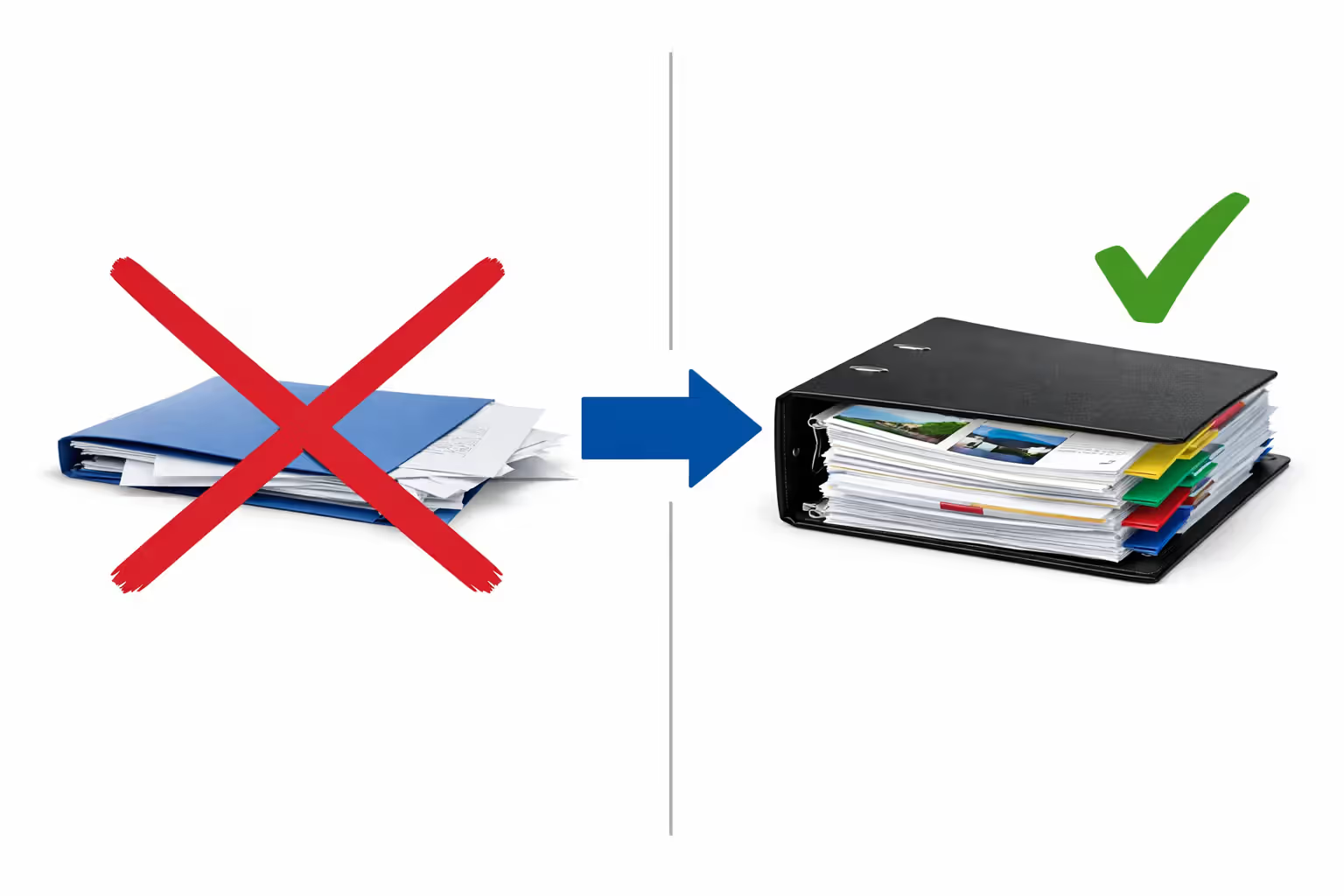
Weak documentation undermines strong cases. When you don't save family videos showing your husband coaching soccer, don't maintain employment records proving your wife's promotion track, don't document out-of-pocket expenses, you hand ammunition to insurance adjusters disputing your damages. Missing medical records create gaps they'll exploit. Incomplete income documentation lets them lowball economic losses. Documentation should start immediately—before memories fade, before emails get deleted, before records disappear.
Author: Daniel Whitford;
Source: mannawong.com
Grief makes terrible negotiation strategy. Anger at lowball offers sometimes pushes families to make unrealistic demands that stall productive negotiations entirely. Financial desperation makes inadequate offers look acceptable. Attorneys help separate emotional reactions from strategic decisions, but you need to trust their guidance even when waiting another six months for better offers feels impossible.
Showing up unprepared signals weakness insurance companies exploit ruthlessly. When attorneys file suit without completing thorough investigation, retain experts three weeks before trial, or arrive at mediation without organized evidence presentations, adjusters smell blood in the water and reduce offers accordingly. Front-loaded investigation, early expert retention, and meticulous evidence organization pay dividends throughout negotiation.
Missing deadlines is unforgivable and sometimes fatal. Statutes of limitations in wrongful death cases range from one to three years depending on your state—miss it and your claim disappears entirely regardless of how strong your case was. Discovery deadlines, procedural requirements, and response deadlines all matter. Attorneys who miss deadlines lose credibility with judges and opposing counsel, destroying negotiation leverage.
Poor attorney-client communication creates information gaps that torpedo negotiations. When you don't promptly provide requested documents, fail to mention relevant facts because you didn't think they mattered, or don't communicate mounting financial pressure preventing you from waiting for better offers, your attorney can't develop optimal strategy. Complete honesty—even about uncomfortable topics like family conflicts or financial problems—lets attorneys address issues proactively rather than getting blindsided during negotiations.
FAQ: Wrongful Death Settlement Negotiations
Getting fair compensation after wrongful death requires more than having a legitimate claim—it demands strategic thinking, exhaustive preparation, and the credibility that comes from actually being willing to try your case. Insurance companies don't write big checks because it's the right thing to do. They respond to leverage, overwhelming evidence, and realistic risk that a jury will hammer them harder than your settlement demand.
When you understand their negotiation tactics, invest properly in case preparation, and work with trial attorneys rather than settlement factories, you position yourself for maximum recovery. The gap between accepting that first $175,000 offer and negotiating strategically to $850,000 isn't just significant—it's often the difference between financial security and financial crisis for families who lost their primary earner.
Settlement negotiations aren't about splitting the difference between your demand and their offer. They're about demonstrating your case's value so convincingly that defendants recognize trial poses greater financial risk than paying fair compensation now. When you've built that foundation—liability evidence so strong their defenses collapse, damage documentation so thorough their disputes seem petty, expert support so credible their contradictory opinions look bought and paid for, and demonstrated trial readiness that makes the threat real—negotiations shift from whether they'll pay fairly to exactly how much and how fast.
The path to maximum compensation takes time, costs money upfront, and requires patience when you're grieving and financially stressed. But families who commit to strategic negotiation rather than convenient quick settlements consistently walk away with hundreds of thousands—sometimes millions—more in their pockets. Your loved one's life had immeasurable value. Your settlement should reflect that reality, not some insurance company's quarterly profit target.