
Legal desk with open case folder, judge gavel, pen, and glasses in soft natural light
Oregon Wrongful Death Statute Guide for Families

Content
Losing someone to preventable harm leaves families reeling—emotionally devastated and often financially vulnerable. Oregon's legal system recognizes this double tragedy. State law grants certain family members the right to pursue compensation when a loved one dies because someone else acted carelessly or with intent to harm.
These aren't easy conversations to have while planning funerals and comforting children. But ignoring the legal side doesn't make financial pressures disappear. Hospital bills arrive. Income stops. Mortgages still come due.
We'll walk through how Oregon handles these claims—the people who qualify to bring them, the money courts allow you to seek, and the ticking clock you can't afford to ignore.
What Qualifies as Wrongful Death Under Oregon Law
Oregon's statutes (specifically ORS § 30.020) spell out when families can sue over a death. The basic test: if your loved one could've sued for their injuries but they survived, you can now sue for their death. That's the core principle.
Think of it as transferring the right to sue from the victim to their survivors. The underlying wrong still needs proving—someone has to be legally at fault.
Criminal prosecution isn't necessary. Most families we're talking about lost someone to mistakes, not murder. A construction company that skipped safety protocols. A distracted driver. A doctor who missed a diagnosis. These situations involve errors in judgment, not evil intentions.
Negligence vs. Intentional Acts
Here's something that surprises people: you don't need to prove someone meant harm. The vast majority of these cases involve negligence—legal jargon for "failing to be careful enough."
Take a grocery store that mops the floor but doesn't put out warning cones. An elderly customer slips, hits their head, and dies three days later. No one at that store wanted to hurt anyone. They just didn't think through the consequences. That's negligence.
Now contrast that with intentional harm. Say someone picks a fight outside a bar, throws a punch, and the victim falls and suffers a fatal head injury. Here, prosecutors will file criminal charges. But the family can still file a civil lawsuit seeking money damages. Two separate tracks—criminal court is about punishment, civil court is about compensation.
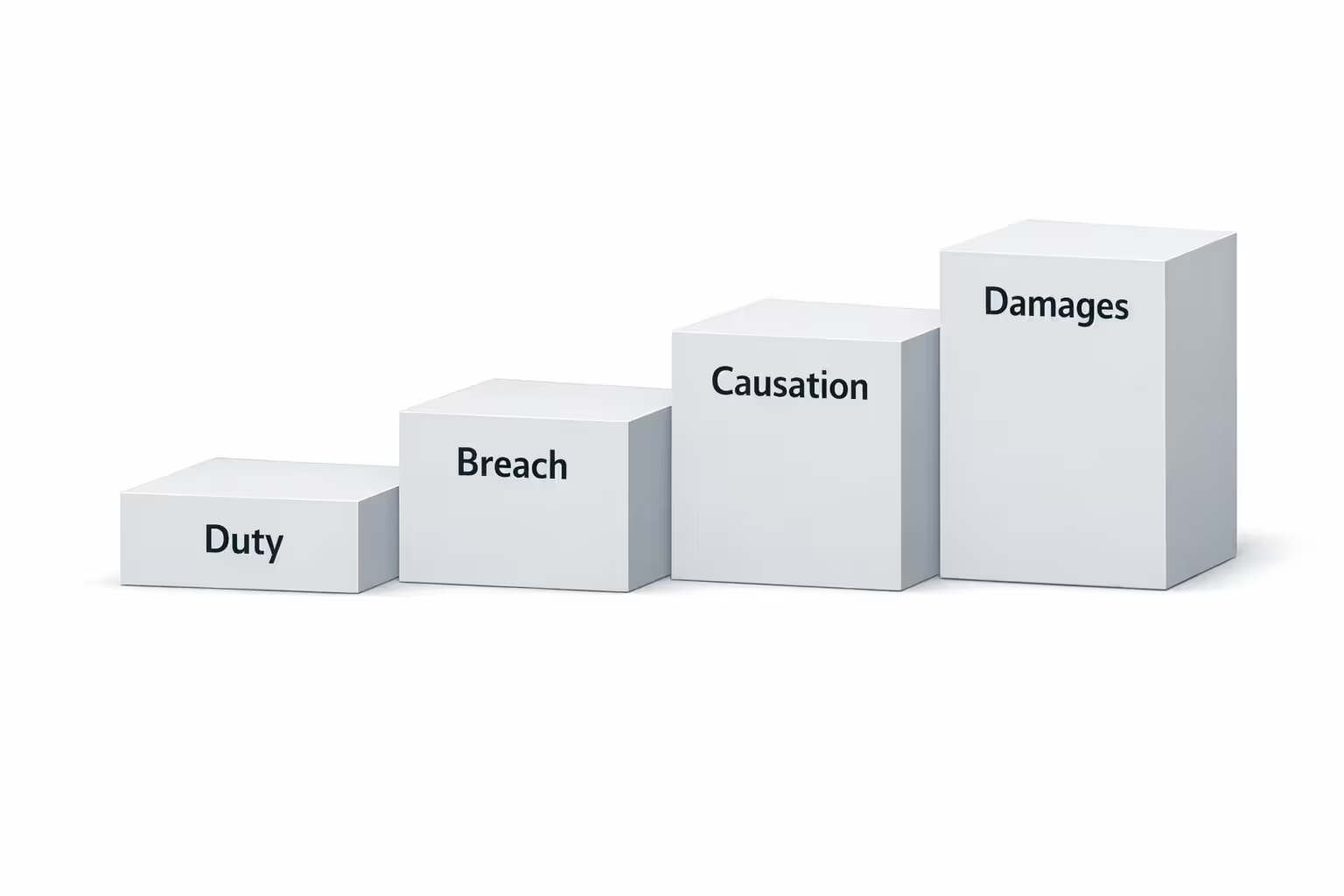
What makes a negligence case work? Lawyers break it into four pieces: the defendant owed a duty to be careful, they breached that duty, their breach caused the death, and actual harm resulted. For that grocery store example: store owners must keep floors reasonably safe (duty), failing to warn about a wet floor breaks that obligation (breach), the fall happened because of the wet floor (causation), and death resulted (damages).
Author: Daniel Whitford;
Source: mannawong.com
Common Wrongful Death Cases in Oregon
Car wrecks top the list. Oregon averages around 500 traffic fatalities yearly. Many involve clear negligence—running red lights, drunk driving, texting behind the wheel. Motorcycle crashes, pedestrians struck in crosswalks, and semi-truck collisions all fall into this category.
Medical errors kill more people than most realize. A recent Johns Hopkins study suggested medical mistakes rank as the third-leading cause of death nationally. We're talking about surgical errors (operating on the wrong limb), medication mistakes (ten times the correct dose), diagnostic failures (calling pneumonia a common cold), and premature hospital discharges. These cases get complicated fast—you'll need medical experts to explain what should've happened versus what actually occurred.
Workplace fatalities hit Oregon's resource-extraction and construction industries hard. Logger crushed by falling timber. Electrician electrocuted on a job site. Worker falls through an unsecured roof. Now, workers' compensation usually provides the only remedy when employers are at fault. But third parties—equipment makers who sold defective machinery, subcontractors who created dangerous conditions, property owners—may face wrongful death liability.
Dangerous property conditions cause deaths too. Restaurant decks that collapse. Apartment fires from faulty wiring that landlords ignored. Hotel swimming pools without required fencing or supervision. Property owners owe visitors reasonable safety—not perfection, but reasonable care.
Defective products round out the common scenarios. Remember the Takata airbag recalls? Airbags that deployed with such force they sent shrapnel into drivers' faces, killing some? That's product liability. Manufacturers must ensure their products won't harm people when used as intended.
Who Can File a Wrongful Death Claim in Oregon
Not everyone can march into court and file these lawsuits. Oregon restricts who gets to sue—and there's good reason. Without rules, you'd have uncles, cousins, friends, and neighbors all filing separate lawsuits over the same death. Chaos.
Instead, Oregon requires one person to file on behalf of everyone with a stake in the outcome. That person? The estate's personal representative.
Personal Representatives and Their Role
Under Oregon law (ORS § 30.020), there's only one person authorized to file: whoever the probate court appoints to handle the deceased person's estate. This person doesn't sue for themselves—they're acting as a fiduciary for all the beneficiaries entitled to compensation.
Did your loved one leave a will naming an executor? That person usually gets appointed, assuming they're willing and capable. The probate court in the county where the deceased lived handles the appointment. You'll file the will, petition for appointment, and receive official letters once approved.
No will? The court appoints an administrator following a priority list set by statute. Surviving spouses come first, then adult kids, then parents, then siblings. Whoever's appointed may need to post a bond (basically insurance protecting the estate from mismanagement), though courts sometimes waive this.
This personal representative wears many hats. They hire the lawyer. Make key decisions about settlement offers. Decide whether to go to trial. And critically, they distribute any money recovered according to Oregon's strict rules—not according to personal whims.
Author: Daniel Whitford;
Source: mannawong.com
Order of Priority Among Beneficiaries
Oregon law names specific people entitled to share in any recovery. It creates a ladder, with closer family members on higher rungs.
Surviving spouses stand at the top. Married at the time of death? You're a beneficiary, period. Doesn't matter if you'd been married 30 years or 30 days. One wrinkle: Oregon doesn't recognize common-law marriage. Couples who lived together for decades without formalizing it don't qualify as spouses under this statute.
Children come next—biological kids, legally adopted kids, even children born after the death (think of a pregnant widow). Age doesn't matter. Your 45-year-old daughter qualifies just like your 5-year-old son. Stepchildren usually don't make the cut unless you formally adopted them.
When there's no spouse or children, parents become beneficiaries. Both parents alive? They split equally. Just one surviving parent? Everything goes to them.
Parents also deceased? Siblings become beneficiaries. This scenario shows up less often since most wrongful death victims either have their own families or still have living parents.
Domestic partners face murkier waters. Oregon recognizes domestic partnerships for some purposes, but the wrongful death statute specifically references "spouses." Registered domestic partners may have claims, but they're not as clear-cut as traditional marriage.
Here's something that catches people off guard: you don't need to prove financial dependence. An adult son who never got a dime from his wealthy father still qualifies as a beneficiary. The law cares about family relationships, not who paid whose bills.
The death of a beloved is an amputation. Recovery begins not when grief ends, but when the survivors find the courage to protect what remains—including the financial stability their loved one worked a lifetime to build
— C.S. Lewis
Damages Available in Oregon Wrongful Death Cases
Money can't bring anyone back. Everyone knows that. But it can replace the financial contributions that stopped when someone died. And Oregon law recognizes that losing someone costs survivors in ways both calculable and incalculable.
Economic Losses Covered
Start with lost income. What would the deceased have contributed to household finances over their remaining work life? This calculation gets detailed fast.
Consider a 40-year-old middle school teacher earning $65,000 annually. She probably would've worked until 67 (another 27 years). But you can't just multiply $65,000 by 27. Economists hired for these cases factor in likely raises based on union contracts and historical patterns. They account for inflation. They reduce the total by the portion she would've spent on herself (personal consumption). And they calculate "present value"—money today is worth more than money 20 years from now because of investment returns.
The final number might land around $900,000 in lost financial support, even though the simple multiplication would suggest $1.755 million. These calculations require expert testimony.
Lost benefits count too. Health insurance through the deceased's employer, retirement account contributions, life insurance premiums the employer paid—all have real value. Families often underestimate this category. A benefits package worth $25,000 annually over 27 years adds up.
Medical bills from the final illness or injury are recoverable. Emergency room charges, ambulance rides, ICU stays—these bills can reach six figures. They're part of the economic harm the death caused.
Funeral and burial costs qualify. Oregon families spend anywhere from $5,000 (direct cremation) to $15,000+ (traditional burial with services). These aren't optional expenses—someone has to handle final arrangements.
Don't overlook household services. The deceased's contributions around the house had value. Childcare, cooking, cleaning, yard work, home repairs—courts recognize these as economic losses. One approach: calculate what it would cost to hire people to perform these tasks. Another: value the deceased's time based on their earning capacity. Either way, 30 years of household contributions adds substantial value.
Non-Economic Damages Explained
Now we enter territory without price tags. How do you value a parent's love? A spouse's companionship? A child's guidance? You can't, not precisely. But Oregon law tries.
Surviving spouses lose their partner—someone to share life's burdens and joys, emotional support during hard times, physical intimacy, and companionship through old age. A 35-year-old widow potentially loses 50+ years of marriage.
Children lose a parent's guidance through life's milestones. No one to teach them to drive, attend their graduations, walk them down the aisle, or meet their grandchildren. The younger the child, the more years of loss.
Parents who lose adult children suffer profound grief even without financial dependency. You raised that person, watched them grow, expected them to outlive you. That loss defies monetary calculation.
Juries hear testimony about these relationships—how close the family was, what role the deceased played, what their presence meant. Then they assign a dollar figure to compensate for that loss. There's no formula, no standard multiplier. Just twelve people trying to quantify the unquantifiable.
Unlike many states that impose arbitrary limits, Oregon permits full recovery for non-economic harm when death occurs. Some jurisdictions cap emotional suffering damages at $250,000 regardless of circumstances. Oregon takes a different approach for wrongful death situations. While the state does limit non-economic damages to approximately $500,000 in standard injury lawsuits, that restriction falls away when the injury proves fatal.
One significant limitation: no punitive damages in wrongful death cases. Punitive damages punish especially reckless behavior—drunk drivers, companies that knew their product was dangerous but sold it anyway. Those damages are available if the victim survived and sued for their injuries. But die from those same injuries? Punitive damages disappear. It's a gap in the law that frustrates many families.
How Damages Are Distributed Among Survivors
Multiple beneficiaries create a math problem: how do you divide one settlement or verdict among several people with different losses?
Oregon doesn't mandate equal splits. A surviving spouse who depended entirely on the deceased's income has a different claim than an adult child who was financially independent. A 5-year-old losing a parent experiences different harm than a 50-year-old sibling who saw the deceased twice a year.
The personal representative must distribute the money proportionally based on each beneficiary's actual loss. Courts look at relationship closeness, financial dependency, age, and other factors.
Smart attorneys get beneficiaries to agree on distribution before settling cases. Nothing tanks a settlement faster than family fighting over who gets what. When beneficiaries can't agree, courts hold hearings and impose a distribution.
| Category of Harm | Specific Examples | Methods of Valuation |
| Tangible Economic Harm | Future wages and career advancement the deceased would have achieved; employment benefits including health coverage and retirement plans; medical treatment costs incurred before passing; cemetery plots, services, and related final expenses; contributions to housework, childcare, and home maintenance | Economic experts analyze pay stubs, benefit statements, and career trajectories; actual bills and invoices document expenses already paid; market research establishes replacement costs for services no longer provided |
| Intangible Personal Harm | Loss of emotional connection and daily partnership; absence of parental involvement in children's development; end of marital relationship and future companionship; psychological suffering and bereavement experienced by survivors | Jury members exercise judgment after hearing family testimony describing their bond; courts weigh the deceased's role in survivors' lives; consideration of survivor ages and dependency levels informs awards |
Oregon's Statute of Limitations for Wrongful Death Claims
Every legal claim faces a deadline. Miss it, and courts slam the door shut—doesn't matter how strong your case might be.
Standard Three-Year Deadline
Oregon gives families three years from the date of death to file a wrongful death lawsuit (ORS § 30.020). Not three years from when the injury happened—from when the person died.
The difference carries real consequences. Imagine someone injured in a May 2023 workplace accident. They fight for life in the hospital for six weeks before dying in July 2023. Your three-year clock starts ticking in July 2023, not May. You'd have until July 2026 to file.
Many families believe three years provides ample opportunity to act. The reality rarely matches that assumption. The first months after losing someone vanish in a fog of grief, funeral planning, and handling the deceased's affairs. Six months pass before you've processed enough to think clearly. Another few months go by while you research attorneys and set up consultations. Now you're a year in.
The attorney you hire needs time to investigate—gathering police reports, medical records, witness statements, employment documents. Insurance companies don't just hand over money; they investigate too, which takes months. Settlement negotiations can drag on. Before you know it, two years have elapsed and you haven't even filed yet.
We see families come in with 90 days left before the deadline expires. They had a strong case—clear liability, significant damages. But we're rushing to file a complaint when we should be methodically building the case. That time pressure helps nobody except the defense. I tell people: if you're thinking about this at all, come talk to a lawyer within the first year, even if you're not ready to commit to filing.
— Robert Chen
What matters is filing the complaint before the three-year mark. The case can continue for years after filing—through discovery, mediation, trial, even appeals. But that initial filing has to happen before the deadline.
Exceptions That May Extend or Shorten the Timeline
A few situations alter the standard timeline, usually making it shorter rather than longer.
Government defendants trigger much tighter deadlines. Planning to sue a city, county, state agency, or other public entity? Oregon's Tort Claims Act requires filing a notice of claim within 180 days of the incident. That's just six months—half a year. This notice isn't the lawsuit itself; it's a prerequisite. The governmental body receives formal written documentation explaining your intended claim. If they deny it (which they usually do), then you can file suit. But miss that 180-day window? You've lost your chance to sue the government, even though the three-year wrongful death deadline hasn't passed yet.
Medical malpractice deaths create another complication. Oregon's medical malpractice statute of limitations normally runs two years from discovering the injury (with a five-year absolute cap from when the negligence occurred). When that malpractice causes death, courts must figure out which deadline applies. Generally, the wrongful death three-year period controls, but the interplay between statutes gets complex.
What about minors? Don't they get extra time? Not in wrongful death cases. Unlike personal injury claims where minors get extended deadlines, the wrongful death statute runs regardless of beneficiaries' ages. A toddler who lost a parent faces the same three-year deadline as an adult beneficiary.
Fraudulent concealment might extend the deadline in rare cases. If the defendant actively hid their role in causing the death, courts may pause the statute of limitations until the deception comes to light. This exception is narrow—it requires proof of intentional hiding, not just the defendant keeping quiet.
What Happens If You Miss the Deadline
File your lawsuit three years and one day after the death? The defendant will immediately move to dismiss based on the statute of limitations. And the judge will grant that motion.
Courts won't give you another chance, allow you to refile, or provide any wiggle room whatsoever. Once the statute of limitations expires, your claim dies permanently. You cannot refile it, amend it, or appeal the dismissal (well, you can appeal, but you'll lose).
This produces harsh results. Families with ironclad cases—video evidence of negligence, witnesses lined up, significant damages—get nothing because they filed too late. Judges will sometimes note the unfairness in their written orders, but they'll still dismiss the case. The legislature set the deadline; courts must enforce it.
That permanent door-slamming is why early consultation with an attorney matters so much. Even if you're not emotionally ready to pursue a claim, at least talk to a lawyer within the first year. Get your timeline straight. Understand your deadlines. Preserve your options.

Author: Daniel Whitford;
Source: mannawong.com
Step-by-Step Process for Filing a Wrongful Death Claim in Oregon
Filing these claims involves several distinct phases. Knowing what to expect helps families navigate the process.
Gathering Essential Documentation
Documentation makes or breaks these cases. Start with the death certificate—it establishes when the person died and the immediate cause. Request several certified copies; you'll need them for various purposes.
If there was an autopsy or medical examiner's report, get it. These documents provide medical detail about injuries and causation that death certificates don't include.
Police reports are gold in accident cases. They document scene conditions, identify witnesses, sometimes include officer opinions about fault. Contact the investigating agency (city police, county sheriff, state police) to request a copy. Be patient—some agencies won't release reports until investigations close, which can take months.
Medical records from treatment before death show injury severity and related expenses. As personal representative, you can sign authorizations allowing hospitals and doctors to release these records.
Financial documentation proves earning capacity and contributions. Tax returns for the past several years, recent pay stubs, employment contracts, benefits summaries—gather everything showing what the deceased earned and what benefits they received.
Photographs capture details that reports miss. Accident scenes, vehicle damage, dangerous property conditions—take pictures from multiple angles. These images become powerful trial exhibits.
Witnesses represent a time-sensitive resource. Individuals relocate to new cities, switch jobs and lose access to old phone numbers, and gradually lose their clear memory of what they observed. Document the identity and current contact methods for everyone present during the incident or anyone familiar with your loved one. Track them down early.
Employment records—personnel files, performance reviews, promotion history—establish earning trajectory. A recently promoted employee with stellar reviews likely would've continued advancing, strengthening the lost income calculation.
In the midst of chaos, there is also opportunity. The strongest legal cases are built not on emotion alone, but on meticulous preparation—every document preserved, every witness identified, every detail recorded before time erodes the truth
— Morris Dees
Appointing a Personal Representative
You can't file a wrongful death suit until someone's appointed as personal representative. This requires opening a probate case.
Head to the circuit court in the county where the deceased lived. File a petition for appointment of personal representative along with the death certificate. If the deceased left a will, file that too. The will typically names an executor; courts usually honor that choice.
No will? The court appoints an administrator following the statutory priority list when deciding who to appoint. Surviving spouse gets first shot, then children, then parents, then siblings. If multiple people at the same priority level want the job, the court decides based on who's most qualified.
Sometimes family members fight over who should serve. These disputes delay everything—the wrongful death case sits on hold while relatives battle in probate court. Try to work these things out privately if possible.
After the appointment becomes official, courts provide documentation known as letters testamentary (when a will exists) or letters of administration (in intestate situations). These official letters establish the personal representative's legal standing to act for the estate, including bringing in legal counsel and initiating lawsuits.
Some smaller estates avoid full probate using Oregon's small estate affidavit procedures. But wrongful death claims don't count toward estate value for this purpose—the claim belongs to beneficiaries, not the estate—so these shortcuts may still be available even when a wrongful death claim exists.
Negotiation vs. Litigation
Most of these cases settle before trial. Here's how it typically unfolds.
After hiring an attorney, the lawyer drafts a detailed demand letter to the responsible party (or more often, their insurance company). This letter lays out what happened, explains why the defendant is liable, describes the harm to beneficiaries, and demands a specific amount of compensation.
The insurance company investigates. They review police reports, interview witnesses, examine medical records, sometimes hire accident reconstruction experts or private investigators. This process takes anywhere from a few weeks to several months.
Eventually the insurer responds, usually with an offer far below the demand. This kicks off negotiations. The attorney presents additional evidence, argues the case's strengths, explains why the offer is inadequate. The insurer may nudge their number higher. The attorney may reduce the demand. Back and forth it goes.
Many cases settle during this negotiation phase. Sometimes a neutral mediator facilitates the discussions, helping both sides find common ground. When both sides can live with a number, they sign settlement agreements releasing all claims.
But some cases don't settle. Either the insurer's offer stays unreasonably low, or the family insists on their day in court. That's when you file a lawsuit.
The complaint (filed in Oregon circuit court) alleges the facts establishing liability and requests damages. The defendant has 30 days to file an answer. Then discovery begins.
Discovery is the evidence-exchange phase. Both sides send written questions (interrogatories), demand documents, and take depositions (recorded, sworn testimony). Discovery in wrongful death cases can be emotionally brutal. Beneficiaries sit in conference rooms answering questions about their relationship with the deceased, how they've coped with the loss, how their daily life changed. Defense attorneys probe for weaknesses, looking for reasons to reduce damages.
Many cases settle during or after discovery. As both sides see the evidence that will actually come out at trial, settlement becomes more attractive. Trials are expensive, time-consuming, and unpredictable.
Cases that don't settle go to trial. Wrongful death trials typically run anywhere from three days to three weeks, depending on complexity. Beneficiaries testify about their loss. Expert witnesses explain economic damages, causation, industry standards. Attorneys make opening statements, examine witnesses, present exhibits, deliver closing arguments. Then the jury deliberates and returns a verdict finding for the plaintiff or defendant, and if for the plaintiff, setting damage amounts.

Author: Daniel Whitford;
Source: mannawong.com
Common Mistakes That Jeopardize Oregon Wrongful Death Claims
Even strong cases can fall apart because of preventable errors. Watch out for these.
Delaying too long before seeking legal help is the number-one mistake. Evidence vanishes—surveillance footage gets erased, physical evidence disappears, witnesses relocate. Meanwhile, the statute of limitations keeps counting down. Some families wait until months before the deadline, leaving insufficient time to properly develop the case.
Talking to insurance adjusters without a lawyer almost always hurts your claim. These adjusters are professionals trained to minimize what their company pays out. They ask leading questions, request recorded statements that can later be taken out of context, and try to get you to accept lowball offers before you understand your claim's true value. Anything you tell an adjuster can and will be used against you.
Accepting quick settlement offers is tempting when you're desperate for money to cover immediate expenses. Insurers know this. They sometimes offer fast payments to grieving families, hoping to close the claim cheaply. These offers are virtually always far below what the claim is actually worth. Once you sign a release and deposit that check, you cannot reopen the claim later when you realize you accepted too little.
Social media posts about the case create ammunition for the defense. Attorneys for defendants routinely search Facebook, Instagram, Twitter, and other platforms for anything that undermines the claim. A photo of a beneficiary smiling at a party might be used to argue their suffering isn't as severe as claimed—even though occasional happiness doesn't erase grief. Better to stay offline or make all accounts fully private.
Failing to preserve evidence allows critical proof to disappear. Vehicles get repaired or sent to salvage yards. Accident scenes change. Surveillance recordings get erased according to retention policies. Right after a death, take immediate steps to preserve evidence—photograph everything, identify witnesses, send preservation letters to anyone who might have relevant materials.
Family disagreements among beneficiaries undermine cases. When relatives fight over who should be personal representative or how money should be split, defense lawyers exploit these divisions. They'll argue that if the family can't agree the deceased was valuable, maybe the claim isn't worth much. Present a united front. Work out internal disputes privately, preferably with a mediator if needed.
Exaggerating or being inconsistent about facts destroys credibility. If your testimony about the deceased's income contradicts tax returns, or if medical records don't support claimed injuries, the entire case suffers. Juries won't believe anything you say once you're caught in one lie. Stick to the truth—let the real facts speak for themselves.
Missing the notice deadline for government claims kills those cases. That 180-day requirement for claims against public entities is firm and unforgiving. Sometimes families don't realize a government entity shares responsibility until after this deadline passes. By then, it's too late.
Frequently Asked Questions About Oregon Wrongful Death Law
No lawsuit brings back someone you love. The Oregon wrongful death statute can't fix what's broken. But it does provide a mechanism for holding people accountable when their carelessness or intentional harm takes a life. And it recognizes that families suffer real, quantifiable financial harm when they lose someone who contributed to the household.
The three-year filing deadline means you can't put this off indefinitely. Evidence grows weaker over time. Witnesses forget. Opportunities to maximize recovery slip away. Consulting an experienced Oregon wrongful death attorney within the first year after your loss preserves your options and ensures that grief doesn't cost your family the financial compensation Oregon law makes available.
Every one of these cases is different—shaped by how the death happened, what role the person played in their family, and which specific laws apply. Understanding Oregon's wrongful death statute—the people authorized to file, the compensation available, the deadlines you're up against—puts you in a position to make informed choices during an impossibly difficult time. Money won't replace who you lost. But pursuing a wrongful death claim honors their memory by demanding accountability and securing financial resources your family needs to rebuild.