
Wooden gavel resting on a dark desk next to an open law book with scales of justice in the blurred background
Wrongful Death Lawsuit for Compensation Claims

Content
Losing a family member is devastating. When that death results from preventable negligence, recklessness, or intentional harm caused by another person or company, the pain cuts even deeper. The legal system provides a path forward through wrongful death claims—civil lawsuits designed to compensate surviving family members for their losses.
Most people don't understand how these cases actually function. They operate under completely different rules than criminal prosecutions. The procedures governing who qualifies to file, what evidence courts require, and the deadlines you must meet create a complex landscape that catches families off guard. Without proper guidance, crucial filing windows close permanently or families make decisions that undermine their claims.
This comprehensive guide explains the wrongful death lawsuit process from start to finish. You'll learn the core legal principles, understand the procedures involved, and get clear answers to the most pressing questions families face during this difficult time.
The Legal Definition of Wrongful Death
In legal terms, wrongful death occurs when a person dies due to negligent conduct, careless behavior, lack of professional skill, or a failure to act when action was required. When these circumstances exist, surviving family members can pursue financial compensation through civil liability claims. State legislatures create these laws individually, which explains the significant variation in rules from one jurisdiction to another.
These statutes have an interesting historical origin. Prior to 1846 in England, common law provided no remedy when negligence caused someone's death. The victim's potential lawsuit died with them, leaving families with zero legal recourse regardless of how egregious the negligence. Lord Campbell's Act changed this harsh rule in 1846, establishing the first statutory framework allowing families to seek justice. American states recognized this same gap in their legal systems and began enacting similar legislation throughout the latter half of the 19th century after witnessing families financially destroyed when negligence killed their primary wage earners.
The fundamental distinction involves civil accountability rather than criminal punishment. Defendants don't face imprisonment from wrongful death verdicts—their liability comes exclusively in financial form. The same incident can certainly trigger both criminal charges (such as vehicular manslaughter) and civil litigation, but these represent completely separate legal proceedings operating under different rules and evidentiary standards.
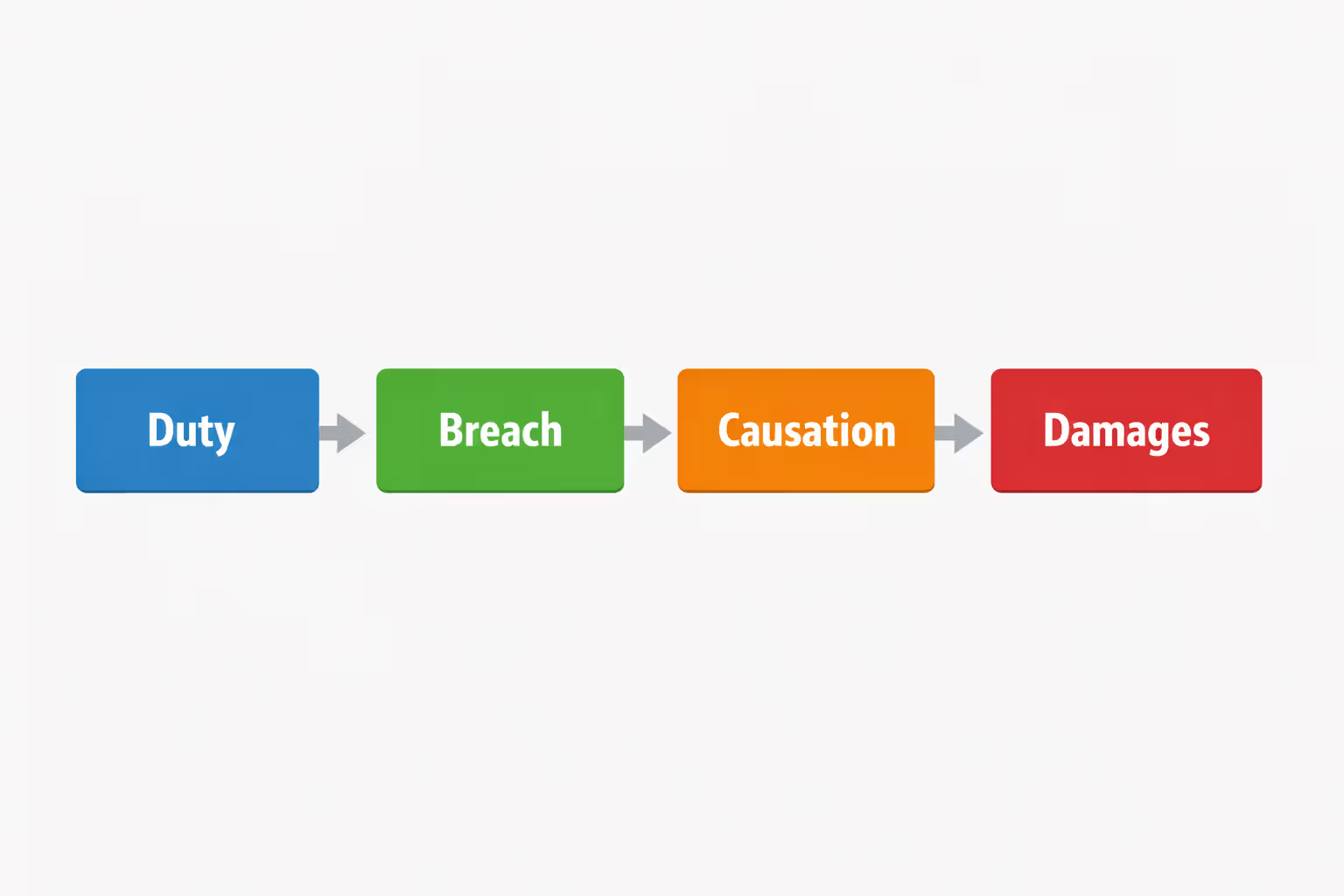
Successfully proving your case requires establishing four specific legal components. You must demonstrate the defendant had a legal obligation to exercise reasonable care toward your deceased family member. Then you'll need to show they violated this obligation through their conduct or failure to act. Next comes proving this violation directly led to the death—not merely contributed as one factor among many, but actually caused the fatality. Finally, you must establish that survivors suffered measurable harm from this death. This framework mirrors standard personal injury law intentionally. The critical difference? Your loved one cannot bring the claim personally.
Author: Daniel Whitford;
Source: mannawong.com
Individual states implement these principles differently in their statutes. California's Code of Civil Procedure Section 377.60 outlines who qualifies as plaintiffs and which damages courts can award. Texas codifies its rules within Civil Practice and Remedies Code Chapter 71. Florida developed a distinctive two-part structure separating estate losses from what individual family members lost personally. Before pursuing any case, you must research your particular state's requirements thoroughly because these procedural variations significantly impact outcomes.
Understanding the distinction between civil and criminal standards is crucial. Prosecutors handling criminal cases must establish guilt beyond reasonable doubt—roughly 95% certainty, representing the most demanding standard in American jurisprudence. Civil wrongful death litigation operates under the preponderance of evidence standard, requiring only that facts are more likely true than false—essentially anything above 50% probability. This lower threshold explains why families occasionally win civil judgments even after criminal juries acquit defendants or prosecutors decline filing charges entirely.
Who Can File a Wrongful Death Claim?
Grief affects many people when someone dies, but state statutes strictly limit who possesses legal standing to file these lawsuits. Your emotional relationship to the deceased matters far less than what the statutory language specifically permits.
Eligible Family Members and Beneficiaries by State
States typically follow one of three approaches: restricting claims to immediate family, permitting extended beneficiaries, or requiring estate-based filing systems.
Jurisdictions limiting standing to immediate family authorize only spouses, children, and occasionally parents to file claims. These states prioritize traditional nuclear family relationships and prevent multiple competing lawsuits arising from a single death.
Jurisdictions with extended beneficiary provisions cast broader nets. Siblings, grandparents, domestic partners, and financially dependent household members all potentially qualify under these statutes. These frameworks acknowledge modern family structures that differ substantially from 19th-century norms.
Estate-based jurisdictions require the deceased person's estate representative—labeled an executor when the will designates them or an administrator when courts appoint them—to file a single unified claim representing all interests. Individual family members cannot pursue separate actions. Instead, one consolidated lawsuit proceeds with any recovery distributed according to statutory formulas or will provisions.
| Jurisdictional Approach | Who Initiates Claims | Representative States | Distribution Method |
| Immediate Family Priority | Spouse holds first position, followed by children, then parents in ranked order | Georgia, Michigan, Indiana | The first qualifying category maintains exclusive filing authority; other categories cannot pursue claims |
| Expanded Beneficiary Access | Spouses, children, parents, siblings, dependents, and partners all qualify | California, Arizona, Louisiana | Multiple qualifying parties may join as co-plaintiffs; judges allocate recoveries based on relationship proximity and demonstrated losses |
| Estate Representative Control | The personal representative exclusively brings actions | New Jersey, Vermont, Delaware | Estate initiates litigation; distributions follow intestacy statutes or testamentary provisions |
| Combined Framework | Spouses and children file directly; estate steps in when no immediate family survives | Florida, Illinois, Pennsylvania | Blends direct family member rights with estate authority as backup for cases lacking close relatives |
Certain jurisdictions implement rigid priority hierarchies. Georgia provides a straightforward illustration: surviving spouses possess primary filing authority. When no spouse exists, children advance to the front position. Without children, parents gain standing. This single-plaintiff approach prevents duplicative litigation over the same death.
The Role of the Estate Representative
Within estate-based frameworks, the personal representative—designated an executor when appointed by will or an administrator through court appointment—must initiate legal action. This individual functions as a fiduciary, creating a legal duty to prioritize all beneficiaries' collective interests rather than personal preferences.
Their duties encompass hiring legal representation, authorizing key strategic litigation decisions, and guaranteeing proper distribution of settlements or verdicts. When beneficiaries believe the representative is mishandling the case, they can petition probate courts for supervision or replacement, though judges generally defer to representatives' judgment absent clear evidence of misconduct.
Even in states permitting direct family member filing, opening estate proceedings often becomes necessary. Why this additional step? Wrongful death claims don't capture every compensable loss. Separate survival actions—compensating the victim for losses experienced between initial injury and death—require estate administration. Medical bills incurred before death, wages lost during that interval, and the victim's personal pain and suffering all belong to the estate rather than wrongful death beneficiaries.
Common Causes and Examples of Wrongful Death Cases
These claims arise from virtually any situation where negligence or intentional harm proves fatal. Certain patterns emerge repeatedly across wrongful death litigation.
Medical errors cause approximately 250,000 deaths annually in America—some estimates rank this as the nation's third leading mortality cause. Surgical mistakes, misdiagnoses, medication errors, and birth injuries generate countless lawsuits annually. Consider scenarios like surgeons operating on incorrect body parts, radiologists mislabeling cancerous masses as benign, or anesthesiologists miscalculating dosages causing fatal reactions. Each situation potentially creates liability when these errors result in patient deaths.
Traffic collisions kill over 40,000 Americans yearly. Intoxicated driving, distraction behind the wheel, excessive velocity, and aggressive driving maneuvers provide straightforward liability grounds. These claims frequently involve complicated negotiations regarding insurance coverage limits, as most at-fault motorists lack sufficient personal wealth to satisfy multi-million-dollar judgments.

Author: Daniel Whitford;
Source: mannawong.com
Occupational fatalities, particularly in construction, manufacturing, and transportation industries, spawn wrongful death litigation against employers, landowners, or equipment manufacturers. Workers' compensation systems provide limited death benefits but don't prevent wrongful death suits against third parties. When a subcontractor's defective scaffolding collapses killing a construction worker, that worker's survivors can sue the subcontractor while simultaneously collecting workers' compensation from the direct employer.
Dangerous products—exploding lithium batteries, collapsing infant cribs, rollover-prone vehicles—create strict liability exposure. Plaintiffs don't need proving negligence under this doctrine, only that products contained design defects, manufacturing flaws, or inadequate warnings, and that these deficiencies caused deaths.
Nursing home neglect and abuse litigation has increased as America's population ages. Bedsores progressing to fatal sepsis, severe dehydration, medication administration errors, and physical abuse in care facilities increasingly generate lawsuits. These cases often reveal systematic understaffing and profit-maximizing neglect.
Property condition deaths occur when hazardous premises cause fatal accidents. Shoppers dying from slips on unmarked wet floors, tenants killed when poorly maintained balconies collapse, or children drowning in pools lacking mandatory safety fencing—all potentially create claims against property owners who failed maintaining reasonably safe conditions.
The death of a human being is not only a private loss but a loss to society as a whole. The law of wrongful death exists because we recognized that when negligence destroys a life, the living must not be left to bear that burden alone. Justice demands that accountability follow wherever carelessness leads
— William L. Prosser
How Wrongful Death Claims Differ from Personal Injury and Criminal Cases
The distinctions between wrongful death lawsuits, personal injury claims, and criminal prosecutions confuse many families, especially when one incident triggers all three proceedings simultaneously.
| Comparison Point | Wrongful Death Action | Personal Injury Action | Criminal Prosecution |
| Party Initiating Action | Designated family members or estate representative per state statute | The person who suffered injuries | Government prosecutor or district attorney's office |
| Required Certainty Level | Preponderance of evidence (exceeding 50% likelihood) | Preponderance of evidence (exceeding 50% likelihood) | Beyond reasonable doubt (approximately 95% certainty) |
| Available Outcomes | Financial compensation awarded to qualified survivors | Financial compensation awarded to injured person | Incarceration, monetary fines, supervised probation, or capital punishment |
| Compensation Nature | Economic and non-economic losses for beneficiaries | Economic and non-economic losses for victim | Restitution occasionally ordered but punishment serves as primary objective |
| Time Limitations | Typically 1-3 years measured from death date | Typically 1-6 years measured from injury occurrence | Varies substantially; homicide generally has no expiration |
| Protections for Accused | Standard civil procedure rules apply; extensive discovery permitted | Standard civil procedure rules apply; comprehensive discovery rights | Constitutional safeguards; Fifth Amendment self-incrimination protection |
An intoxicated driver causing a fatal collision might face vehicular manslaughter charges while the victim's family simultaneously pursues wrongful death litigation. Criminal prosecution aims to punish dangerous conduct and deter future similar behavior; civil litigation aims to compensate survivors for their measurable losses. Criminal convictions strengthen civil cases because issue preclusion (also termed collateral estoppel) can prevent defendants from relitigating facts already proven beyond reasonable doubt in criminal proceedings.
However, criminal acquittals don't eliminate civil liability. The O.J. Simpson cases perfectly demonstrate this principle: a criminal jury acquitted Simpson of murder under the heightened standard, yet a civil jury subsequently held him liable for wrongful death using the reduced preponderance standard.
Personal injury claims require living plaintiffs who experienced harm. When injuries eventually prove fatal, the personal injury claim doesn't simply continue unchanged—it transforms into wrongful death litigation with different beneficiaries and modified damage calculations. Many jurisdictions also authorize survival actions, essentially allowing estates to continue the deceased's personal injury claim for losses experienced before death.
The Wrongful Death Claim Process: Step-by-Step
Pursuing these lawsuits involves multiple sequential stages, typically consuming one to three years from initial filing through final resolution.
The process begins with attorney consultations. Most wrongful death lawyers operate on contingency arrangements—collecting 33-40% of any recovery—making initial consultations free. During this meeting, attorneys evaluate whether your circumstances satisfy legal requirements, identify potential defendants, and estimate potential claim value.
Investigation follows consultation. Attorneys gather medical documentation, accident reports, witness accounts, employment records, and expert analyses. Medical malpractice deaths might require retaining physician experts for treatment record reviews. Product liability deaths need engineers examining allegedly defective items.
Complaint filing officially launches the lawsuit. This document identifies all defendants, articulates factual allegations establishing liability, and specifies requested damages. After defendants receive formal process service, they typically have 30 days for responding.
Discovery enables both parties exchanging information through written interrogatories, document production requests, and depositions where witnesses provide sworn testimony recorded by court reporters. This phase commonly consumes six to twelve months and generates evidence ultimately determining settlement value.
Mediation or direct settlement negotiations occur in approximately 95% of wrongful death cases. Neutral third-party mediators facilitate compromise, or attorneys negotiate directly. Settlements eliminate trial uncertainty and deliver faster resolution, though they typically yield lower payments compared to jury verdicts in strong liability cases.
Trials become necessary when settlement negotiations collapse. Wrongful death trials last anywhere from two days to two weeks. Plaintiffs present evidence proving both liability and damages, defendants counter both elements, and juries (or occasionally judges sitting without juries) render final decisions.
Post-trial motions and appellate proceedings can extend the process another year or longer. Losing parties may request new trials or appeal to higher courts, though most wrongful death verdicts survive appellate challenges.

Author: Daniel Whitford;
Source: mannawong.com
Statute of Limitations by State
Every state imposes filing deadlines for these claims. Missing this window permanently eliminates your right to sue—courts dismiss cases regardless of evidence strength once statutes expire.
Most jurisdictions establish one-to-three-year windows measured from death dates. California establishes a two-year limit. Texas provides two years. Florida allows two years. New York also uses two years from death (medical malpractice wrongful death claims follow additional complex timing rules).
The clock typically begins running on the death date rather than when injuries occurred. Someone injured in January who dies from those injuries in June triggers a statute running from June. This differs from personal injury statutes, which typically begin when injuries occur.
Discovery rules pause statutes in certain states when plaintiffs couldn't reasonably have discovered wrongful conduct earlier. A family learning two years post-death that a physician's missed diagnosis caused the fatality might receive extended filing time, depending on their state's specific discovery provisions.
Minority tolling freezes statutes for child beneficiaries in many states. If a five-year-old loses a parent, the statute might remain paused until that child reaches age 18, protecting minors from forfeiting claims because adults failed acting promptly.
Burden of Proof Requirements
Plaintiffs carry the burden of establishing every element by preponderance standards. This involves presenting evidence making each element more likely true than false—anything exceeding 50% probability.
You must establish defendants owed a duty of care. Motorists owe other road users obligations to operate vehicles safely. Physicians owe patients obligations to provide competent medical treatment. Property owners owe visitors obligations to maintain reasonably safe premises. Some relationships automatically create duties; others require analyzing foreseeability and public policy factors.
Duty breaches mean demonstrating defendants failed meeting required care standards. Lay witnesses can testify about obvious breaches like red light violations. Professional malpractice requires expert testimony establishing what reasonable professionals would have done differently under similar circumstances.
Causation contains two components: factual cause and legal cause. Factual cause questions whether death would have occurred absent the defendant's breach. Legal cause questions whether death was a foreseeable breach consequence. A physician's negligence causing hospital discharge one day early, after which that patient dies in an unrelated collision, satisfies factual causation but likely fails legal causation.
Damages require proof with reasonable certainty. Economic damages like funeral costs and lost earnings need documentation—receipts, employment records, expert economist testimony. Non-economic damages like lost companionship rely on survivor testimony describing relationships with deceased family members.
In a civil society, the measure of justice is not only how we punish those who do wrong, but how we care for those who suffer the consequences. Compensation in wrongful death is not about placing a price on life—it is about recognizing the profound economic and emotional void that negligence leaves behind
— Benjamin N. Cardozo
What Damages Can You Recover in a Wrongful Death Lawsuit?
Wrongful death damages attempt compensating families for both quantifiable financial losses and intangible harms. State statutes control which damages courts can award and calculation methodologies.
Economic damages encompass concrete financial losses. Funeral and burial costs typically range $7,000 to $15,000 and nearly always qualify for recovery. Medical expenses incurred before death may be claimed within wrongful death actions or through separate survival actions, depending on your state's statutory structure.
Lost earnings represent the deceased's projected lifetime income. Expert economists calculate this by projecting salary progression, accounting for inflation, and discounting to present value. A 35-year-old engineer earning $90,000 annually might have $3 million in future earnings projected across a 30-year remaining career. Lost benefits—health insurance coverage, retirement plan contributions, equity compensation—substantially increase these figures.
Lost household services cover the value of work your loved one contributed at home: childcare, meal preparation, housecleaning, property maintenance, yard work, financial management. Courts use either replacement cost approaches (what hiring help would cost) or opportunity cost methods (what the deceased could have earned working those hours instead).

Author: Daniel Whitford;
Source: mannawong.com
Non-economic damages compensate for losses lacking receipts and paychecks. Loss of companionship, guidance, and consortium recognizes family relationships carry value transcending economics. Children losing parents lose not just financial support but also mentorship, affection, and life guidance.
Survivor pain and suffering—the grief, anguish, and emotional distress following loss—qualifies for compensation in many states. Some jurisdictions cap these damages or restrict them to particular relationships like spouses and minor children.
Punitive damages punish especially egregious conduct and deter similar future behavior. Drunk drivers with multiple prior DUI convictions, companies knowingly marketing dangerous products despite internal safety warnings, or nursing homes systematically neglecting residents despite repeated violations might all face punitive damages. Most states require clear and convincing evidence of intentional misconduct or gross negligence—a heightened standard beyond the preponderance rule governing other damages. Punitive damages frequently face statutory caps like double the compensatory amount or fixed ceilings such as $250,000.
Certain jurisdictions prohibit specific damage categories. Virginia caps total wrongful death recoveries at $2.65 million regardless of actual losses. California permits recovery for lost household services but prohibits damages for grief or emotional sorrow. Your attorney requires detailed familiarity with local rules for properly valuing claims.
Distribution of recovered amounts varies by jurisdiction. Some states allocate damages based on each beneficiary's relationship and individual demonstrated loss. Others split proceeds equally among all statutory beneficiaries. Estate-based states follow intestacy statutes or will provisions. Attorney contingency fees come off the top, then medical liens or government benefit reimbursements get satisfied, with remainders distributed to beneficiaries according to state formulas.
Frequently Asked Questions About Wrongful Death Claims
Wrongful death lawsuits cannot restore what families have lost—no financial recovery brings back your loved one. Yet these claims serve vital purposes beyond compensation: providing financial stability when breadwinners die unexpectedly, holding negligent parties accountable for preventable deaths, and sometimes driving systemic changes preventing future tragedies. The legal process itself feels overwhelming while you're grieving, making it critical to find experienced attorneys who handle both legal complexity and emotional sensitivity these cases demand.
Justice Potter Stewart articulated the underlying philosophy in a landmark wrongful death decision: "The purpose of a wrongful death statute is not to enrich survivors but to compensate them for the real economic loss they have suffered." These laws acknowledge that death creates measurable harm—lost income, lost household contributions, lost guidance and companionship—and that responsible parties should bear those costs rather than forcing innocent families to shoulder them alone.
If you've lost someone to another party's negligence, recklessness, or intentional conduct, consult wrongful death attorneys quickly. Initial consultations cost nothing, and filing deadlines expire faster than most people realize. Understanding your legal options doesn't diminish your grief or dishonor your loved one's memory—it provides a pathway toward financial stability and meaningful accountability during an impossibly difficult time.